Written by Daylogue Editorial Team. Published August 14, 2026. Reviewed and updated August 14, 2026.
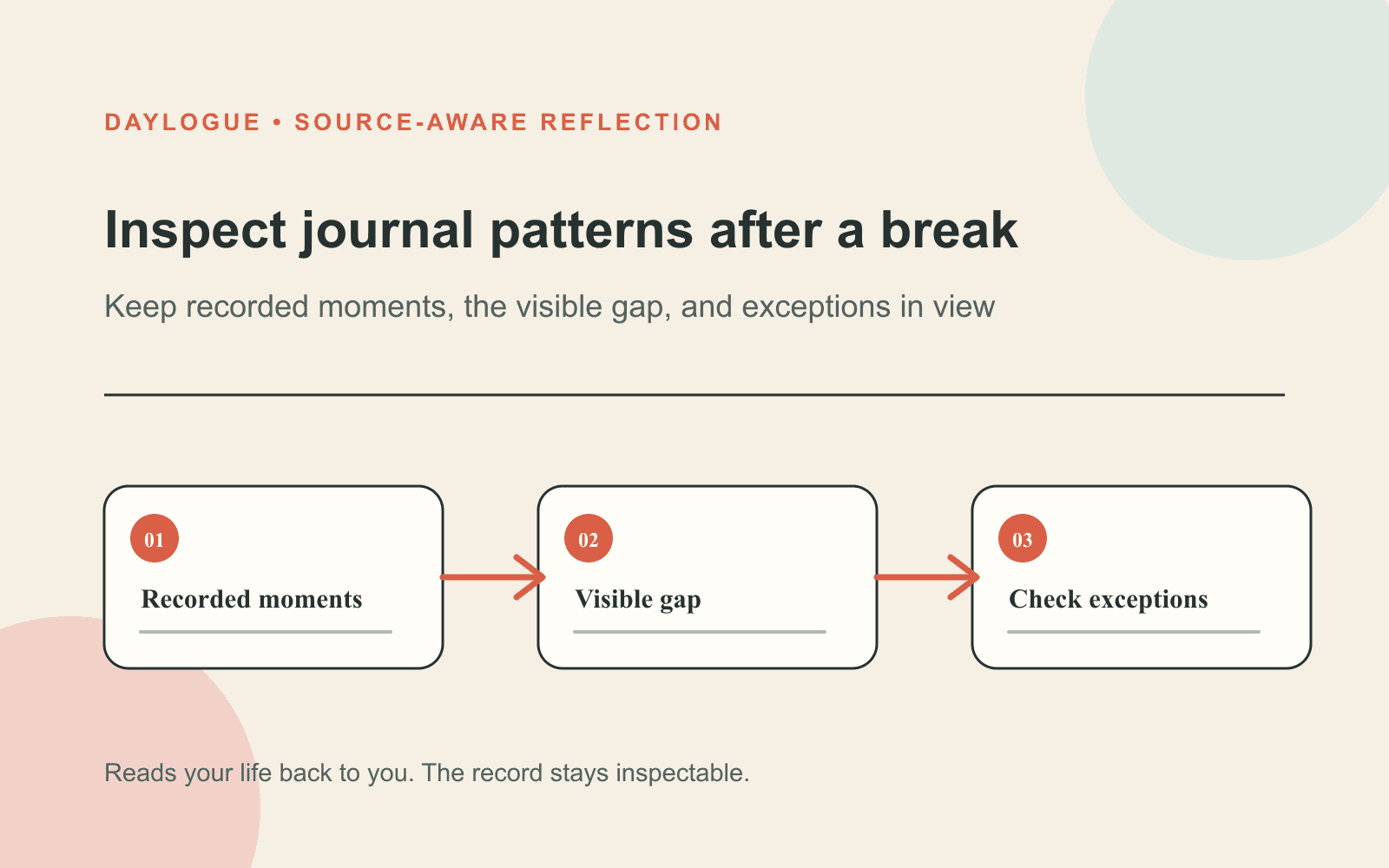
To return to a journal app that finds patterns after a break, begin with one current entry. A gap can remain unrecorded. One situation, your own words for how it landed, and one detail can support a later comparison. An app may fit when it shows the source entries behind an observation and offers correction or dismissal controls. A repeated overlap can invite a question, but it does not prove a cause or define who you are.
Return with today, not a reconstructed week
A gap in your journal is not a debt. Open a fresh entry and write about what is close enough to remember clearly. You might note the meeting that stayed in your head, the point when your energy changed, or the task that felt easier than expected. Leave the missing days missing. A current, specific entry gives you a better foundation than a rushed summary written to make the timeline look complete.
Start with one question: "What is most noticeable right now?" If that feels too broad, ask what took your attention during the past hour. Write one sentence and stop if that is enough. The goal is to create an honest record, not to prove that you are back for good. Tomorrow can be another entry, or it can remain unrecorded. Both are valid.
- Write from what you remember clearly today.
- Leave unrecorded days unrecorded.
- Use one concrete moment instead of a weekly summary.
- Stop after one sentence when that is enough.
Record details you can compare later
Pattern review needs more than a broad line such as "work was a lot." Add a detail you could recognize in another entry: "I kept checking the time during the last call," or "I had more room to think after lunch outside." These notes stay close to what happened. They do not assign a hidden motive or decide what the moment means.
A compact entry can contain three parts: the situation, your wording for the experience, and one open question. Try, "The group chat kept pulling me away from reading. I felt scattered. Does that happen at the same time on other days?" The question remains yours. A journal app can organize entries, but it cannot know your cause, intention, or identity from a short record.
01
Name the situation
Record one event, place, task, or time of day that you can recognize again.
02
Use your own words
Describe how the moment landed without forcing a label that does not fit.
03
Leave a question open
Write what you may want to compare later, without deciding the answer in advance.
Choose observations you can inspect
A useful pattern feature points back to the entries that produced the observation. If an app says a topic keeps appearing on certain days, access to the supporting notes and exceptions makes the observation inspectable. Language such as "showed up alongside" or "appeared in these entries" leaves room for interpretation. A jump from a repeated detail to a statement about personality, future, or health does not.
Daylogue keeps its observations within reflection and leaves their meaning with the person. Daylogue states that its observations are designed for reflection, not diagnosis, prediction, treatment, or clinical decision-making. It is not therapy and is not a replacement for professional care. Daylogue states that a recurring overlap does not show that one thing caused another. Those boundaries are practical tests for any journal app that finds patterns. The record can stay visible, the wording can stay tentative, and disagreement remains available.
- Can you open the exact entries behind an observation?
- Does the app show exceptions and missing context?
- Can you correct, dismiss, or ignore an observation?
- Does the wording avoid causes, forecasts, and person labels?
Review repetition without turning it into a verdict
After several entries, search for situations that repeat. Maybe the same slot in your week appears beside a rushed feeling. Maybe quiet mornings keep showing up in entries where reading felt easier. Write the observation in plain language, then ask what happened on the exceptions. One different day can add useful context and keep the pattern from hardening into a rule.
Daylogue gives a concrete product example: stress running higher on the nights a person logged under six hours. Even that overlap is a prompt for reflection, not proof that one caused the other. Your record can help you form a better question. It cannot replace your judgment or professional care.
| Instead of | Write | Then check |
|---|---|---|
| I always lose focus at night | Focus felt harder in three night entries | Which nights were different? |
| That meeting ruins my day | I wrote about feeling rushed after this weekly slot | What else was happening? |
| I am bad at routines | I returned twice after unrecorded gaps | What made returning easier? |
| Sleep causes my stress | Higher stress appeared on nights logged under six hours | Does the overlap continue? |
Check privacy before you put personal details back in
Returning is a good moment to reread the privacy policy. Check what the service stores, what its servers can read, whether entry text appears in notifications, and how deletion or export works. Look for a direct answer about model training and advertising. A lock icon alone does not explain who can process your writing or why.
Daylogue says most journal entries and check-in notes are stored in readable form on its servers so it can write narratives and surface patterns. It is not end-to-end encrypted. Daylogue also says it does not sell personal data, use entries for advertising, or train AI models on personal entries. Decide whether those terms fit your needs before returning. You can keep identifying details broad when names and locations do not add value.
- Read what the service stores in readable form.
- Check whether entry text appears in notifications.
- Find deletion and export controls before you need them.
- Confirm how personal entries are used for model training and advertising.
Keep research claims separate from your own record
A journal app can be useful without promising a particular outcome. A 2025 systematic review included 51 positive expressive writing studies and found substantial differences in the writing techniques, methods, and outcomes studied. The authors reported more consistent results for wellbeing and positive affect than for stress or physical health. They also rated the included studies poor or fair in quality.
That mixed evidence is a reason to stay specific. Try a prompt because it helps you notice and remember, not because a page promises it will change your health. Your experience may differ by topic, timing, privacy, and what else is happening in your life. If writing about something feels unhelpful, you can stop, switch questions, or choose another kind of support.
A seven-entry return plan with no attendance rule
Use this as a menu, not a streak. Entry one: What is most noticeable today? Entry two: What took more energy than expected? Entry three: When did my attention change? Entry four: What felt easier this time? Entry five: Which situation keeps returning to mind? Entry six: What was different from the last similar day? Entry seven: What question do I want to carry forward?
After any gap, resume with the next question that feels useful. When you have enough entries to compare, underline recurring situations and circle the exceptions. Write one sentence beginning with "I notice" and another beginning with "I am not sure yet." This keeps the record useful without turning it into a score or a fixed story about you. Daylogue is not therapy and is not a replacement for professional care.
Checklist
Journal pattern return checklist
Use these checks to restart with one current entry and keep every later observation visible, tentative, and open to correction.
- Begin with one current moment while leaving unrecorded days as a gap.
- Record a situation, your own wording, and one open question.
- Confirm that every observation links back to its source entries.
- Look for exceptions before considering repetition useful.
- Reject causes, forecasts, personality labels, and composite scores.
- Review readable storage, notification, deletion, and model-training terms.
- Keep a one-line entry option and no attendance rule.
Common questions
Should I fill in every unrecorded day before restarting?
No. Start with what you remember clearly today and leave the gap alone. Backfilling can create a polished timeline without giving you trustworthy detail.
How many entries does an app need before showing a pattern?
There is no universal number that makes an observation true. Look for repeated situations, inspect the source entries, and check exceptions before considering an overlap useful.
What makes a journal pattern trustworthy?
A trustworthy feature lets you see the entries behind an observation, understand its wording, notice missing context, and correct or dismiss it. The wording can remain free of causal claims and person verdicts.
Can a journal app tell me why something keeps happening?
No app can know a cause from repeated entries alone. It can organize what you recorded and show overlaps that may help you ask a more specific question.
How do I return without starting another streak?
Treat each entry as useful on its own. Keep a one-line option, dismiss reminders freely, and return with the present day after any unrecorded gap.
Sources
Sources were checked on the dates shown. Product details and policies can change.
- Daylogue evidence and methods · Daylogue · checked August 14, 2026
- Daylogue privacy policy · Daylogue · checked August 14, 2026
- Positive expressive writing systematic review · PLOS One · checked August 14, 2026
Keep exploring
Daylogue Knowledge Center
Browse practical guides for reflection, journaling, patterns, and privacy.
Read moreHow Daylogue shows patterns
See how candidate patterns stay connected to evidence and correction.
Read moreWhy Daylogue exists
Read the principles behind a system for self-understanding.
Read moreDaylogue is not therapy and is not a replacement for professional care.