Written by Daylogue Editorial Team. Published August 14, 2026. Reviewed and updated August 14, 2026.
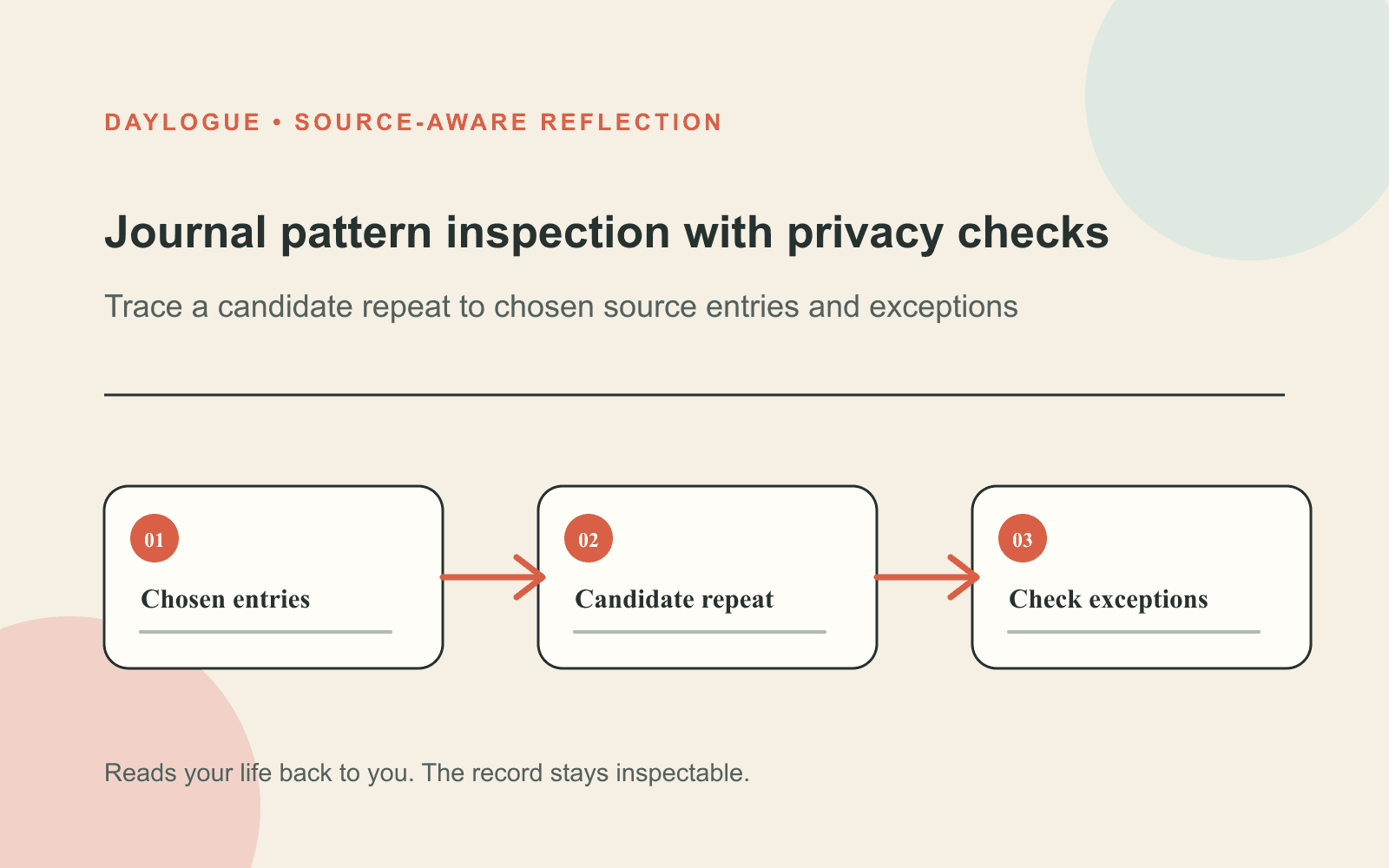
For private writing, choose a journal app that finds patterns only from what you decide to record, links every observation to its source entries, shows exceptions and missing context, and lets you correct or dismiss the read. Check readable storage, provider processing, deletion, and model-training terms before adding sensitive details. A pattern should describe repeated situations or overlaps. It should not infer emotion from your face or voice tone, assign a cause, predict what comes next, or reduce you to a score.
Define a useful pattern before an app defines one for you
A useful journal pattern stays close to the record. It might say that the same topic appeared in several evening entries or that higher stress showed up in check-ins where you logged under six hours. It names the observations and the time frame. It does not jump from repeated words to a hidden motive, a personality label, or a forecast about what you will do next.
Write your own standard before evaluating a product: "I want to see repeated situations, the entries behind them, and the moments that did not fit." This sentence gives you a way to reject a polished but uncheckable insight. A pattern feature earns attention by helping you return to your own evidence, not by sounding certain about a private life it can only know through selected entries.
| App wording | What it does | Better question |
|---|---|---|
| Deadlines appeared in four entries | Names repeated content | Which entries and dates? |
| You cannot handle pressure | Labels the person | What situations were recorded? |
| Stress was higher in check-ins under six hours | Describes an overlap | Where did that overlap not appear? |
| Poor sleep causes your stress | Assigns a cause | What other context was present? |
| Your week score is 62 | Collapses different signals | Can each signal stay visible on its own? |
Record comparable context without keeping every detail
Pattern finding improves when entries contain details that can be compared, but private writing does not require names or full transcripts. Note the type of situation, time of day, your own wording, and one selected field if it feels useful. "Late work call, rushed, wanted quiet afterward" can support a later comparison without naming an employer, coworker, client, or project.
Use the same broad label when the situation returns. If you call one event "late work call" and another "evening meeting," decide whether they should be grouped or kept separate. Consistent wording can make review easier while keeping unlike moments in separate categories. The record can preserve differences that matter to you, even when a cleaner tag would produce a simpler chart.
01
Name the situation
Choose a broad, repeatable label that does not require a person's name or exact location.
02
Use your own words
Describe how the moment landed without letting the app upgrade it into a stronger emotion label.
03
Add one comparison detail
Record timing, setting, sleep, or another field only when it helps answer your question.
04
Leave meaning open
End with what you want to compare instead of deciding why the situation happened.
Require a route back to every source entry
An observation should open into the entries that support it. You should be able to see the dates, relevant lines, selected fields, and any filters that shaped the result. If the product presents a conclusion without showing the record, you cannot tell whether it grouped unlike situations, relied on one unusually detailed entry, or ignored a correction you already made.
Inspect at least one positive example and one awkward example. Open an observation that feels right, then check whether the cited entries really support its wording. Next, open one that feels wrong or too broad. Look for a correction, dismissal, or feedback control. A trustworthy feature must make disagreement possible without requiring you to rewrite your private history to fit the app's category.
- Can you open the exact entries behind the observation?
- Can you see the dates and fields used?
- Are edited or deleted entries handled clearly?
- Can you correct the grouping or wording?
- Can you dismiss an observation without penalty?
Look for the day that did not fit
Repetition becomes more useful when the product also shows a comparable exception. If rushed notes appear around several late meetings, find a late meeting that did not feel rushed. What changed about the length, role, preparation, or setting? The exception may narrow the question. It may also show that the first grouping was too broad to deserve your attention.
Daylogue states that a recurring overlap does not show that one thing caused another. Use that as a product-evaluation rule. An app can surface what showed up together in your record. It cannot prove why it happened from repetition alone. Good wording leaves space for missing entries, different contexts, and the possibility that the overlap will disappear as the record grows.
Keep signals separate instead of accepting a person score
Mood, energy, stress, sleep, themes, and timing describe different parts of a check-in. Combining them into one score can hide the actual moment. A low-energy morning and a satisfying conversation may both be true. Ask whether the product lets you view each field in its own context and whether missing data remains missing instead of lowering a combined number.
Be cautious with labels such as resilient, avoidant, balanced, or at risk. Those words turn selected entries into a verdict about the person. A pattern journal should read the record back to you, not announce who you are. Prefer phrases such as "appeared in these entries" and "showed up alongside." You decide what deserves attention and what does not fit.
Protect the private inputs behind the pattern
Pattern features need access to some record, so read the storage model before writing the sensitive version. Check whether journal text, selected fields, summaries, embeddings, and audio follow different rules. Find out which providers process the content and whether the service uses entries for advertising or model training. Review deletion and export before you depend on the archive.
Daylogue says journal entries and check-in notes are stored on its servers in readable form so it can write narratives and surface patterns. Daylogue is not end-to-end encrypted. Its privacy policy says it does not sell personal data, use entries for advertising, or train models on personal entries. Those terms may fit one person's private-writing needs and not another's. Read the current policy, then choose the detail level accordingly.
Run a seven-entry product test without starting a streak
Test the app with seven entries made whenever they fit, not seven consecutive days. Repeat one broad situation label across at least three entries. Add one deliberate exception and one entry with very little detail. Edit a phrase after saving. Delete another test entry. Then inspect how the product handles repetition, missing context, corrections, and removal.
At the end, answer four questions. Did each observation link to its sources? Did the wording stay tentative? Could you see an exception? Did the privacy terms match what the product needed to process? Keep the tool only if the record still feels like yours. A visually impressive pattern is not useful when you cannot inspect, question, or remove it.
- Create entries on your own schedule, with no consecutive-day rule.
- Repeat one broad situation label across several entries.
- Add one comparable exception on purpose.
- Edit one entry and delete another test entry.
- Inspect every observation and try the correction controls.
Decision Table
Private pattern journal evaluation card
Use this card to test whether a journal app keeps source evidence, uncertainty, correction, and private-data handling visible.
- Every observation opens into its exact source entries and dates.
- Repeated situations are described without a cause or personality label.
- Comparable exceptions and missing entries remain visible.
- Mood, energy, stress, sleep, and themes stay separate rather than becoming one score.
- The product accepts corrections, dismissals, edits, and deletions.
- The privacy policy explains readable storage and provider processing.
- The product does not infer emotion from face, voice tone, or physiology.
- Your chosen words and fields remain the basis of every observation.
Common questions
What should a journal app pattern actually show?
It should show the repeated situation or overlap, the source entries, the time frame, relevant fields, and exceptions. The wording should remain tentative and avoid causes, forecasts, labels, or scores.
How many journal entries prove a pattern?
No universal entry count proves a personal pattern. Repetition across distinct times can justify a closer look, but you still need source entries, comparable exceptions, and room for missing context.
Can a pattern-finding journal tell me why something happens?
No. It can organize what you recorded and show what appeared together. It cannot establish a cause from recurring entries, and it should leave interpretation with you.
How can I keep pattern journaling private?
Use broad labels, omit names, read storage and provider terms, check notification previews, and understand deletion and export. Record only the context needed for the question you want to examine.
Should a journal app give me one score for the week?
A combined score can hide conflicting moments and missing data. Prefer separate signals, dated examples, and plain-language observations that you can inspect and question.
Sources
Sources were checked on the dates shown. Product details and policies can change.
- Daylogue evidence and methods · Daylogue · checked August 14, 2026
- Daylogue privacy policy · Daylogue · checked August 14, 2026
Keep exploring
Daylogue Knowledge Center
Browse practical guides for reflection, journaling, patterns, and privacy.
Read moreHow Daylogue shows patterns
See how candidate patterns stay connected to evidence and correction.
Read moreWhy Daylogue exists
Read the principles behind a system for self-understanding.
Read moreDaylogue is not therapy and is not a replacement for professional care.