Written by Daylogue Editorial Team. Published August 14, 2026. Reviewed and updated August 14, 2026.
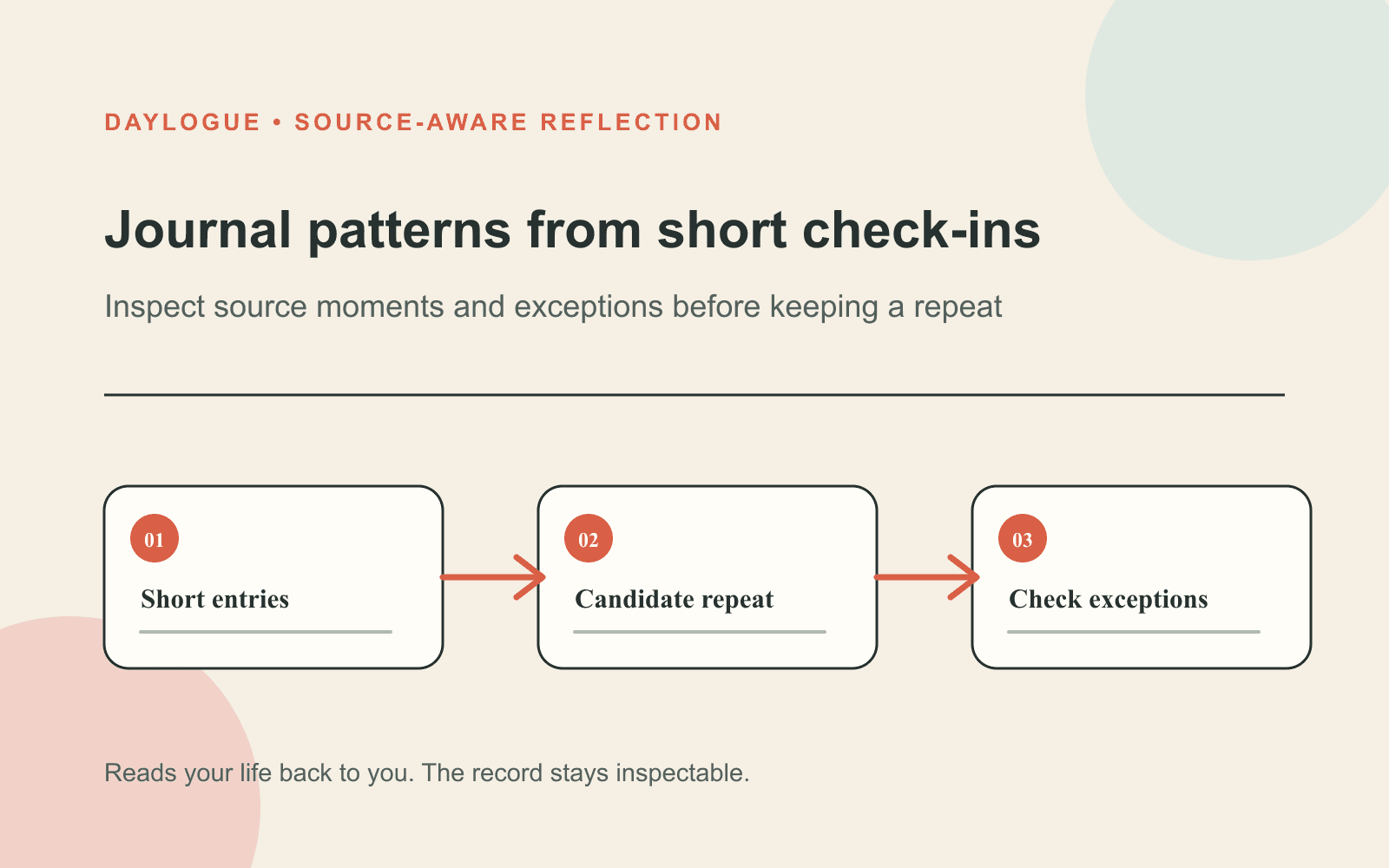
For short check-ins, choose a journal app that keeps every pattern connected to the exact entries behind it. Look for a clear minimum number of observations, visible dates, comparable situations, counterexamples, and a way to correct or dismiss a candidate pattern. Short entries can support comparison, but a repeated overlap does not prove a cause or define who you are.
Record small moments that can be compared
A short entry can still give a pattern feature something clear to work with. Name one situation, add a date or time context, and use your own words for what stood out. "Rushed before the weekly review" is easier to compare than "Bad day."
You do not need to turn every check-in into a form. A few consistent details help, but the entry should still sound like you. If a field does not fit, leave it blank. Missing context is better than a guessed answer.
- Name the situation.
- Keep the date or weekly context.
- Use a specific word or phrase.
- Leave unknown details unknown.
Ask how the app decides a repeat is worth showing
A single entry is an event, not a pattern. Two similar notes may be a coincidence. Look for a product that waits for repeated observations across distinct moments and explains when an observation is still tentative.
The app should separate a possible repeat from a conclusion. Language such as "this came up a few times" is more honest than "you always do this." Ask whether the threshold changes by pattern type and whether sparse data lowers confidence.
| Question | Why it matters | Useful answer |
|---|---|---|
| How many entries are required? | Prevents one moment from becoming a verdict | Several observations across distinct times |
| Can I open the source entries? | Makes the observation inspectable | Dates and exact supporting records |
| Are exceptions included? | Tests whether the repeat holds | Comparable entries that do not fit |
| Can I correct it? | Keeps the record answerable to you | Dismiss, edit, or add context |
Open the source entries before accepting an observation
A useful pattern card should be a doorway, not a verdict. Open the dated entries and check whether they describe comparable situations. A phrase that appears in class, at home, and during travel may not mean the same thing in each context.
Check what the app counted and what it left out. If one entry was misread or a tag no longer fits, correct it. If the product cannot show the record behind a claim, you cannot tell whether the observation reflects your words or a summary you would reject.
01
Read the supporting entries
Open each dated source and confirm that the words and situation match the observation being shown.
02
Compare the context
Check whether the moments are similar enough to belong together instead of sharing only one broad word.
03
Add or correct context
Edit a mistaken tag, dismiss the candidate, or note what the current record is missing.
Look for the days that do not fit
Counterexamples are comparable moments that do not support the candidate repeat. If several short entries connect a weekly slot with feeling rushed, look for the same slot when you did not feel rushed. The exception may narrow the question or show that the first grouping was too broad.
Daylogue states that a recurring overlap does not show that one thing caused another. Keep causes open. A calendar slot, amount of sleep, task, or conversation can show up beside an experience without producing it.
- Compare the same kind of moment.
- Include ordinary and easier days.
- Check visible gaps in the record.
- Keep a cause as a question.
Keep the pattern about the record, not the person
Good pattern language describes what appeared in the entries. "Feeling rushed appeared beside this weekly slot" stays tied to the record. "You cannot handle deadlines" assigns a fixed trait and reaches beyond what short check-ins can support.
Daylogue says its observations are designed for reflection, not diagnosis, prediction, treatment, or clinical decision-making. It is not therapy and is not a replacement for professional care. Choose tools that preserve this boundary and invite your interpretation instead of issuing advice.
- Prefer appeared, repeated, and overlapped.
- Avoid always, never, and this is who you are.
- Watch for diagnostic or predictive labels.
- Keep the person's interpretation in control.
Check privacy before the history builds
A pattern feature needs a record across time, which makes storage terms especially important. Read what the service can access, whether entries train models, who processes the content, and what deletion removes. Check whether exports include both source entries and generated observations.
Daylogue says most journal entries and check-in notes are stored in readable form on its servers so it can write narratives and surface patterns. It is not end-to-end encrypted. Daylogue says it does not sell personal data, use entries for advertising, or train AI models on personal entries. Decide whether that tradeoff fits your writing.
- Read server-access terms.
- Check model-training language.
- Find complete export and deletion controls.
- Review notification preview settings.
Keep writing expectations grounded
A 2025 systematic review examined 51 positive expressive writing studies in non-clinical populations, and the authors rated the included studies poor or fair in quality. The formats and study methods varied. A pattern feature should not turn uncertain research into a promise about what journaling will do for you.
Use short check-ins to preserve details and support your own review. You can pause, change formats, or return after a gap. The record does not become more honest because an app demands daily attendance.
Test a pattern card with sample entries
Before building a private history, create a small set of ordinary sample entries. Use three notes about the same kind of event, one note that clearly differs, and one visible gap. Keep the language simple enough that you already know what a careful observation could say. Then check whether the app groups the entries as you expected.
Open the resulting card and trace every statement back to the samples. If the app says a situation repeated, confirm the dates and wording. If it suggests a cause, look for a way to remove or correct that statement. If it hides the differing note, the card is giving you a cleaner story than the record supports.
Delete one supporting entry and see what changes. A trustworthy feature should update the observation or lower its confidence when the evidence changes. Then export the record. Check whether the export includes the source notes, the generated card, and your corrections. This test shows whether the product handles patterns as revisable observations or permanent labels.
Repeat the sample with two broad words that appear in different contexts. Check whether the app groups them automatically or asks you to confirm the connection. Shared vocabulary is not always shared meaning. The surrounding entry should remain available so you can separate similar language from genuinely comparable moments.
01
Create a known sample
Write several ordinary entries with one planned repeat, one clear exception, and one missing day.
02
Trace the observation
Open every cited entry and confirm that the dates, words, and contexts support the card's wording.
03
Change the evidence
Edit or delete one source and confirm that the candidate observation changes with the record.
04
Inspect the export
Verify that source entries, generated observations, and your corrections remain distinguishable outside the app.
Framework
The SOURCE check for journal patterns
Use this six-part review each time an app shows a candidate pattern, then keep, revise, or dismiss it based on the record you can inspect.
- Sources: Open every dated entry behind the observation.
- Occurrences: Count distinct comparable moments.
- Uncertainty: Check whether the wording matches the evidence strength.
- Relevance: Confirm that the grouped situations belong together.
- Counterexamples: Find comparable entries that do not fit.
- Editability: Correct, dismiss, or add context to the candidate.
Common questions
Can short journal entries reveal patterns?
They can support comparison when each entry records a specific situation or detail. The app should still show source entries, exceptions, and uncertainty.
How many entries should a journal app use before showing a pattern?
A single entry is not enough. Look for several observations across distinct moments and language that stays tentative when the record is thin.
What is a journal pattern counterexample?
It is a comparable entry that does not support the candidate repeat, such as the same weekly slot without the reaction seen on other days.
Should a pattern app tell me what caused a feeling?
No. Repeated overlap does not establish cause. A responsible app can show what appeared together and leave the explanation open to you.
What privacy details matter for pattern detection?
Check readable storage, provider access, model-training terms, export, deletion, and whether generated observations disappear when the account is removed.
Sources
Sources were checked on the dates shown. Product details and policies can change.
- Daylogue evidence and methods · Daylogue · checked August 14, 2026
- Daylogue privacy policy · Daylogue · checked August 14, 2026
- Positive expressive writing systematic review · PLOS One · checked August 14, 2026
Keep exploring
Daylogue Knowledge Center
Browse practical guides for reflection, journaling, patterns, and privacy.
Read moreHow Daylogue shows patterns
See how candidate patterns stay connected to evidence and correction.
Read moreWhy Daylogue exists
Read the principles behind a system for self-understanding.
Read moreDaylogue is not therapy and is not a replacement for professional care.