Written by Daylogue Editorial Team. Published August 14, 2026. Reviewed and updated August 14, 2026.
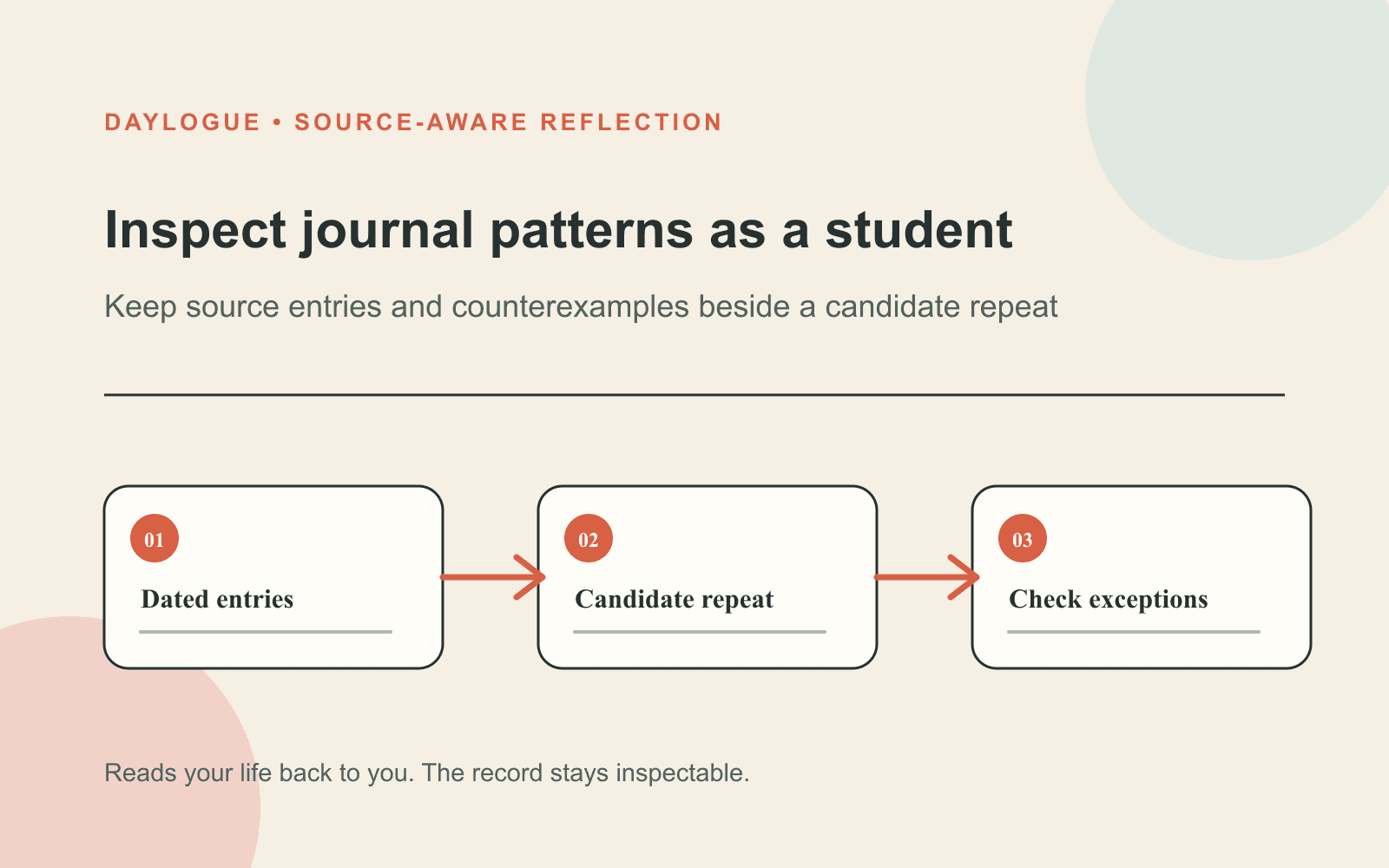
A journal app that finds patterns should do more than collect entries. It should help a student compare recurring contexts, such as course load, sleep logged in a check-in, social time, and the same slot in the week, while showing the entries behind an observation. Look for clear evidence, cautious language, correction controls, export and deletion options, and an honest privacy explanation. Read every pattern as a prompt to look closer, not proof that one part of life caused another.
Pattern finding starts with comparable moments
A standard journal stores what you wrote. A pattern-finding journal also helps you compare what repeats across entries. For a student, that might mean noticing that low energy keeps appearing in check-ins written after the same long class block, or that a particular topic returns during weeks with several deadlines. The app should point back to the moments that support the observation, so you can see the record instead of accepting a polished sentence on trust.
The comparison only works when the entries contain enough context. A note that says "bad day" may be honest, but it gives your future self little to compare. Add the course or activity, the time of day, what happened just before the check-in, and the feeling or energy level you chose to record. Those details do not need to become an essay. Two concrete sentences can create a more useful record than a page of general recap.
Choose a few signals that answer a real question
Start with a question that belongs to your actual week. You may want to know when studying feels easiest, which parts of group work leave you drained, or what tends to be present on mornings when getting started feels harder. Pick two or three details that can help you compare those moments. More fields do not automatically create more clarity. A long form can become another assignment and make honest check-ins less likely.
Keep observation separate from explanation. "Energy was low after the late lab again" records a repeat. "The lab ruins the rest of my week" assigns a cause and stretches one moment into a larger conclusion. The first sentence leaves room to check sleep, food, workload, commute, and the rest of the day. The second can make an early hunch feel settled before the record supports it.
- A context you can name, such as a class block, study setting, commute, or recurring time slot
- One self-reported signal, such as mood, energy, stress, or hours of sleep logged that day
- A brief note about what happened, written in language you would recognize a month later
- An optional question you want the record to help you revisit, without assuming the answer
A useful observation shows its work
When an app presents a pattern, ask what it compared. Check which dates or entries contributed, what fields were used, and whether missing days changed the picture. A sentence can sound specific while hiding a thin record. If you cannot inspect the supporting moments, treat the result as a suggestion for your own review rather than a dependable summary of the semester.
A recurring overlap does not show that one thing caused another. A late class and lower energy may appear together because both happen on an already crowded day. The pattern can still be useful. It tells you where to look. It does not tell you what decision to make, and it should never become a label about your ability, motivation, personality, or future performance.
| What the app shows | What to check | Careful reading |
|---|---|---|
| A topic repeats | Open the supporting entries | The topic appeared more than once |
| Two signals appear together | Check dates, missing entries, and other context | The overlap is worth watching |
| A weekly slot stands out | Compare what actually happened in that slot | The time may carry useful context |
| A summary sounds certain | Look for uncertainty and a correction path | Your interpretation remains the deciding one |
Use a small routine that survives a busy week
The goal is not a perfect record of campus life. It is a set of entries clear enough to compare. Choose a moment you already reach most days, such as closing your laptop after studying or getting back from a regular activity. Write what happened, one signal you want to remember, and the detail that made the moment different. After an unrecorded gap, return with today. Reconstructed entries often reflect what feels most memorable now, not what you noticed then.
Review at a pace that gives ordinary differences time to appear. During a quick review, mark what repeated, what changed, and what remains unclear. Keep a surprising result open. One demanding Tuesday may be an exception. Several similar Tuesdays may justify watching the time slot more closely. You are building a record for questions, not a scorecard for how well you handled the week.
01
Name one moment
Capture one class, conversation, work shift, study block, or quiet part of the day instead of summarizing everything.
02
Add comparable context
Record the time or recurring slot, what happened, and one self-reported signal that matters to your question.
03
Review the source entries
When a repeat appears, reopen the supporting moments and note what matches, what differs, and what is still unknown.
04
Keep the conclusion provisional
Write the observation in plain language and leave the cause undecided until the record gives you more to inspect.
Research supports curiosity, not a guaranteed result
Research on writing and personal narratives offers useful context, but it does not prove that a particular app will produce a particular outcome. A 2025 systematic review included 51 studies and judged all included studies poor or fair in quality, so it called for more rigorous research. The review found more consistent results for reported wellbeing and positive affect than for several other outcomes, and it emphasized that study methods varied.
Read the privacy details before the first real entry
Student entries can contain names, locations, schedules, academic concerns, family details, and conversations that involve other people. Before writing, check what the service stores, whether entries remain readable on its servers, which providers process the content, whether the content trains models, and what deletion includes. A lock icon cannot answer those questions. The privacy policy should explain them in ordinary language.
Daylogue stores journal entries and check-in notes in readable form on its servers, with TLS in transit and per-user database access controls. Daylogue says it does not sell personal data or use personal entries to train AI models. Its servers read entries to create narratives, summaries, and pattern observations, so Daylogue is not end-to-end encrypted. That tradeoff should be understood before you put a real classmate, instructor, workplace, or family situation into an entry.
- What content remains readable to the service after the check-in
- Which outside providers process entries and what each provider retains
- How to export entries before leaving the service
- Whether deleting an account removes entries, generated text, and structured fields
- How much identifying detail your reflection actually needs
How Daylogue frames pattern journaling
Daylogue is a system for self-understanding. Pattern journaling is how it reads you. It can surface a repeat such as stress running higher on nights when you logged under six hours. The observation is designed to send you back to your own record, not to predict what will happen or decide what the overlap means.
Daylogue has no approved public research or outcome claim for the product. Its evidence page separates product behavior from research still being prepared and says observations are for reflection. Daylogue is not therapy and is not a replacement for professional care. A student journal app can help organize what you chose to record, but it cannot know the full context of your life or decide what kind of support a situation calls for.
Choose the app you can question
A good choice makes its limits visible. You can inspect the entries behind a pattern, correct the record, understand what is stored, and leave with an export. The app uses tentative language when evidence is thin and never turns a mood, topic, or rough stretch into a person-level verdict. It also lets you return after a gap without inventing missing days or using shame to pull you back.
Try the workflow with low-stakes entries before sharing anything sensitive. Record a recurring study block, review what the app saves, test an edit, find the export and deletion controls, and read one generated observation against the original notes. That short trial reveals more than a feature list. The right journal app helps you notice. It still leaves the meaning with you.
Worksheet
Student pattern check worksheet
Use these questions to inspect one app observation against the entries behind it before deciding what, if anything, the repeat means to you.
- What exact dates or entries support this observation?
- Which field, phrase, or recurring time slot was compared?
- What was different in the entries that did not fit?
- Could missing check-ins be changing the picture?
- What other context appeared in the same moments?
- Does the wording describe an overlap without claiming a cause?
- Can I correct the source entry and see what changes?
- What question do I want to carry into the next check-in?
Common questions
What should a student pattern journal track?
Track only what serves a real question. A recurring context, one self-reported signal, and a brief note about what happened can be enough. More fields can add friction without adding clarity.
Can a journal app tell me why a pattern happens?
No. It may show that two details repeat or appear together, but an overlap does not establish cause. Use the observation to review the supporting entries and consider other context.
How much should I write in each student journal entry?
Write enough to recognize the moment later. Two concrete sentences about what happened, the recurring context, and one signal often create a more comparable record than a broad recap.
Is Daylogue end-to-end encrypted?
No. Daylogue reads entries on its servers to create narratives, summaries, and pattern observations. Its policy says data is protected in transit by TLS and with per-user access controls.
Does journaling guarantee better wellbeing?
No. The assigned research reports mixed and limited evidence, with study quality concerns and calls for stronger methods. A journal can support reflection without promising a personal outcome.
Sources
Sources were checked on the dates shown. Product details and policies can change.
- Daylogue evidence and methods · Daylogue · checked August 14, 2026
- Daylogue privacy policy · Daylogue · checked August 14, 2026
- Positive expressive writing systematic review · PLOS One · checked August 14, 2026
Keep exploring
Daylogue Knowledge Center
Browse practical guides for reflection, journaling, patterns, and privacy.
Read moreHow Daylogue shows patterns
See how candidate patterns stay connected to evidence and correction.
Read moreWhy Daylogue exists
Read the principles behind a system for self-understanding.
Read moreDaylogue is not therapy and is not a replacement for professional care.