Written by Daylogue Editorial Team. Published August 8, 2026. Reviewed and updated August 8, 2026.
Journal pattern confidence is bounded by coverage, consistency, comparability, counterexamples, and missing context. A careful confidence statement explains how much of the record was eligible, whether matches spread across time, and what could change the interpretation. It does not score the person or turn uncertainty into a prediction.
Confidence belongs to the observation
A confidence limit describes the evidence behind one proposed pattern. It does not describe the person, their self-awareness, or how reliable their feelings are. Keep the object of the sentence explicit: “This observation has limited coverage” is appropriate. “You are inconsistent” turns a data limitation into a verdict and should never appear.
This distinction is especially important in a personal journal. People write more on some days than others. They may skip routine days and return during intense moments. The record can still be useful, but its shape matters. Confidence language should explain that shape without making the writer feel judged for living an ordinary, uneven life.
Begin with eligible coverage
Daylogue tracks four core metrics across every check-in: mood, energy, stress, and sleep hours. A sleep-and-stress observation depends on entries where both fields are available. Report that eligible count separately from the total date range. Ten eligible check-ins across thirty days are not thirty observations.
Coverage includes distribution. A dozen entries in one week may richly describe that week and say little about the rest of the month. State whether the evidence spreads across several weeks, clusters around one event, or contains long gaps. This gives the reader a realistic sense of reach without inventing a precise score.
Look at consistency and counterexamples together
Consistency asks whether the same bounded relationship appears in comparable moments. Counterexamples ask where it breaks. Both belong in the confidence statement. A relationship that appears across several weeks but fails during travel may still be useful if the wording includes that condition. The exception makes the observation more accurate, not less worthy.
Avoid hiding complexity behind “high confidence.” Plain language is usually clearer: “This appeared in most eligible check-ins across three weeks, with two counterexamples during travel.” The sentence lets the person inspect strength and limit at once. It also shows what new entry could change the interpretation.
Confidence in recurrence is not confidence in cause
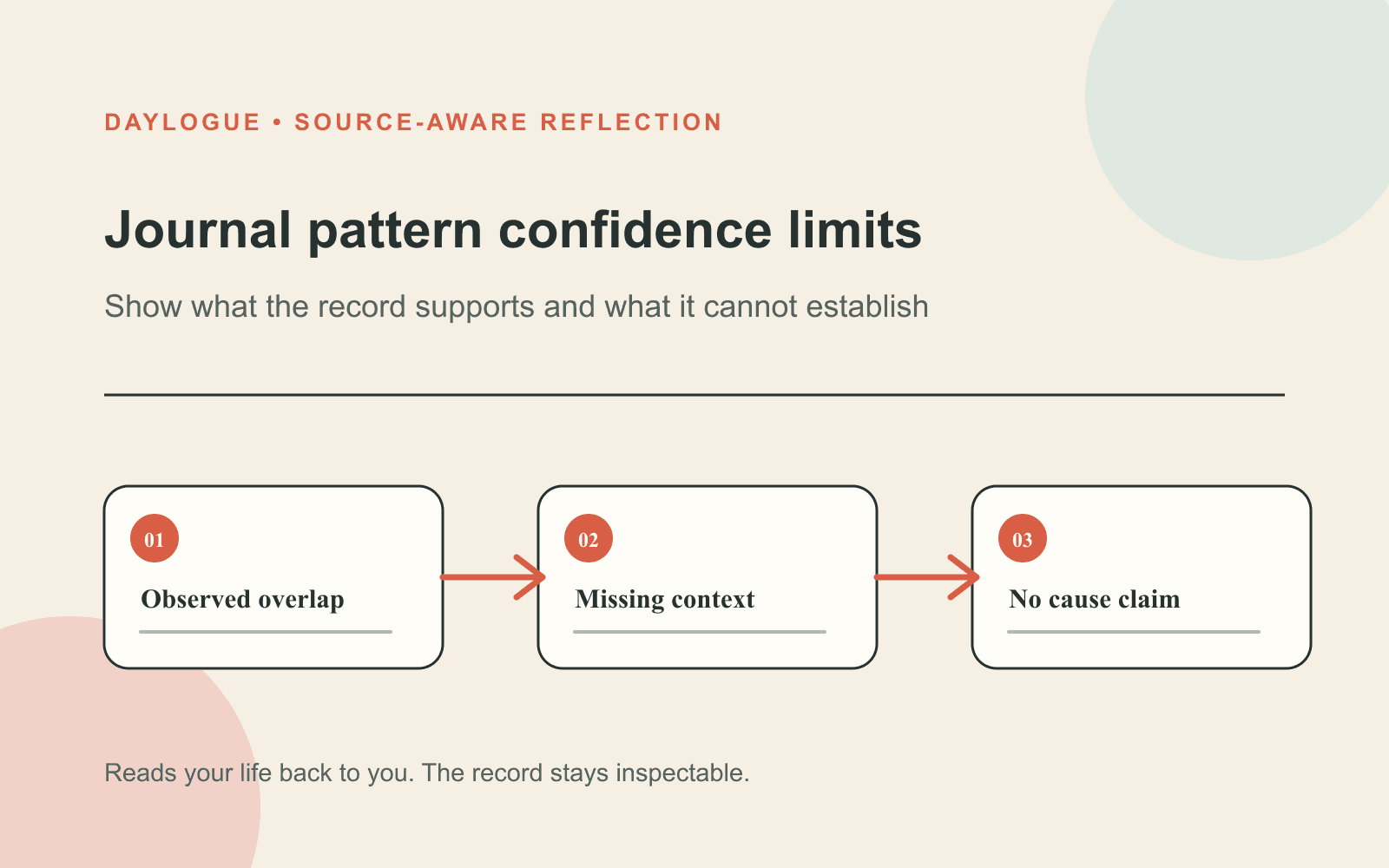
A recurring overlap does not show that one thing caused another. You can become more confident that two recorded details repeatedly appeared together while remaining uncertain about why. Keep those as separate questions. The first concerns the shape of the record. The second concerns explanation and may require information the journal never captured.
The same separation applies to prediction. A stable past repeat does not guarantee the next comparable moment. Schedules change. People respond differently. A pattern can fade. Confidence language should stay anchored to the selected past window and avoid telling the person what will happen.
Avoid precision that the evidence has not earned
Numerical confidence can look scientific even when the method, calibration, and interpretation are unclear. Use counts, coverage, distribution, and visible exceptions before reaching for a score. If a score cannot explain what would move it up or down, it does not help the reader challenge the observation.
No research or outcome claim has been approved for public use yet. That boundary matters when discussing reliability. Daylogue can describe verified product behavior and the evidence behind a personal observation. It should not convert that into a validated outcome claim or imply that a confidence label guarantees benefit.
| Dimension | Question | How to report it |
|---|---|---|
| Coverage | How many entries were eligible? | Give eligible and total counts. |
| Distribution | Are matches spread or clustered? | Name the weeks or cluster. |
| Consistency | How often did comparable entries fit? | Give matches and counterexamples. |
| Context | What relevant detail may be missing? | State the limit without guessing. |
Write a confidence note in five lines
Line one names the observation. Line two states the date range and eligible count. Line three describes distribution. Line four names the strongest counterexample or missing field. Line five states the limit and invites a response. This format is short enough to read and specific enough to challenge.
Offer confirm, reject, reinterpret, and keep watching. Rejection can mean the person knows context the record missed. Reinterpretation can preserve the overlap while changing its meaning. Keep watching can be the most honest choice when coverage is thin. The system should make all four responses feel normal.
01
Describe coverage
State the window, eligible entry count, and distribution without converting them into a person-level score.
02
Add resistance
Include the strongest counterexample, missing field, and contextual limit near the observation.
03
Return control
Invite the person to confirm, reject, reinterpret, or keep watching based on lived context.
Confidence does not require opening everything
The NIST Privacy Framework is a voluntary tool for identifying and managing privacy risk. A confidence view should reveal only the evidence needed to understand the observation. It can show counts, dates, fields, and selected context while leaving unrelated private writing closed.
The final sentence should return authority to the reader. The system can surface a candidate pattern from what someone chooses to share. The person can confirm, reject, or reinterpret it. Confidence describes the trail behind the suggestion. Meaning still belongs to the life around the record.
Example: describe confidence without a score
A pattern appears in eight of ten eligible check-ins across five weeks. The two counterexamples fall in different weeks, so the evidence is distributed rather than confined to one cluster. A plain confidence note can say exactly that. It does not need “82 percent confidence,” a number whose calibration and meaning the reader cannot inspect. Counts, dates, and exceptions communicate the evidence more directly.
Now add the limits: seven other days in the window have no comparable check-in, and the record does not contain full context about workload. The person says one counterexample happened during a holiday. The final note can describe the recurring overlap as developing or stronger evidence within the eligible record while keeping cause uncertain. This wording gives the reader a reason to pay attention and an equally visible reason not to mistake the observation for a fixed truth.
A confidence note should expire when its evidence window no longer matches the person’s life. A new schedule, relationship context, health change, or check-in habit can alter comparability. Review the observation rather than carrying its old confidence forward automatically. Historical notes can remain visible as part of the story, but they should not outrank newer context. Confidence is a description of a particular trail at a particular time, not a permanent badge attached to someone. Avoid color systems that quietly become judgments. Red can feel like failure, green like success, and a rising bar like personal improvement even when the label is only meant to describe evidence coverage. Plain words, counts, and visible limits usually communicate more accurately. If color is used, pair it with text and never let color carry the conclusion alone. Accessibility and emotional register matter together here. Also distinguish uncertainty from contradiction. Thin coverage means there is not enough eligible evidence. Contradictory coverage means comparable entries point in different directions. The first response may be to keep watching. The second may be to narrow, split, or reject the observation. Calling both “low confidence” hides a useful difference. The person should be able to see which problem exists and what evidence would change the result. Finally, preserve the reader’s response with the confidence note. If they reject an observation because the window missed a major change, that context becomes part of future review. The system learns nothing useful by repeating the same suggestion without carrying forward the person’s correction.
- Use eligible counts instead of unexplained percentages.
- Report whether matches are distributed or clustered.
- Name missing days and context near the observation.
- Apply confidence language to the evidence, never the person.
- Distinguish thin evidence from comparable entries that directly conflict.
- Store the reader’s correction so future versions do not repeat a known mistake.
- Pair any visual indicator with plain text that explains the underlying evidence.
Framework
Pattern confidence limit card
Use this card to describe evidence strength in plain language while preserving counterexamples, missing context, and the person’s right to disagree.
- Report eligible entries separately from total days in the selected window.
- Describe whether matches are spread across time or concentrated in one cluster.
- Name the strongest counterexample and any condition it reveals.
- List missing fields and unshared context that could change the reading.
- Use low, developing, or stronger evidence only for the observation, never the person.
- Avoid numerical confidence scores unless the method and meaning are genuinely validated.
- Give the reader confirm, reject, reinterpret, and keep-watching options.
Common questions
What does confidence mean for a journal pattern?
It describes how well one observation is supported by eligible coverage, distribution, comparable examples, and counterexamples. It should never become a score of the person.
Is a numerical confidence score better?
Not automatically. Counts and plain-language limits are clearer when a numerical method has not been validated or cannot explain what changes the score.
Can a pattern have strong recurrence but uncertain cause?
Yes. The record may repeatedly show two details together while leaving direction and explanation unresolved. Those are separate confidence questions.
How do missing entries affect confidence?
They reduce coverage and may bias which moments are represented. Mark them as gaps and report eligible counts. Silence is missing coverage rather than a neutral result.
Who decides whether a pattern fits?
The person does. A system can show the evidence trail and its limits, but lived context may confirm, reject, or substantially reinterpret the suggestion.
Sources
Sources were checked on the dates shown. Product details and policies can change.
- Daylogue pattern features · Daylogue · checked August 8, 2026
- Daylogue evidence and methods · Daylogue · checked August 8, 2026
- NIST AI Risk Management Framework · National Institute of Standards and Technology · checked August 8, 2026
- NIST Privacy Framework · National Institute of Standards and Technology · checked August 8, 2026
Keep exploring
Daylogue Knowledge Center
Browse practical guides for reflection, journaling, patterns, and privacy.
Read moreHow Daylogue shows patterns
See how candidate patterns stay connected to evidence and correction.
Read moreWhy Daylogue exists
Read the principles behind a system for self-understanding.
Read moreDaylogue is not therapy and is not a replacement for professional care.