Written by Daylogue Editorial Team. Published August 8, 2026. Reviewed and updated August 8, 2026.
A journal pattern counterexample is a comparable entry that does not behave as the proposed pattern predicts. Counterexamples help test scope, expose missing conditions, and prevent cherry-picking. A strong observation shows both fitting examples and exceptions, then narrows its wording when the exceptions matter.
Counterexamples are part of the pattern
A proposed pattern becomes useful only when it can meet the entries that disagree with it. If several Sunday evenings show higher stress, a calm Sunday evening is not a mistake to remove. It is evidence about the boundary of the observation. Perhaps the difference was workload, company, travel, or a change in routine. Perhaps the original pattern was simply too broad.
Counterexamples protect the person from a story that grows more certain each time it is repeated. They also make the observation more personal. “Sundays are hard” may become “Sundays with unfinished work often felt tense in this month’s check-ins.” The narrower sentence is less dramatic and more useful because it identifies a condition the record actually contains.
Choose comparable entries first
An exception matters most when it resembles the fitting examples in relevant ways. Compare the same field set, similar time window, or recurring situation. A calm morning is not a strong counterexample to a proposed evening pattern. A calm evening in the same weekly slot is stronger. Define comparability before reading the values so the criteria do not shift to protect the pattern.
Daylogue tracks four core metrics across every check-in: mood, energy, stress, and sleep hours. If a proposed pattern compares stress and sleep hours, a counterexample needs both fields. Entries missing one field should stay visible as gaps, but they cannot confirm or challenge the relationship.
Search for the opposite on purpose
Start with the strongest wording in the observation and ask what an opposite entry would look like. Then search the covered window for it. If the pattern says energy is lower in a recurring slot, look for steady or higher energy in that same slot. If it says a theme keeps returning, look for comparable entries where the theme is absent.
This deliberate search counters the natural pull toward confirming examples. A polished observation can make matching entries easier to remember. The opposite search restores balance. It does not require equal numbers on both sides. It requires giving conflicting evidence a fair chance to change the conclusion.
Notice when exceptions are explained away too quickly
A recurring overlap does not show that one thing caused another. The same caution applies when explaining a counterexample. Saying “that day was different because I exercised” may be a useful personal note, but the record may not establish exercise as the reason. Label it as context or a hypothesis, then keep the exception in view.
If every exception receives a special explanation, the pattern becomes impossible to disprove. That is worth noticing. A useful observation has conditions that can be checked. When counterexamples pile up, narrow the claim, split it into separate patterns, or reject it. Changing the wording with the evidence keeps the observation closer to the record.
Narrow, split, keep watching, or reject
Narrow when exceptions identify a missing condition. Split when two distinct situations are hiding under one label. Keep watching when coverage is too sparse to decide. Reject when the observation depends on selective examples or cannot survive comparable conflicts. These responses make disagreement productive instead of framing it as a failure.
No research or outcome claim has been approved for public use yet. That evidence boundary reinforces a simple editorial rule: describe verified product behavior and the person’s visible record without promising a result. Counterexamples belong in that honest account because they show the record as it is, not as a success story.
| Evidence shape | Response | Example wording |
|---|---|---|
| One clear exception | Inspect and possibly narrow | Often appeared, with one exception during travel. |
| Two different conditions | Split | Separate workday and weekend observations. |
| Sparse comparable entries | Keep watching | Early signal with limited coverage. |
| Conflicts dominate | Reject | The selected record does not support this pattern. |
Run a five-minute counterexample review
Read the observation once. Define a comparable entry. Find the strongest fitting example and the strongest conflicting example. Write one difference you can see and one difference that might exist but was not recorded. Then choose narrow, split, watch, or reject. The process is quick because it is aimed at the decision, not exhaustive analysis.
The NIST AI Risk Management Framework is intended for voluntary use. Its broader focus is organizational risk, but a relevant design habit is to create explicit review and challenge points. In a journal pattern flow, the counterexample review is that challenge point. It makes correction a normal part of using the feature.
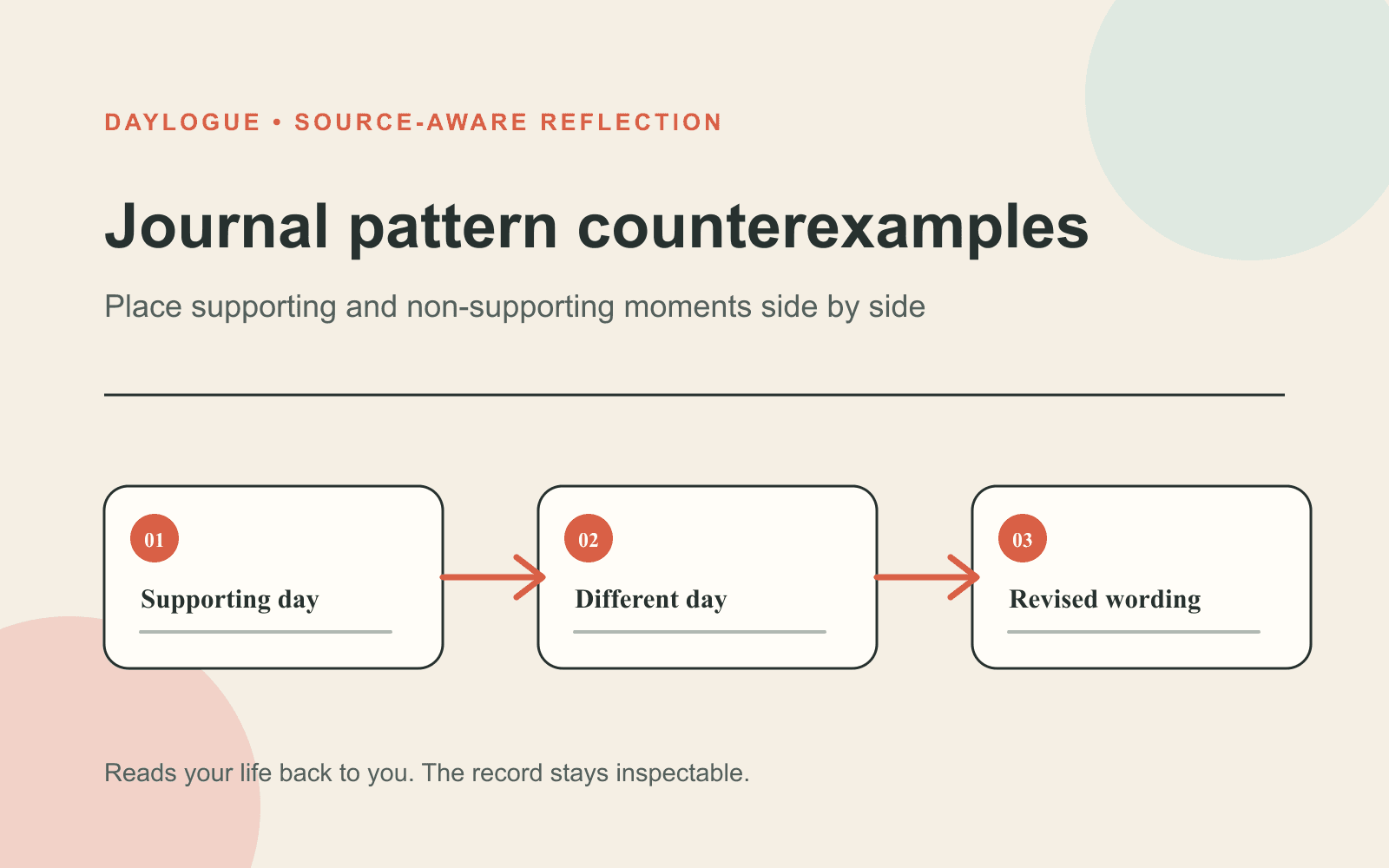
01
Define comparable
Choose the time, situation, and required fields that make an exception relevant before seeing the result.
02
Find the strongest conflict
Search deliberately for the entry that most clearly resists the proposed pattern and preserve its context.
03
Change the conclusion
Narrow, split, keep watching, or reject the observation based on what the conflicting evidence reveals.
Write an observation that can be wrong
Avoid words such as always, never, and proves. Use a defined window and a count when possible. Include the condition that survived the exception review. A statement that can be wrong can also be tested, corrected, and trusted. A vague statement that absorbs every outcome offers little help.
End by preserving the counterexamples with the pattern receipt. If new entries resemble them, the observation may need another revision. That record of change matters. It shows that the tool reads what you choose to share and leaves the meaning open to your context rather than hardening an early summary into a label.
Example: when a Sunday pattern breaks
A proposed pattern says Sunday evenings carried lower energy across a month. Three Sundays fit. The fourth shows steady energy and a written note about spending the afternoon outside with friends. That entry is a strong counterexample because it shares the same weekly slot and contains the required energy field. It does not prove that time outside or company produced the difference. It does show that “Sunday evenings are low energy” is too broad for the selected record.
The revised observation might focus on Sundays with unfinished preparation for Monday, if that context appears in the fitting entries and not merely in memory. Another honest response is to keep watching because four opportunities are still sparse. The key is that the counterexample changes the decision. It is not tucked into a footnote after a confident headline. By using resistance as evidence, the journal helps the person see conditions and uncertainty instead of memorizing a simplified identity statement.
Counterexamples also improve what you watch next. Instead of collecting more entries in general, identify the condition that made the conflict informative. The next comparable Sunday, notice whether unfinished preparation is present in the words you choose to share. The aim is not to engineer a preferred result. It is to give the original observation a fair test. A pattern that survives becomes more specific. A pattern that fades has still helped by clearing away a story the record could not support. Keep a short counterexample log beside the current wording. Record why each entry was comparable, which required fields were present, and what visibly differed. Visible differences can remain observations until the record supports an explanation. The log is a memory aid, not a causal model. Over time, it can show that one exception was unusual or that exceptions form their own repeated condition. Either result gives the person a better map of the record. It also prevents a later summary from forgetting the evidence that once challenged the pattern.
- The exception shares the same weekly slot.
- The required field is present, so it is not a gap.
- Context narrows the observation without proving cause.
- Sparse opportunities can justify a keep-watching decision.
- Keep every challenge visible beside later versions of the pattern wording.
Framework
Counterexample finder for journal patterns
Use this checklist to locate comparable entries that resist a proposed pattern and decide whether to narrow, split, or reject it.
- Write the pattern so a counterexample could clearly disagree with it.
- Define what makes two entries comparable before searching for exceptions.
- Look at the same weekday, time window, field set, or recurring situation.
- Separate missing data from a genuine opposite result.
- Record contextual differences without using them to dismiss every exception.
- Narrow or split the pattern when counterexamples reveal more than one condition.
- Reject the observation when it survives only by explaining away every conflict.
Common questions
What is a journal pattern counterexample?
It is a comparable entry that conflicts with the proposed pattern. It may show the observation is too broad, depends on another condition, or does not have enough support.
Does one counterexample erase a pattern?
Not automatically. One exception may narrow the wording or reveal context. The key is to examine comparable entries and avoid dismissing conflicts merely because they are inconvenient.
How do I know if entries are comparable?
Choose criteria tied to the claim, such as the same time window, recurring slot, situation, and available fields. Set those criteria before checking whether the entry fits.
What is the difference between missing data and a counterexample?
Missing data cannot show the proposed relationship or its opposite. A counterexample contains the needed fields or context and shows a result that conflicts with the observation.
When should I reject a proposed pattern?
Reject it when it relies on cherry-picked examples, cannot survive comparable conflicts, or keeps changing its rules to explain away every exception.
Sources
Sources were checked on the dates shown. Product details and policies can change.
- Daylogue pattern features · Daylogue · checked August 8, 2026
- Daylogue evidence and methods · Daylogue · checked August 8, 2026
- NIST AI Risk Management Framework · National Institute of Standards and Technology · checked August 8, 2026
- NIST Privacy Framework · National Institute of Standards and Technology · checked August 8, 2026
Keep exploring
Daylogue Knowledge Center
Browse practical guides for reflection, journaling, patterns, and privacy.
Read moreHow Daylogue shows patterns
See how candidate patterns stay connected to evidence and correction.
Read moreWhy Daylogue exists
Read the principles behind a system for self-understanding.
Read moreDaylogue is not therapy and is not a replacement for professional care.