Written by Daylogue Editorial Team. Published August 28, 2026. Reviewed and updated August 28, 2026.
Relationship prompts for a parent or caregiver should focus on one exchange at a time. Record what was said or done, separate that from what you think it meant, and identify any need, request, or boundary that is actually yours to name. Keep the journal from deciding another person’s motives. Protect identifying details, especially when the entry involves a child, care recipient, client, colleague, or family member. Keep the resulting note editable so a later conversation can add context or correct the first reading.
Record the exchange before writing its meaning
Begin with words and actions you could point to: a message was unanswered, a pickup time changed, someone interrupted, or a request received a no. Add the setting and sequence. This creates a source record without requiring a transcript. Avoid copying another person’s private message when a short paraphrase preserves what you need for your own reflection.
Then write your interpretation on a separate line. “They do not respect my time” may be the thought that arrived, but it is not the same kind of evidence as “the agreed time changed twice.” Keeping the layers visible does not dismiss your reaction. It prevents the first explanation from being mistaken for the only possible account.
Sort facts, assumptions, needs, and requests
Four headings can slow the page down. Facts contain observable details. Assumptions contain motives or predictions you cannot verify. Needs describe what would make the situation more workable for you. Requests name something specific another person could answer. A boundary describes what you will do, not a rule that controls the other person.
The headings may reveal that you do not have enough information for a request yet. They may also show that the issue is logistical rather than a statement about the relationship. Leave an item blank when you do not know. Uncertainty is more accurate than filling the space with a motive the other person never stated.
| Layer | Example | Check |
|---|---|---|
| Fact | The handoff moved from 5:00 to 6:00 | Could both people verify this? |
| Assumption | My schedule does not matter to them | What information is missing? |
| Need | I need earlier notice when plans change | Is this mine to name? |
| Request or boundary | Can we confirm changes by noon? | Can the other person answer clearly? |
Use prompts to prepare, not rehearse a verdict
Before a conversation, ask what outcome is actually needed. It may be clarity, advance notice, a pause, a different division of work, or simply acknowledgment. Then ask which part of the story the other person has not heard from you. This shifts the journal away from proving fault and toward identifying a sentence you can responsibly own.
Avoid prompts that claim access to another person’s inner state. Replace “Why are they manipulating me?” with “What behavior am I responding to, and what limit do I want to state?” Replace “Why does my child not care?” with “What happened, what have I asked, and what context might I not know?” The revised wording stays useful even when the relationship is complicated.
- What happened in the exchange, in order?
- Which words are facts and which are interpretations?
- What do I need the other person to understand?
- What request can receive a clear yes, no, or alternative?
- What detail belongs to someone else and should not be stored?
A worked example: a late care handoff
Suppose a sibling arrives an hour later than planned for a care handoff. The source line is the time change and when notice arrived. The interpretation line might be, “My time is always considered flexible.” The need line is, “I need notice early enough to rearrange work.” A request could be, “If the time will change, can you tell me by noon?”
On another date, the sibling may arrive on time or provide early notice. Preserve that counterexample. It does not erase the late handoff; it narrows the broadest wording. Daylogue states that a recurring overlap does not show that one thing caused another. Several difficult exchanges also do not establish a motive that the record cannot verify.
Protect the people who appear in your journal
Relationship notes can expose someone who did not choose the journal. Use “my child,” “a relative,” “a coworker,” or another role label when a name is unnecessary. Omit medical details, school records, client facts, financial information, and copied private messages. Your reflection can describe how an exchange affected your choices without becoming an archive of someone else’s private life.
Daylogue does not use personal entries to train its own models. Provider handling follows current written terms, configuration, and subprocessor disclosures. Daylogue reads the entries you choose to sync to create narratives and surface patterns. Entries are not end-to-end encrypted. Review access, correction, export, deletion, and device privacy before saving sensitive material.
Keep a readback from assigning motives
A digital tool can find repeated phrases or bring several exchanges together. It cannot see the full relationship or determine intent. Daylogue does not infer emotion from faces, voice tone, or physiology. It works from the words and context people choose to share. A summary that says someone “felt,” “wanted,” or “intended” something should be rewritten unless the source entry directly records their own statement.
Keep source links available and keep every generated observation editable. Ask whether the summary distinguishes your interpretation from the event. Look for a different exchange that challenges the wording. The best outcome is not a polished explanation; it is a note that makes your evidence, uncertainty, request, and privacy choices easy to see.
Draft a conversation opening that stays with your evidence
Use the journal to draft one or two sentences, not an argument for every point. A grounded opening can name the event, its practical effect, and the request: “When the handoff time changed after lunch, I had to move a work call. Could we confirm changes by noon when possible?” This wording does not predict the other person’s answer or claim that one exchange defines the relationship.
Read the draft aloud and remove words such as always, never, obviously, and everyone unless the record truly supports them. Check whether the request is specific enough to answer and whether a boundary names your own action. You may decide not to send or say the draft. Preparing a clear sentence can still show which part of the event matters and which assumptions need more information.
Finish with the part you can own
End the entry with one of four things: a question you want to ask, a request you can make, a boundary you will keep, or a decision to wait. This keeps the page connected to your agency without making you responsible for another person’s response. A boundary might be “I will not discuss this during the school pickup,” rather than “They must stop upsetting me.”
Daylogue is not therapy and is not a replacement for professional care. Journal prompts do not replace appropriate help for safety, legal, medical, or care decisions. They can provide a private draft for ordinary communication. Stop when more writing starts repeating the same verdict or storing details that do not belong to you.
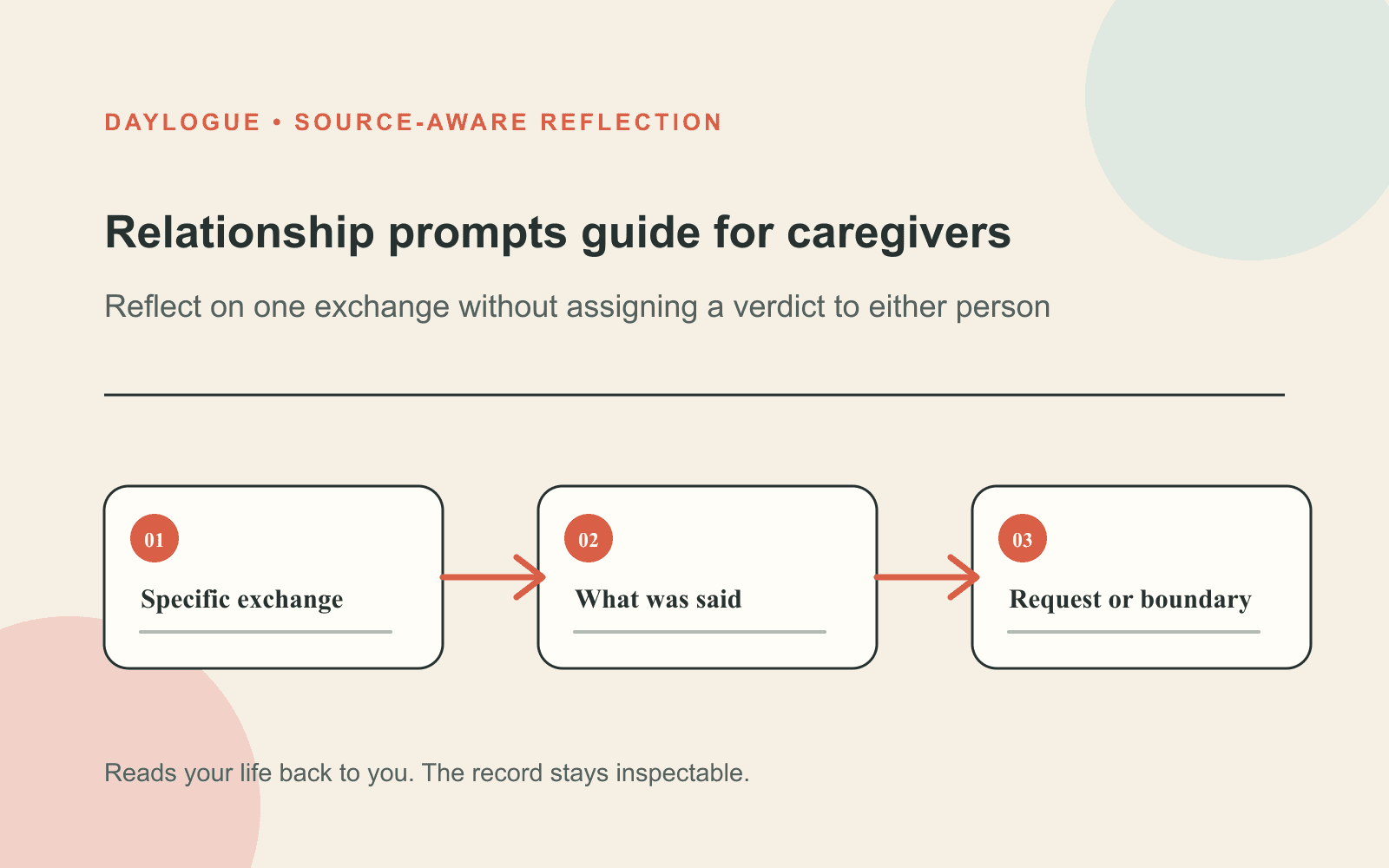
01
Write the observable exchange
Record the sequence without copying more private detail than your reflection requires.
02
Mark every interpretation
Separate what you inferred from what the other person actually said or did.
03
Choose your own next line
Name a question, request, boundary, or pause that does not claim control over the other person.
Worksheet
Facts, assumptions, needs, and requests worksheet
A private four-part worksheet for caregivers preparing for an ordinary relationship conversation without assigning motives.
- Fact: what could both people verify?
- Assumption: what am I inferring without direct evidence?
- Need: what would make this situation workable for me?
- Request: what specific response could the other person give?
- Boundary: what action is mine to choose?
- Privacy check: which details do not belong in the record?
Common questions
How do I journal about someone without violating their privacy?
Use role labels, paraphrase only what you need, and omit identifying, medical, school, client, financial, and copied-message details.
What is the difference between a request and a boundary?
A request asks another person for a specific response. A boundary states what you will do or not do if a situation occurs.
Can prompts tell me what another person intended?
No. Record behavior and your interpretation separately. Motive remains unknown unless the person directly explains it, and even that statement belongs in context.
How do I know when to stop a relationship entry?
Stop after the event, interpretation, need, and possible next line are clear, or when additional writing only repeats a verdict.
Sources
Sources were checked on the dates shown. Product details and policies can change.
- Daylogue evidence and methods · Daylogue · checked August 28, 2026
- Daylogue privacy policy · Daylogue · checked August 28, 2026
Keep exploring
Daylogue Knowledge Center
Browse practical guides for reflection, journaling, patterns, and privacy.
Read moreHow Daylogue shows patterns
See how candidate patterns stay connected to evidence and correction.
Read moreWhy Daylogue exists
Read the principles behind a system for self-understanding.
Read moreDaylogue is not therapy and is not a replacement for professional care.