Written by Daylogue Editorial Team. Published August 29, 2026. Reviewed and updated August 29, 2026.
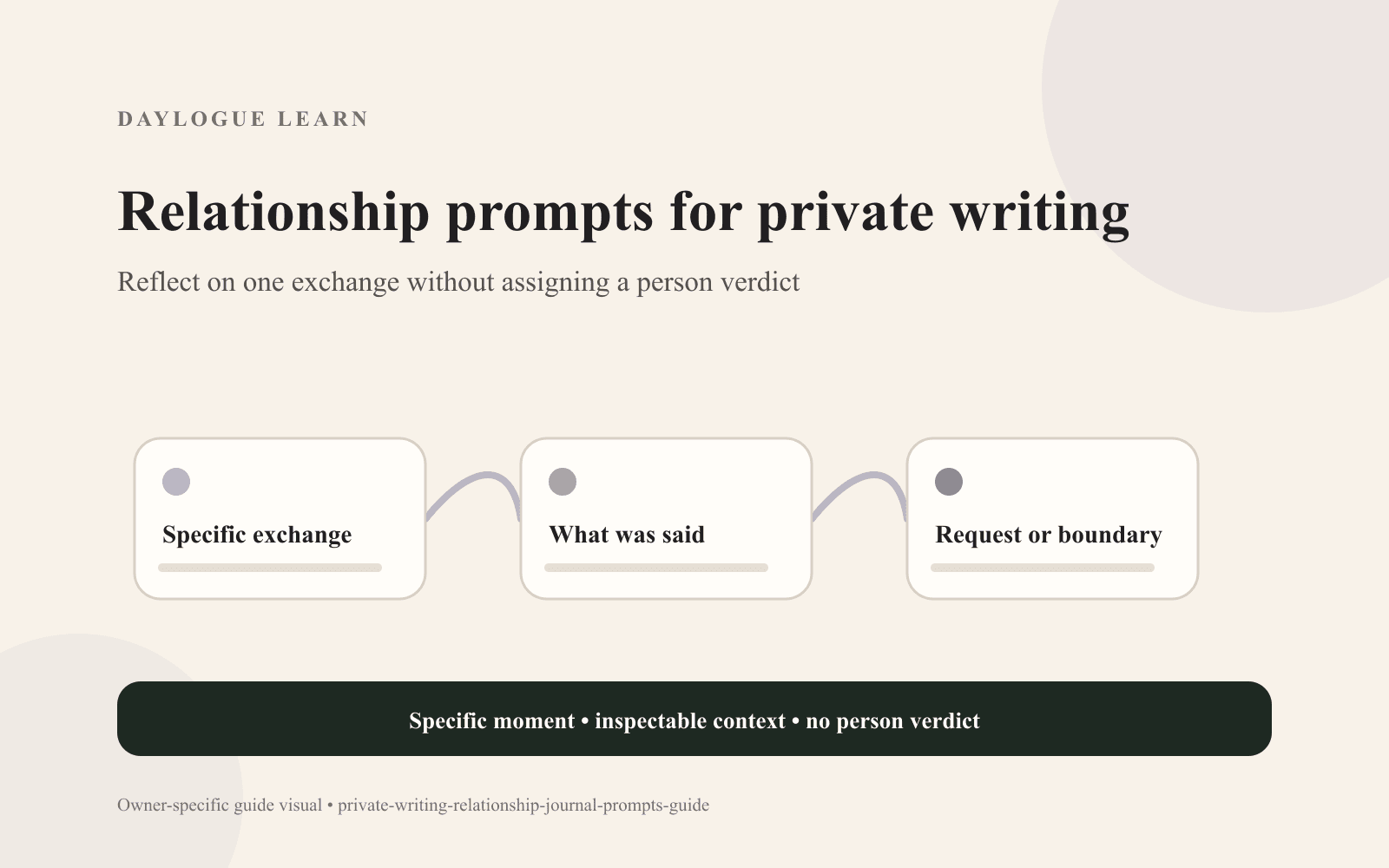
For private relationship writing, choose one exchange and divide the page into three parts: what was said, what you inferred, and what you want to request or protect. Quote only the words you remember. Mark missing context instead of filling it. The entry can help you prepare for a conversation, but it cannot tell you another person’s motive.
Begin with the scene, not the story about it
A difficult conversation can keep replaying because memory blends words, tone, timing, and interpretation into one fast account. Give the scene a few anchors first. Note where you were, what happened just before the conversation, the words you remember, and what ended the exchange. If you are unsure about a detail, write that uncertainty down.
This first pass is intentionally plain. Instead of writing that someone ignored you, record that you asked a question and did not receive an answer before they left the room. The second sentence may still feel painful, but it stays close enough to the specific exchange that you can inspect it later.
Sort the private exchange note into four kinds of notes
People writing privately often try to make one paragraph carry everything. A simpler page separates the record into four lanes: what happened, what you felt, what you needed, and what you are assuming. None of those lanes has to be complete before you stop writing. Keep the private exchange note tied to the specific exchange rather than a fixed identity.
The assumption lane matters most when emotions are high. A sentence such as ‘they wanted to embarrass me’ may feel certain, but it names an intention you cannot observe directly. Move it into a question: ‘What did they mean when they brought that up in front of everyone?’ That keeps your experience visible without turning a guess into a person verdict. Keep the private exchange note tied to the specific exchange rather than a fixed identity.
| Lane | Write this | Example |
|---|---|---|
| What happened | Observable words or actions | The topic changed before my question was answered |
| What I felt | Your own named reaction | I felt shut out and tense |
| What I needed | The missing condition or request | I needed a direct answer or a time to return to it |
| What I assume | A guess rewritten as a question | Did they need space, or did they miss the question? |
Keep relationship reflection expectations modest and inspectable
A 2025 systematic review examined 51 positive expressive writing studies, and the authors rated the included studies poor or fair in quality. The formats, topics, comparisons, and outcomes varied. Use that evidence as a reason to keep expectations modest, not as a promise that one question, schedule, or writing style will create a particular result.
Daylogue says its observations are designed for reflection, not diagnosis, prediction, treatment, or clinical decision-making. For this relationship reflection guide, the useful standard is simpler: does the private exchange note preserve a specific exchange, show what remains unknown, and leave the interpretation open to revision? If not, shorten or change the conversation question.
Turn the private exchange note into one next conversation
A private exchange note does not have to produce the perfect response. It can help you choose one piece of the conversation that is ready to be spoken. Circle the observable specific exchange, underline your own need, and write one question that allows a real answer. Leave one conversation question open when the available context is incomplete.
A grounded opening might be: ‘When the topic changed before my question was answered, I felt shut out. Can we return to it tonight?’ That sentence names the event and your experience. It does not claim to know why the other person changed the subject. Leave one conversation question open when the available context is incomplete.
01
Pause the replay
Write the date, setting, and first clear fact so the memory has a place to begin.
02
Name your side
Record your feeling, need, and request without assigning an emotion or motive to the other person.
03
Mark uncertainty
Put a question mark beside every intention, hidden meaning, or future outcome that you cannot know.
04
Choose one question
Draft a short question that asks for clarification and leaves room for an answer you did not predict.
Record the exchange before writing its meaning
Begin with words and actions you could point to: a message was unanswered, a pickup time changed, someone interrupted, or a request received a no. Add the setting and sequence. This creates a source record without requiring a transcript. Avoid copying another person’s private message when a short paraphrase preserves what you need for your own reflection.
Then write your interpretation on a separate line. “They do not respect my time” may be the thought that arrived, but it is not the same kind of evidence as “the agreed time changed twice.” Keeping the layers visible does not dismiss your reaction. It prevents the first explanation from being mistaken for the only possible account.
A worked example: plans changed late
Suppose a friend changed weekend plans after you had already prepared. Record the message in a short paraphrase, the time it arrived, and the practical effect on you. Keep the missing reason in a separate line rather than supplying one from frustration.
A possible next step is to ask what changed and explain the impact of the timing. That opening stays with what you know. It does not decide the friend’s motive or guarantee how the conversation will go.
Draft a conversation opening that stays with your evidence
Use the journal to draft one or two sentences, not an argument for every point. A grounded opening can name the event, its practical effect, and the request: “When the handoff time changed after lunch, I had to move a work call. Could we confirm changes by noon when possible?” This wording does not predict the other person’s answer or claim that one exchange defines the relationship. Leave one conversation question open when the available context is incomplete.
Read the draft aloud and remove words such as always, never, obviously, and everyone unless the record truly supports them. Check whether the request is specific enough to answer and whether a boundary names your own action. You may decide not to send or say the draft. Preparing a clear sentence can still show which part of the event matters and which assumptions need more information. Leave one conversation question open when the available context is incomplete.
Use relationship questions without pressure
Choose one question about the exchange, your need, or a request you may want to make. Skip questions that presume betrayal, avoidance, or another motive. You can write one sentence, revise the question, or leave it unanswered.
Keep another person’s story narrower than your own. Paraphrase private messages when the exact text is unnecessary, remove identifying details, and focus on the part of the exchange you experienced directly.
Choose the scope, the question, and the stopping point
Keep the scope to one exchange. Choose a question that matches what happened rather than redirecting the entry toward a presumed cause. Then decide where the note ends. A scene, an answer, and one unresolved point may be enough.
More writing remains optional. Stop when the page begins repeating the same accusation or imagined reply. The next useful information may come from the conversation itself, not from another paragraph written alone.
Prompt Pack
Relationship Journal Prompts for Private Writing: twelve prompts
Choose one question for a specific relationship moment, answer in your own words, and leave the interpretation open to later context.
- What words can I quote accurately?
- What happened before this exchange?
- Which part hurt or confused me?
- What am I inferring about intent?
- What context is missing?
- What do I want the other person to understand?
- What request can I state directly?
- What boundary belongs to me?
- What outcome cannot I control?
- What would repair look like in concrete terms?
- What can wait for a calmer conversation?
- What story am I willing to revise?
Common questions
What words can I quote accurately?
Use this as a conversation question about a friend changing plans after you had already prepared, without giving a reason. Answer with one observable detail first, then add your current reading only if it helps. You can stop after the record is clear.
Which part hurt or confused me?
Keep the answer inside one specific exchange. Write what changed, what stayed fixed, and which fact is missing. That structure prevents a limited private exchange note from becoming a verdict about a person or an entire period.
What do I want the other person to understand?
Put the direct answer in your own words and remove names that add nothing to the task. If the question assumes a motive or outcome, rewrite it so the missing context remains visible.
What outcome cannot I control?
Return to dated source lines before calling this a repeat. Look for an exception and an unrecorded gap. A repetition can support another question, but it cannot prove a cause by itself.
What story am I willing to revise?
Leave this unanswered when the available record is too thin. A useful private writing practice allows an open question, a visible gap, and a clean stopping point without inventing completion.
Sources
Sources were checked on the dates shown. Product details and policies can change.
- Daylogue evidence and methods · Daylogue · checked August 29, 2026
- Positive expressive writing systematic review · PLOS One · checked August 29, 2026
Keep exploring
Daylogue Knowledge Center
Browse practical guides for reflection, journaling, patterns, and privacy.
Read moreHow Daylogue shows patterns
See how candidate patterns stay connected to evidence and correction.
Read moreWhy Daylogue exists
Read the principles behind a system for self-understanding.
Read moreDaylogue is not therapy and is not a replacement for professional care.