Written by Daylogue Editorial Team. Published August 29, 2026. Reviewed and updated August 29, 2026.
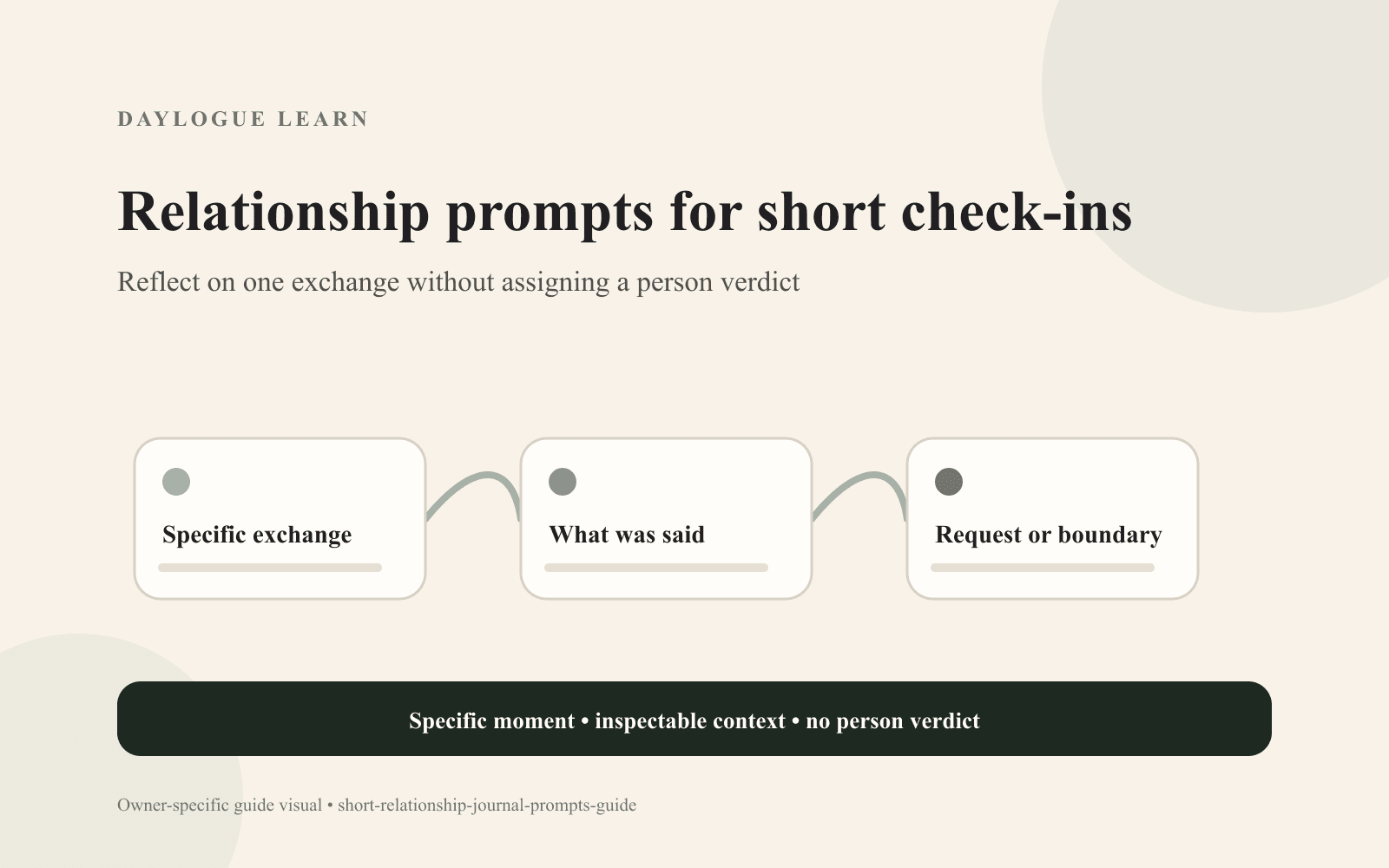
For a short relationship check-in, write three things: the specific exchange, the words or actions you remember, and the request or boundary that matters now. Keep guesses about motive in a separate question. You can stop after three lines. The aim is a usable record of one moment, not a verdict about the whole relationship.
Choose one relationship moment with clear edges
Start with a conversation, disagreement, or quiet moment between two people. Put a date or time beside it if that detail helps you find the moment again. Describe the setting, the action, and the change you noticed. Avoid opening with a summary of your character, another person, your career, or your entire week. A small scene gives you evidence you can inspect later and revise when new context arrives.
Consider a text that felt abrupt after plans changed. A broad entry might say that everything felt wrong. A useful record would say the reply was five words and arrived at 8:40 p.m. That sentence does not need to explain the cause. It simply preserves the part you know while leaving room for whether the other person was rushed, annoyed, distracted, or simply brief.
- What exactly happened in this exchange?
- Which words do I remember without filling gaps?
- What did I ask for clearly?
- What do I wish I had said more plainly?
- What am I assuming about the other person?
- What fact would change my interpretation?
Separate the record from your first reading of it
Use two labels on the page: “record” and “my current reading.” Under the first, write only observable details from this relationship moment. Under the second, write the interpretation that arrived first. The labels keep both parts available without pretending they carry equal certainty. You can revise the reading later without rewriting what happened.
Add a third line called “missing context.” Put whether the other person was rushed, annoyed, distracted, or simply brief there. This is not indecision. It is an accurate part of the record. When the mind supplies a fast explanation, the missing-context line makes the gap visible and gives you a more useful question than a fixed conclusion would.
| Part | What belongs there | What to leave out |
|---|---|---|
| Record | Words, actions, timing, and changes you can place | Motives you cannot verify |
| Current reading | Your tentative interpretation in your own language | Claims that the reading must be final |
| Missing context | Questions, gaps, and details you do not have | Invented facts that make the story neater |
| Possible next step | ask what they meant before answering the version you imagined | A promise that depends on someone else |
Give the check-in a clean stopping point
A short check-in needs a visible stopping point. Decide on three lines, two minutes, or one completed question before you begin. The boundary is permission to stop, not a demand to squeeze every thought into a tiny answer. For this guide, a complete entry can contain the moment, one detail, and one open question. If more arrives and you want to continue, keep writing. The format serves the moment. The moment does not owe the format a performance.
Try a narrow sequence: name what happened, identify what changed, then ask what they meant before answering the version you imagined. Read the three lines once. Remove any sentence that assigns a motive or predicts an outcome without support. The remaining entry may look plain, but plain language is easier to compare with what actually happens later.
01
Name the scene
Place a conversation, disagreement, or quiet moment between two people in a specific part of the day or week.
02
Keep one concrete detail
If it fits the record, you could write, “The reply was five words and arrived at 8:40 p.m.” The detail stays with what you can verify from the moment itself.
03
Mark the open question
Keep whether the other person was rushed, annoyed, distracted, or simply brief visible instead of smoothing the gap away.
04
Choose the stopping point
End after the record is useful, even when the relationship question remains open.
Keep the entry from becoming a person verdict
A limited record cannot establish that you are lazy, bad at relationships, incapable of gratitude, terrible at work, or destined to repeat a week. It also cannot establish another person’s motives. Replace identity labels with situations and actions. “I delayed this reply twice” gives you something to inspect. “I ruin every conversation” turns two moments into an identity.
Daylogue says its observations are designed for reflection, not diagnosis, prediction, treatment, or clinical decision-making. That boundary is useful even when you write with paper and pen. The entry can support attention and memory, while a narrow slice of a life cannot produce certainty about a person.
- Replace identity labels with dated actions.
- Keep motives as questions until you have context.
- Preserve mixed responses instead of choosing one label.
- Write the exception beside the apparent repetition.
Reread relationship entries with their receipts
When several entries collect, attach every observation to dates or source moments. You might notice a phrase, situation, time slot, or request appearing again. Quote the relevant lines. Then look for the entry that does not fit. Repetition can make a question worth following, but it should not erase gaps, different circumstances, or days you did not record.
Daylogue states that a recurring overlap does not show that one thing caused another. Use language such as “appeared beside,” “showed up in,” or “was present in these entries.” Avoid turning an overlap into an explanation. For this example, the next useful move is to ask what they meant before answering the version you imagined, while keeping whether the other person was rushed, annoyed, distracted, or simply brief open.
Keep expectations proportional to the evidence
A 2025 systematic review examined 51 positive expressive writing studies, and the authors rated the included studies poor or fair in quality. The studies varied in topic, format, comparison, and outcome. That makes the research a reason for modest expectations, not a guarantee that a particular prompt or schedule will produce a particular result.
A study of 395 American young adults found narrative coherence was positively related to identity functioning, while its links with broader well-being measures were only partially confirmed. The authors described the connection between coherence and well-being as more complex than a simple rule. Use writing because it helps you preserve and examine experience, then judge the practice by what it actually gives you.
Decide how private writing will stay private
A private preference should shape the amount of detail you record. Replace a name with a role when identity does not matter. Leave out an address, employer, or third-party story when the reflection works without it. On a shared device, check notification previews, account access, exports, and saved history before assuming a short entry is hidden.
Online journals have service-specific terms. Daylogue reads the entries you choose to sync to create narratives and surface patterns. Entries are not end-to-end encrypted. Daylogue does not use personal entries to train its own models. Provider handling follows current written terms, configuration, and subprocessor disclosures. Read the current policy and decide whether the tradeoff fits what you plan to write.
- Use roles instead of names when names add nothing.
- Check device previews and shared account access.
- Read server storage and provider-processing terms.
- Inspect export and deletion controls.
- Keep third-party stories narrower than your own.
Try one relationship entry now
Choose one question from the prompt pack and answer it with the scene already in view. Write the record first. Add your current reading only after the concrete detail is down. Mark what you do not know, then stop. If the entry immediately produces a sweeping conclusion, rewrite that sentence so it points back to an action, date, phrase, or change.
Return only if the record has something useful to compare. You may carry one open question forward, or you may close the page without a goal. Missed days do not need reconstruction, and the practice does not need a streak. The value comes from an honest record you can revisit, not from perfect attendance or a polished explanation.
Prompt Pack
Relationship Journal Prompts for Short Check-Ins: twelve prompts
Choose one question for a specific relationship moment, answer in your own words, and leave the interpretation open to later context.
- What exactly happened in this exchange?
- Which words do I remember without filling gaps?
- What did I ask for clearly?
- What do I wish I had said more plainly?
- What am I assuming about the other person?
- What fact would change my interpretation?
- What boundary matters before the next conversation?
- What can wait until I have more context?
- What part of this belongs to me?
- What outcome am I trying to force?
- What would a curious follow-up sound like?
- What does not need a conclusion tonight?
Common questions
What is a good first relationship prompt?
Start with “What exactly happened in this exchange?” It points to one part of the record and leaves the interpretation open. Answer with a specific moment rather than a summary of yourself.
How short can a useful check-in be?
Three lines can be enough: what happened, what changed, and what you do not know yet. Continue only when more writing feels useful.
How should I read a repeated relationship theme?
Return to the dated entries, quote the lines that support the observation, and look for an exception. Repetition can support a question, but it does not prove a cause or define a person.
What if the prompt assumes something that is not true?
Rewrite it in neutral language or skip it. A prompt should help you begin with your own record, not supply a motive, feeling, identity, or answer on your behalf.
What if I miss several days?
Continue with the day in front of you. Leave unknown days as gaps rather than reconstructing them for completeness. There is no need to protect a streak.
Sources
Sources were checked on the dates shown. Product details and policies can change.
- Daylogue evidence and methods · Daylogue · checked August 29, 2026
- Daylogue privacy policy · Daylogue · checked August 29, 2026
- Positive expressive writing systematic review · PLOS One · checked August 29, 2026
- Narrative identity and psychological well-being research · Frontiers in Psychology · checked August 29, 2026
Keep exploring
Daylogue Knowledge Center
Browse practical guides for reflection, journaling, patterns, and privacy.
Read moreHow Daylogue shows patterns
See how candidate patterns stay connected to evidence and correction.
Read moreWhy Daylogue exists
Read the principles behind a system for self-understanding.
Read moreDaylogue is not therapy and is not a replacement for professional care.