Written by Daylogue Editorial Team. Published August 27, 2026. Reviewed and updated August 27, 2026.
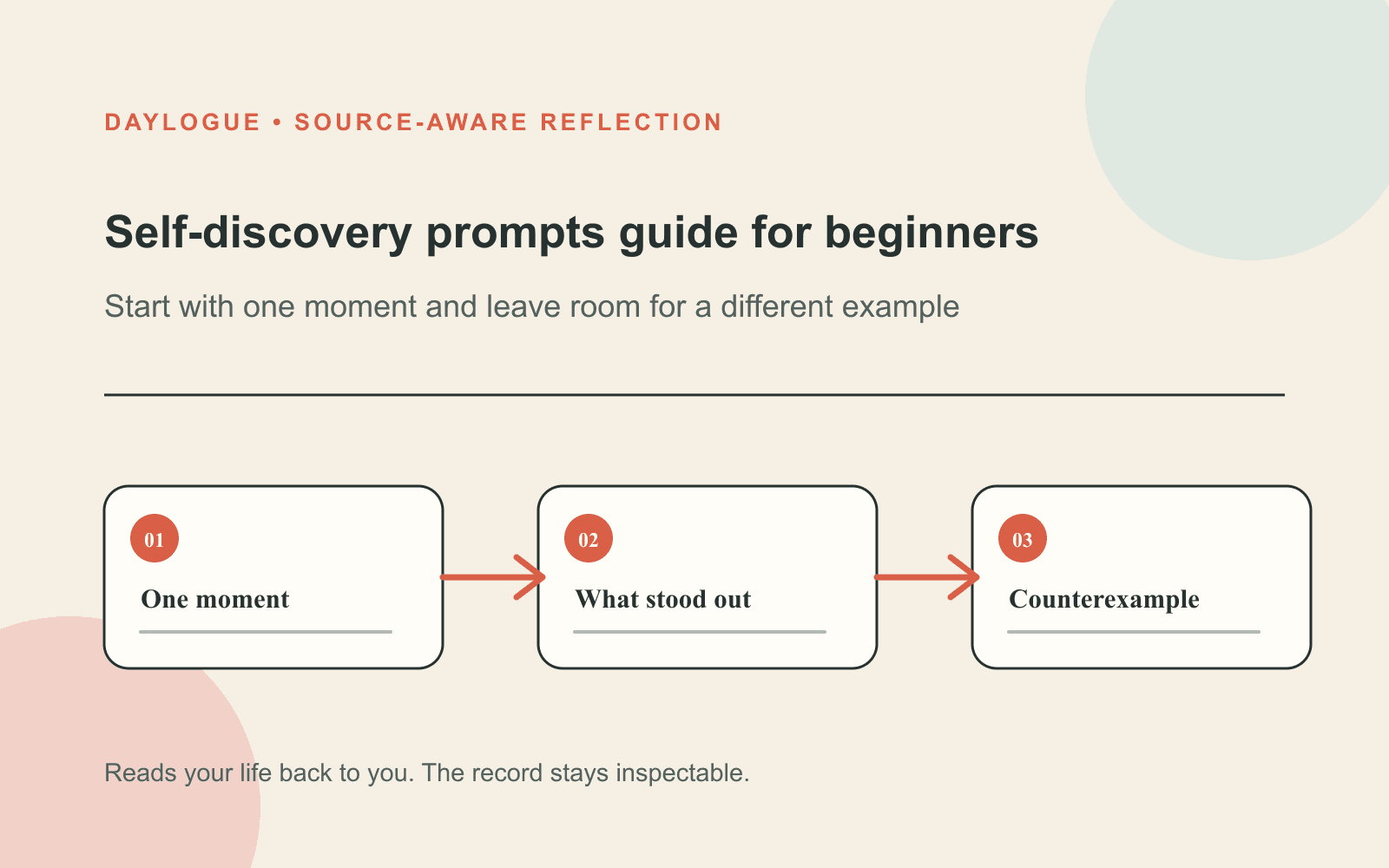
Self-discovery journaling begins with specific moments, not a demand to define who you are. Choose one recent choice, conversation, or routine. Write what happened, what you noticed, what mattered, and what remains uncertain. Compare the entry with a different day before naming a pattern. The goal is a better question about your life, not a permanent label, diagnosis, or score.
Start with a scene you can actually remember
‘Who am I?’ is too large for a first page. Begin with the last moment you changed your mind, agreed when you wanted time, or felt unexpectedly at ease. Write where you were, who was present, what happened first, and what changed. This creates a record you can inspect later. An entry such as ‘I stayed after the meeting because the unfinished decision kept pulling at me’ offers more room for discovery than ‘I am bad at boundaries.’ The scene can support several interpretations, and later experience can correct the first one.
Separate observation from interpretation
Draw two columns. Put what a camera or calendar could confirm on the left: the call lasted forty minutes, you asked three questions, or you left before the discussion ended. Put your current explanation on the right: you wanted clarity, felt rushed, or expected disagreement. The explanation matters, but it is not the same kind of evidence. Marking the difference prevents a first impression from becoming a verdict. It also gives a later entry somewhere to disagree when the same behavior appears in a different setting for a different reason.
| Observed | Current interpretation | Question to carry |
|---|---|---|
| I rewrote the message twice | I may have expected conflict | What response was I trying to prevent? |
| I stayed late after the decision | I wanted closure | Would I stay if the owner were clear? |
| I skipped the invitation | I needed quiet | Was quiet the need or was uncertainty the barrier? |
Look for values in choices, not slogans
A values list can sound impressive while revealing little. Ask what you protected when two good things competed. Perhaps you left a networking event to call a sibling, delayed a polished proposal to verify a fact, or accepted a slower plan because another person needed access. Name the cost as well as the choice. A value becomes visible through tradeoffs, but one decision does not define your permanent priorities. Compare several scenes, including an exception, before deciding that a word such as care, accuracy, freedom, or loyalty belongs in your working vocabulary.
- What did I protect when I could not protect everything?
- Which cost was I willing to accept in that moment?
- When did I make the opposite choice, and what changed?
Notice what holds and drains your attention
Avoid turning energy into a moral score. Record the setting, duration, task shape, people present, interruptions, and the sleep hours or stress you chose to log that same day. Then ask where attention became easier or harder. A quiet morning may help on one day and feel isolating on another. Your stress running higher on the nights you logged under six hours is the kind of same-check-in overlap a pattern system can inspect. It does not prove that sleep caused the stress, and it is not a next-day prediction.
Write about relationships without reading minds
Describe the words, timing, and behavior you observed before guessing another person’s motive. ‘They looked at the clock twice and ended the call early’ preserves a scene. ‘They do not respect me’ closes it too soon. Add what you expected, what you asked, and what remains unknown. If you want to prepare for a conversation, write a question that could produce new information. The journal can help you understand your own reaction and boundary. It cannot decide what another person secretly intended or whether you should stay, leave, forgive, or confront.
Follow one recurring choice for a week
Choose a decision that appears often enough to compare, such as accepting a meeting, postponing a personal plan, or reaching for your phone during a pause. Each time it appears, record the trigger, available options, constraint, choice, and immediate result. Keep the exercise small enough to survive an ordinary week. Do not backfill a missed day. At the end, lay the scenes beside one another and look for what changed. The useful discovery may be an exception, such as saying no easily when the request arrives in writing rather than in a live call.
Review for repeats, exceptions, and missing context
During a weekly readback, mark repeated words or situations, then deliberately find a comparable scene that did not fit. Ask whether the apparent pattern depends on time, location, company, workload, or information you did not record. Missing entries stay missing. A hard week with three notes should not be presented as a complete sample of every day. The narrative-identity study in the assigned sources describes context, chronology, and theme as distinct parts of narrative coherence, while also reporting a more complex relationship with wellbeing than a simple guarantee would suggest.
01
Circle the repeat
Mark a situation, phrase, or choice that appears in more than one dated entry.
02
Find the exception
Locate a comparable moment where the expected response or outcome did not appear.
03
Name what is missing
Write the context you would need before considering the observation as a useful pattern.
04
Leave a question
Choose one question the next real situation may help answer without forcing a conclusion.
Ask about change without demanding a reinvention
Try ‘What feels harder to keep doing?’ ‘What has become easier without my noticing?’ and ‘Which old explanation no longer fits the evidence?’ These questions make room for gradual change. They do not require a dramatic breakthrough or a five-year plan. A beginner can answer with one sentence and return later. If an answer becomes a fixed label, attach it to a date and scene. ‘This week I avoided decisions with unclear owners’ is inspectable. ‘I am indecisive’ turns a temporary observation into a person verdict and loses the context that could make it useful.
Choose a journal boundary before writing intimate details
Paper, local notes, and synced journals have different access, processing, retention, and loss risks. Read concrete disclosures instead of relying on a one-word privacy promise. Leave credentials, account numbers, restricted workplace facts, and another person’s identifying details out. Daylogue reads the entries you choose to sync to create narratives and surface patterns. Entries are not end-to-end encrypted. Daylogue does not infer emotion from faces, voice tone, or physiology. It works from the words and context people choose to share. Those boundaries should shape what you choose to include.
Keep self-discovery in a non-clinical lane
A journal can preserve your account, organize questions, and show recurring details. It cannot diagnose you, establish another person’s motives, or replace professional care. Daylogue is not therapy and is not a replacement for professional care. If a prompt increases pressure, invites unsafe disclosure, or keeps you circling the same hard material, stop, switch to a factual description, or seek support from a person you trust. There is no streak to repair. Returning after a gap begins with the day you are actually in, not an apology for the missing pages.
Worksheet
Observation before interpretation worksheet
A beginner worksheet for keeping a dated scene, current interpretation, counterexample, and open question together on one page.
- Date and location of the scene
- What happened in observable order
- The choice or turning point
- What I expected before it happened
- My current interpretation
- A different explanation that still fits
- A comparable scene that did not fit
- One question for the next real moment
Common questions
What is a good first self-discovery journal prompt?
Ask, ‘When did I change my mind this week, and what new information mattered?’ It leads to a specific scene and leaves room for more than one interpretation.
How long should a beginner answer each prompt?
Long enough to preserve the event, sequence, and open question. One focused paragraph is enough when it contains the detail you want to revisit.
What if I do not know the answer?
Write what you observed and name the uncertainty. ‘I do not know yet’ is useful context and is more honest than filling the gap with a permanent label.
Can my journal answers contradict each other?
Yes. Different contexts can produce different choices, and later evidence can correct an earlier interpretation. Keep both scenes instead of forcing one identity statement.
How often should I review self-discovery entries?
A weekly readback gives several dated scenes without requiring daily perfection. Review repeats, exceptions, and missing context, then leave one question for the next week.
Sources
Sources were checked on the dates shown. Product details and policies can change.
- Daylogue evidence and methods · Daylogue · checked August 27, 2026
- Daylogue privacy policy · Daylogue · checked August 27, 2026
- Narrative identity and psychological well-being research · Frontiers in Psychology · checked August 27, 2026
Keep exploring
Daylogue Knowledge Center
Browse practical guides for reflection, journaling, patterns, and privacy.
Read moreHow Daylogue shows patterns
See how candidate patterns stay connected to evidence and correction.
Read moreWhy Daylogue exists
Read the principles behind a system for self-understanding.
Read moreDaylogue is not therapy and is not a replacement for professional care.