Written by Daylogue Editorial Team. Published August 28, 2026. Reviewed and updated August 28, 2026.
Self-discovery prompts for a parent or caregiver work best when they begin with a real choice, tension, or transition. Record one scene, notice what mattered to you in it, and leave room for another example to complicate the first reading. The goal is not to discover a fixed type of person. It is to build an accurate, revisable record of how your needs and choices show up across different care contexts, with enough room for those choices to look different next time.
Begin with a choice you can locate in time
Broad questions such as “Who am I now?” can feel impossible at the end of a care-filled day. Narrow the question to a choice you remember: when you said yes, when you delayed asking for help, when you protected an hour, or when two roles competed. Record the setting and sequence before assigning a trait to yourself. A source moment gives reflection something solid to work from.
Ask what mattered in that choice. Perhaps you were protecting privacy, preserving stability, meeting a deadline, or avoiding one more negotiation. More than one value can be present, and they can conflict. The entry does not need to decide which value is the “real” one. It can show how a particular decision made sense within the context you had.
Separate a care role from a complete description of you
Parent, caregiver, employee, partner, sibling, and friend are roles with real demands. None is a complete person-verdict. When a prompt asks what you want, answer within a defined window: this afternoon, this handoff, this season, or this decision. That scale makes room for a preference without requiring a permanent identity statement.
Notice language that turns one action into character. “I canceled my plan after the appointment changed” describes an event. “I always erase myself” is a much larger interpretation. Keep the larger line if it captures your concern, but place it beside dated examples and counterexamples. A second scene may narrow the claim or reveal that the choice changes with available support.
| Identity verdict | Source moment | Discovery question |
|---|---|---|
| I never ask for help | I handled Tuesday pickup alone | What made asking feel costly then? |
| Caregiving is my whole life | Three personal plans moved this month | Which part of my week still feels chosen? |
| I am bad at boundaries | I answered one call during protected time | What boundary was unclear or unsupported? |
Choose a prompt path: values, energy, voice, or boundaries
Different questions reveal different parts of a moment. A values prompt asks what you were protecting. An energy prompt asks which task required attention and what was available. A voice prompt asks what you said, withheld, or rewrote. A boundary prompt asks where responsibility began and ended. Select one path rather than interrogating the scene from every angle.
Keep the wording open. “What did I protect by making that choice?” permits several answers. “Why do I sabotage my own time?” arrives with a judgment already built in. Rewrite prompts that presume motive, permanence, or failure. A useful question should help you notice context while leaving you free to disagree with its framing.
- What value was I protecting in this choice?
- Where did I speak clearly, and where did I edit myself?
- Which responsibility felt chosen and which felt assumed?
- What would I want if no immediate answer were required?
- What boundary needs clearer support rather than more willpower?
Compare two scenes before keeping a conclusion
Suppose one entry describes skipping lunch to finish a care task. Before concluding that you never protect your time, find a different day. Perhaps you kept an appointment, accepted a handoff, or stopped work at the planned hour. Put the scenes beside each other and ask what changed: timing, help, information, urgency, or the cost of saying no.
Daylogue states that a recurring overlap does not show that one thing caused another. The same caution applies when two choices resemble each other. A repeated decision can be worth naming, but it does not prove a hidden trait or single driver. Preserve the situations that do not fit so your language stays proportional and open to correction.
Use a coherent story without forcing every event to fit it
Narrative research can offer useful concepts, but it should not become a promise about an individual. One study of young adults found associations between narrative coherence and parts of identity functioning, while several expected links with well-being were only partly supported. The authors described the relationship as more complex than a simple “better story, better life” rule.
For a caregiver, coherence can mean keeping time, sequence, and the subject of the entry clear. It does not mean smoothing contradictions or producing a resolved ending. A careful journal can hold “I chose this” beside “I resent the constraint” without deciding that one sentence invalidates the other. Complexity is information, not a writing defect.
Keep tools from deciding who you are
A digital journal may group similar words or show related moments. That organization can support a question, but it should not issue a personality verdict or composite score. Daylogue does not infer emotion from faces, voice tone, or physiology. It works from the words and context people choose to share. Unrecorded context and your later interpretation still matter.
Daylogue does not use personal entries to train its own models. Provider handling follows current written terms, configuration, and subprocessor disclosures. Daylogue reads the entries you choose to sync to create narratives and surface patterns. Entries are not end-to-end encrypted. Remove identifying details that are not yours to share, and keep automated wording editable.
Use role transitions as a self-discovery source
Transitions often reveal more than broad identity questions. Notice the minute after a school drop-off, the shift from a work call into a care task, or the first quiet moment after someone else takes over. Ask which expectations followed you across the boundary and which ones you were ready to set down. The answer may describe timing and environment more clearly than it describes a permanent trait.
Compare two transitions that look similar on the calendar but feel different in practice. One may include preparation, privacy, or a clear handoff; another may arrive without notice. Record what you did in each case and what option was available. This gives self-discovery a concrete base and keeps the journal from claiming that a single role transition reveals a hidden or fixed identity.
Use a small monthly self-check instead of a scorecard
Once a month, choose three entries from different contexts: one care moment, one work or household moment, and one moment that belonged mostly to you. Ask what you chose, what constrained the choice, and what you would like to test next. Keep the roles unranked and separate from a balance score. The value is in seeing where the contexts differ.
Daylogue is not therapy and is not a replacement for professional care. These prompts support personal reflection and cannot settle urgent, legal, medical, or family decisions. Stop when the page becomes exposing or circular. A self-discovery practice remains useful when it produces a clearer question, not a final answer about the person writing.
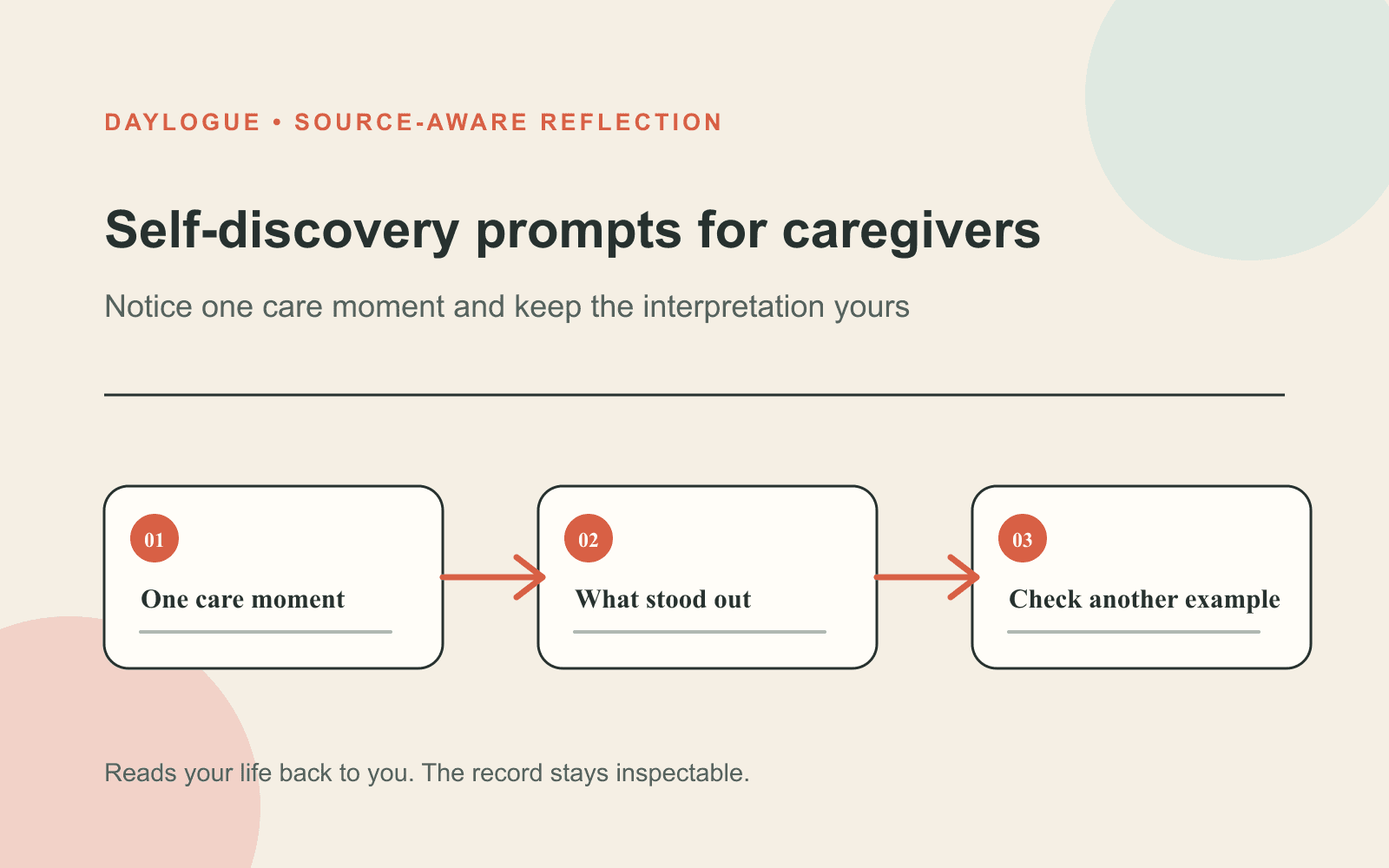
01
Select a dated choice
Pick one decision or transition that can be described without summarizing your whole identity.
02
Name context and values
Record what was available, what mattered, and which competing needs were present at that time.
03
Check another example
Find a contrasting moment before keeping broad language about who you are or what you always do.
Framework
The context, choice, and counterexample framework
A three-part way for parents and caregivers to explore identity through dated choices without turning one moment into a fixed label.
- Context: what was happening and what options were available?
- Choice: what did you do and what mattered in that decision?
- Constraint: what limited the available choices?
- Counterexample: when did a similar situation unfold differently?
- Revision: what wording now fits both scenes?
Common questions
What makes a self-discovery prompt useful for caregivers?
It begins with a specific choice or transition, asks an open question, and leaves room for another example to change the first interpretation.
Should I use these prompts to define my personality?
No. Use them to examine moments, roles, values, and context. One entry should not become a permanent label or person score.
How can I reflect on identity beyond caregiving?
Include moments from work, friendship, rest, interests, and private time. Compare contexts without ranking which role is the most authentic.
Can an AI journal tell me who I am?
It can organize what you shared and suggest wording, but it lacks unrecorded context and should not decide your identity or issue a verdict.
Sources
Sources were checked on the dates shown. Product details and policies can change.
- Daylogue evidence and methods · Daylogue · checked August 28, 2026
- Daylogue privacy policy · Daylogue · checked August 28, 2026
Keep exploring
Daylogue Knowledge Center
Browse practical guides for reflection, journaling, patterns, and privacy.
Read moreHow Daylogue shows patterns
See how candidate patterns stay connected to evidence and correction.
Read moreWhy Daylogue exists
Read the principles behind a system for self-understanding.
Read moreDaylogue is not therapy and is not a replacement for professional care.