Written by Daylogue Editorial Team. Published August 14, 2026. Reviewed and updated August 14, 2026.
The best self-discovery journal prompts for people who prefer private writing begin with a specific moment and let you control the level of detail. Ask what you chose, what you avoided, what held your attention, or what felt worth protecting. Use initials, broad descriptions, or no names at all. Separate what happened from your interpretation, and keep more than one explanation open. Privacy is part of the method, not a reason to make your reflection vague.
Start with a moment, not a verdict about yourself
A question such as "Who am I really?" asks for a conclusion before you have gathered the details. Begin with an ordinary scene instead. What choice took longer than expected? When did you feel less edited? Which task kept your attention after you meant to stop? A concrete moment gives you something you can describe without turning one day into a permanent statement about your character.
Write the event first, then add a possible meaning on a separate line. "I declined the extra project" is an event. "I may be protecting time for work I care about" is one interpretation. Another could be that you were tired or unsure about the request. Keeping those layers apart makes the entry more honest and gives a later entry permission to change the story.
| Broad question | Private prompt | Detail you can omit |
|---|---|---|
| What do I value? | Which choice felt worth the effort today? | Names and exact locations |
| What am I good at? | What did I handle with less friction this time? | Employer or school details |
| Where do I belong? | Where did I explain myself less? | Relationship labels |
| What do I want? | Which option kept returning to my attention? | The full decision history |
| What are my limits? | What agreement felt heavier after I made it? | The other person's words |
Choose the smallest useful level of detail
Private writing does not require a complete transcript of your life. Replace a name with "someone at work," a location with "the usual place," or a quoted message with your own summary of what mattered. Keep the detail that helps you recognize the situation later. Leave out the detail that only increases exposure. The entry can still be precise about your choice, attention, or reaction.
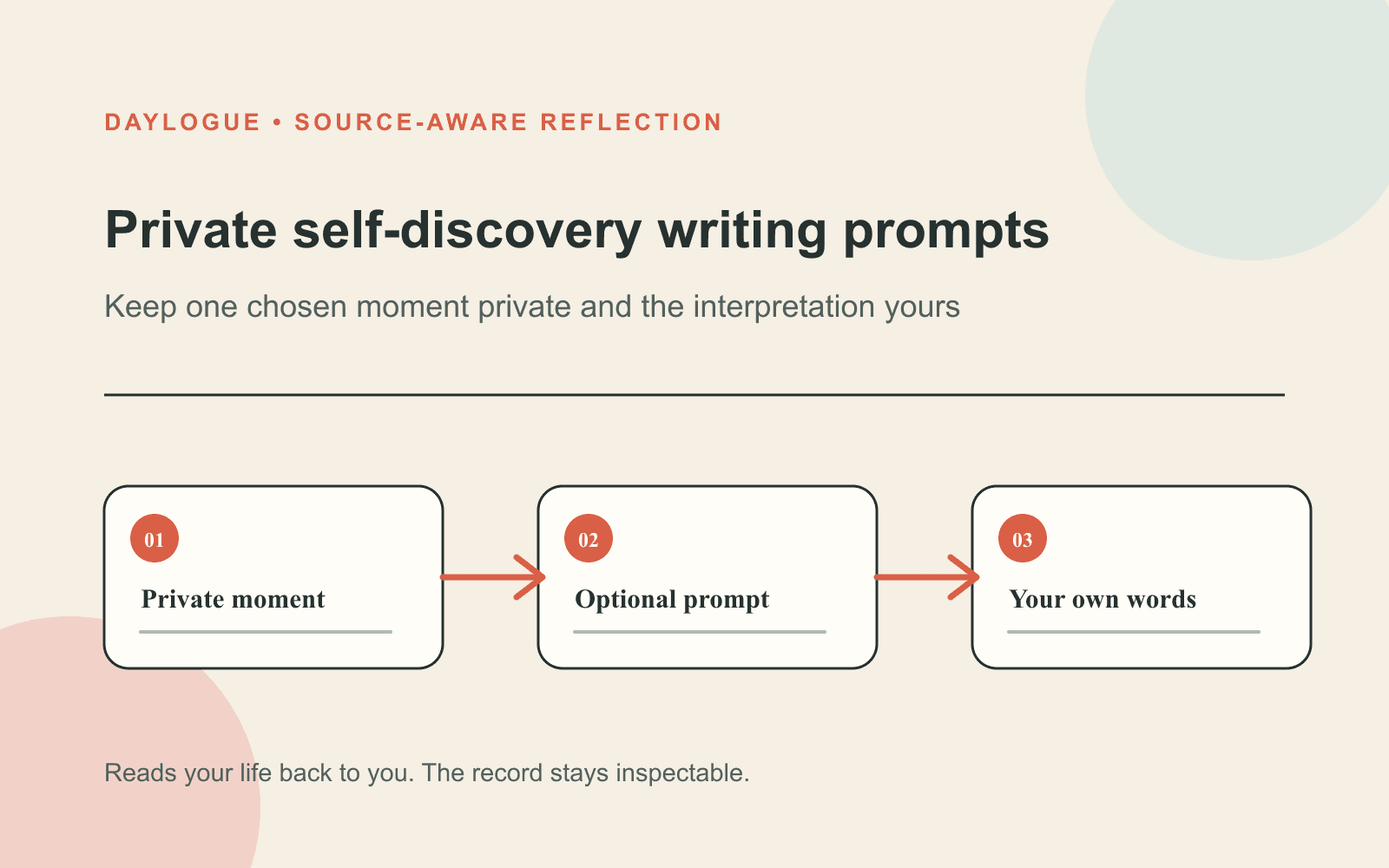
Try writing in three layers. The first line names the situation broadly. The second records what you did or noticed. The third asks what you are not sure about yet. For example: "A familiar request came up. I agreed before checking my schedule. I am not sure whether I wanted to help or wanted to avoid disappointing someone." The reflection remains useful without identifying anyone else.
01
Name the scene broadly
Use a role-free phrase such as a conversation, a request, or a familiar place.
02
Keep your action
Record what you chose, delayed, protected, or changed because that is the part you can examine.
03
Leave one question open
End with what remains uncertain instead of forcing a neat explanation from one entry.
Ask what you protected when two things competed
Values often show up in tradeoffs, not in impressive words. Ask what you made room for when time was tight. What did you refuse to rush? Which promise mattered even though nobody would have known if you changed it? What bothered you because it crossed a line you care about? These prompts stay grounded in choices and avoid asking you to produce a polished list of virtues.
Include conflicts. You can want independence and still appreciate help. You can care about achievement and resent how much room it takes. Write both sides in the same entry. A private page is allowed to hold tension without resolving it. When a similar choice appears later, compare the conditions rather than deciding that one side was the real you and the other was a mistake.
- What did I make time for even though the day was crowded?
- Which decision would I make again if nobody noticed?
- What did I protect when two priorities competed?
- Which rule felt useful, and which felt borrowed?
- What kind of effort felt worth repeating?
Follow attention before you explain it
Attention can give you a clean starting point because it describes what happened without demanding an emotion label. Ask when time moved quickly, when you kept checking the clock, what pulled you away, or which part of a task you returned to voluntarily. Add the setting and time of day if they matter. Watch for one distracted afternoon expanding into a large conclusion about your abilities or direction.
Exceptions make the prompt stronger. If a group setting usually feels tiring but one gathering did not, what was different about the role, pace, topic, or length? If quiet usually helps but one silent morning felt restless, keep that too. Self-discovery becomes more accurate when the journal can hold both the recurring situation and the moment that did not fit it.
- When did I lose track of time today?
- What kept pulling my attention away?
- Which part of the task did I return to without prompting?
- Where did I feel less edited or watched?
- What was different in the exception?
Write about relationships without writing someone else's story
Keep the focus on what you observed in yourself. Ask when you agreed too quickly, when a conversation left you clearer, what kind of request was easy to make, or where you used fewer explanations. Avoid deciding what another person intended. Their motive is not available from your page, and a detailed guess can crowd out the part you actually know: what happened and what you chose next.
A useful relationship entry can be almost anonymous. "I changed the subject when the conversation reached a topic I care about" may be enough. You can explore what you wanted to protect without naming the person, copying their words, or defining the relationship. If the context later matters, add it then. Maximum disclosure is not the price of an honest reflection.
Review repeated choices without boxing yourself in
After several entries, underline recurring verbs and situations. Maybe "explain," "delay," or "protect" appears more than once. Maybe you keep noting rushed mornings or quieter conversations. Turn each repetition into a question. Where else did it appear? Which similar moment felt different? What information is missing? Repetition can help direct your attention, but it does not define your personality.
Daylogue states that a recurring overlap does not show that one thing caused another. That limit applies to manual review too. If late meetings and low energy appear together in a few entries, record the overlap and inspect the exceptions. Notice when an overlap starts reading like a cause, forecast, or rule. Your journal can make the next question more specific while leaving the meaning with you.
Check digital privacy before writing the sensitive version
A private-feeling screen is not the same as a private storage model. Before putting identifying details into a journal service, read what the company stores in readable form, what its servers process, who its providers are, and how deletion works. Check whether entries appear in notifications or shared summaries. Decide what level of disclosure fits those terms, then use broad wording where a name or location adds no reflective value.
Daylogue says journal entries and check-in notes are stored on its servers in readable form, protected in transit by TLS and per-user database access controls. Daylogue is not end-to-end encrypted. It reads entries to write narratives and surface patterns. Its privacy policy also says it does not sell personal data, use entries for advertising, or train models on personal entries. Read the current policy yourself before choosing what to record.
Build a private practice that can survive a gap
Choose a short menu instead of a schedule. One day you might ask what felt worth protecting. Another day you might note where your attention changed. On a fuller day, compare a current choice with an earlier one. On a day when writing feels too exposed, record only the question. A practice stays yours when the amount and timing can change without turning the gap into a failure.
The aim is a record you trust enough to revisit. End each entry with one of three lines: "I noticed," "I may be reading this as," or "I am not sure yet." Those openings separate observation, interpretation, and uncertainty. Over time, the pages can show how your questions changed. They do not need to deliver one final description of who you are.
Prompt Pack
Private self-discovery prompt pack
Use these prompts to examine real choices and recurring situations while keeping names, places, and other identifying details optional.
- Which choice felt worth the effort today?
- What did I protect when two priorities competed?
- Where did I explain myself less?
- What kept returning to my attention?
- Which agreement felt heavier after I made it?
- What happened in a similar situation that felt different?
- What is one explanation, and what is another?
- What detail can I leave out without losing the point?
Common questions
Can self-discovery journaling work without names or exact details?
Yes. Keep the part that supports reflection, such as your choice, attention, or response. Use broad descriptions for people and places when exact details do not change the question you are exploring.
What is a good first private self-discovery prompt?
Try, "Which choice felt worth the effort today?" It begins with a real moment, avoids asking for a fixed identity statement, and can be answered without naming anyone else.
How do I keep a journal entry from becoming a verdict?
Write what happened before what you think it means. Add a second possible explanation and one exception. This keeps the entry open to new context rather than turning one moment into a permanent rule.
What should I check before using a digital journal for private writing?
Read what is stored in readable form, what is processed by providers, whether the service is end-to-end encrypted, and how deletion, export, notifications, advertising, and model training work.
How often should I review private self-discovery entries?
Review when you have enough entries to compare situations. There is no required schedule. Look for repeated choices and exceptions, then carry one question forward without assigning yourself a score.
Sources
Sources were checked on the dates shown. Product details and policies can change.
- Daylogue evidence and methods · Daylogue · checked August 14, 2026
- Daylogue privacy policy · Daylogue · checked August 14, 2026
Keep exploring
Daylogue Knowledge Center
Browse practical guides for reflection, journaling, patterns, and privacy.
Read moreHow Daylogue shows patterns
See how candidate patterns stay connected to evidence and correction.
Read moreWhy Daylogue exists
Read the principles behind a system for self-understanding.
Read moreDaylogue is not therapy and is not a replacement for professional care.