Written by Daylogue Editorial Team. Published August 13, 2026. Reviewed and updated August 13, 2026.
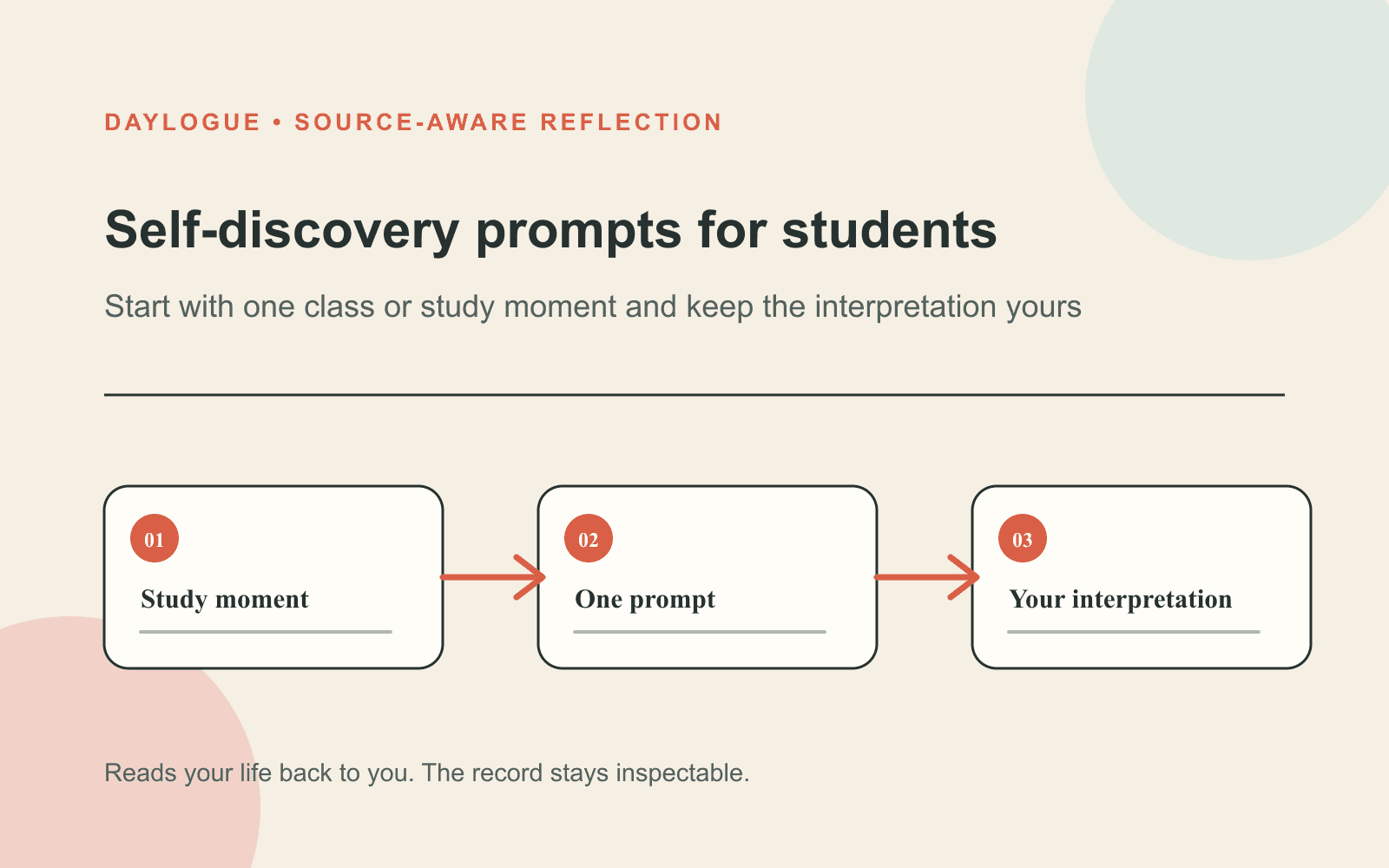
Good self-discovery journal prompts for students ask about specific choices and situations before asking for a sweeping statement about identity. Begin with a recent moment: when did you feel engaged, what did you protect, what did you change your mind about, or whose expectations shaped a decision? Write what you know, separate it from what you are guessing, and leave room for your answer to change. Self-discovery is an ongoing record, not a quiz with one final result.
Begin with evidence from your actual day
Broad questions such as "Who am I?" can produce broad answers. Start closer to the ground. Ask when you lost track of time this week, which commitment you wanted to keep, or what made you speak up when staying quiet would have been easier. These moments show how you moved through a real situation. They do not prove a permanent trait, but they give you something honest to examine.
Write the event before the interpretation. "I stayed after class to finish the conversation" is an event. "I care about understanding things fully" is one possible reading. Add another possibility if it exists. Maybe you were curious, worried about the assignment, or enjoying the conversation. Keeping observation and interpretation separate makes the page easier to revisit. Future entries can support, complicate, or replace your first explanation.
| Topic | Too broad | Try this instead |
|---|---|---|
| Values | What are my values? | Which choice this week felt worth the effort? |
| Strengths | What am I good at? | What did someone ask me to help with? |
| Belonging | Where do I fit? | Where did I edit myself less? |
| Direction | What should I do with my life? | Which next step feels worth testing? |
| Boundaries | What are my limits? | What did I agree to and later resent? |
Prompts that reveal what you protect
Values often become visible through tradeoffs. Ask: What did I make time for even when the week was crowded? What bothered me because it crossed a line I care about? When did I feel proud of how I handled something? Which decision would I make again even if nobody noticed? These questions focus on action instead of asking you to choose impressive words from a list.
Look for tension too. You may value independence and still want help. You may care about achievement and resent how much space it takes. Write both sides without forcing them into a tidy answer. A student schedule contains competing demands, so your entries may show values colliding rather than lining up. That does not make the reflection inconsistent. It shows the real decision you were trying to make.
- What did I defend when it would have been easier to let it go?
- What did I spend time on without needing recognition?
- Which rule feels useful to me, and which feels borrowed?
- What kind of effort feels worth repeating?
- When did I choose honesty over convenience?
Prompts about energy, attention, and environment
Your attention can offer clues about fit. Ask where you felt absorbed, restless, rushed, or checked out. Note what the setting was like, who was present, what the task required, and what happened before the change. Avoid jumping from "I was bored in one lecture" to "I chose the wrong major." One entry captures one day. Repeated notes across different days give you a better reason to ask a larger question.
Pay attention to exceptions. If group work usually drains you but one project did not, what was different about the instructions, people, timing, or role? Exceptions keep reflection from turning into a list of fixed rules. They can show which conditions matter and which first explanation was too simple. The goal is not to predict yourself perfectly. It is to notice enough detail that your next choice has more context.
01
Locate the change
Choose one moment when your focus or energy noticeably shifted during the day.
02
Describe the setting
Record the task, timing, people, and expectations without deciding which detail caused the change.
03
Find an exception
Ask when a similar situation felt different and what changed around it.
04
Choose a small test
Name one low-stakes adjustment you could try, then observe rather than demand a result.
Notice who you are around other people
Relationships change what becomes easy to say, ask, or admit. Try: Around whom do I explain myself the least? Which conversation left me clearer? When did I agree too quickly? What kind of support is easy for me to receive, and what kind is awkward? Focus on your experience and choices. A journal cannot tell you what another person intended, and guessing at their motives usually takes you farther from what you actually know.
Use broad descriptions when privacy matters. "Someone in my program" may be enough. You can record a boundary without copying a private conversation word for word. If a prompt concerns family, friendship, dating, or identity, decide whether the device and service are private enough before adding details. Self-discovery does not require maximum disclosure. Sometimes the truest entry is also the shortest one you feel safe keeping.
Ask about change without demanding a five-year plan
School makes the future feel close and enormous at the same time. Replace "What should I do with my life?" with a question you can test: What kind of problem do I want to spend another hour on? Which responsibility would I like to try before committing? What information would make this decision less foggy? Who has direct experience I could ask? A small experiment can teach you more than a perfect-sounding declaration.
Record what you expect before the experiment, then what actually happened. Maybe you attend one club meeting, take an office-hours conversation, shadow a task, or protect one evening from obligations. The journal holds both versions. If the result surprises you, resist editing the earlier entry to make yourself look consistent. The gap between expectation and experience is often the part worth keeping.
- What am I curious enough to try once?
- What information am I missing from this decision?
- Which option feels attractive mainly because someone expects it?
- What would make the next step smaller and reversible?
- What did the experience teach me that planning could not?
Review your pages without boxing yourself in
When you reread, mark recurring verbs, situations, and choices. Maybe "explaining," "building," or "organizing" appears several times. Maybe you keep writing about quiet mornings or last-minute plans. Consider these repetitions questions. Ask what else was true on those days and where the pattern did not appear. Avoid turning a handful of entries into "I am the kind of person who always..." Your context can change, and so can you.
Use a journal tool that leaves interpretation with you
A digital journal can help you search old entries or notice repeated words, but it should not hand down a verdict about your personality. Look for tools that show where an observation came from, allow corrections, and explain how your data is handled. Be cautious when software claims to know your motives, predict your future, or identify an emotion from your face, voice tone, or body. Your own words and choices should remain the source.
Daylogue does not run emotion recognition on your face or on the tone of your voice. It works from what you choose to share. Most entries and generated summaries remain readable on its servers because those systems write narratives and surface patterns, and Daylogue is not end-to-end encrypted. Read those details before using it for private reflection. Whatever tool you choose, let it preserve your questions rather than replace them with answers. Daylogue is not therapy and is not a replacement for professional care.
Worksheet
Observation before interpretation worksheet
Use one real moment to explore a possible value, preference, or need while keeping uncertainty visible.
- What happened, in one sentence?
- What did I choose or avoid?
- What did I notice in my attention or energy?
- What is one possible explanation?
- What is another possible explanation?
- What detail does not fit my first story?
- When has a similar situation felt different?
- What small question do I want to carry forward?
Common questions
What is a good first self-discovery prompt for students?
Try "Which choice this week felt worth the effort?" It starts with a real event, then gives you room to explore what mattered without demanding a permanent label.
How do I answer when a prompt feels too broad?
Shrink the time frame and name a situation. Replace "What do I want?" with "What did I want during yesterday's decision?" Specific moments are easier to describe and revisit.
Can self-discovery journal answers change over time?
Yes. Keep the earlier answer instead of correcting it. The change may show new context, a new priority, or simply a different day. None of those requires a fixed conclusion.
Should an app tell me what my entries mean?
An app can organize what you shared and point to recurring details, but you decide what those details mean. Prefer observations you can inspect over labels or person-level scores.
How often should I review self-discovery entries?
Review after enough entries exist to compare situations, perhaps every few weeks. Look for repetitions and exceptions. There is no need to review on a fixed schedule or maintain a streak.
Sources
Sources were checked on the dates shown. Product details and policies can change.
- Daylogue evidence and methods · Daylogue · checked August 13, 2026
- Daylogue privacy policy · Daylogue · checked August 13, 2026
- Positive expressive writing systematic review · PLOS One · checked August 13, 2026
- Narrative identity and psychological well-being research · Frontiers in Psychology · checked August 13, 2026
Keep exploring
Daylogue Knowledge Center
Browse practical guides for reflection, journaling, patterns, and privacy.
Read moreHow Daylogue shows patterns
See how candidate patterns stay connected to evidence and correction.
Read moreWhy Daylogue exists
Read the principles behind a system for self-understanding.
Read moreDaylogue is not therapy and is not a replacement for professional care.