Written by Daylogue Editorial Team. Published August 8, 2026. Reviewed and updated August 8, 2026.
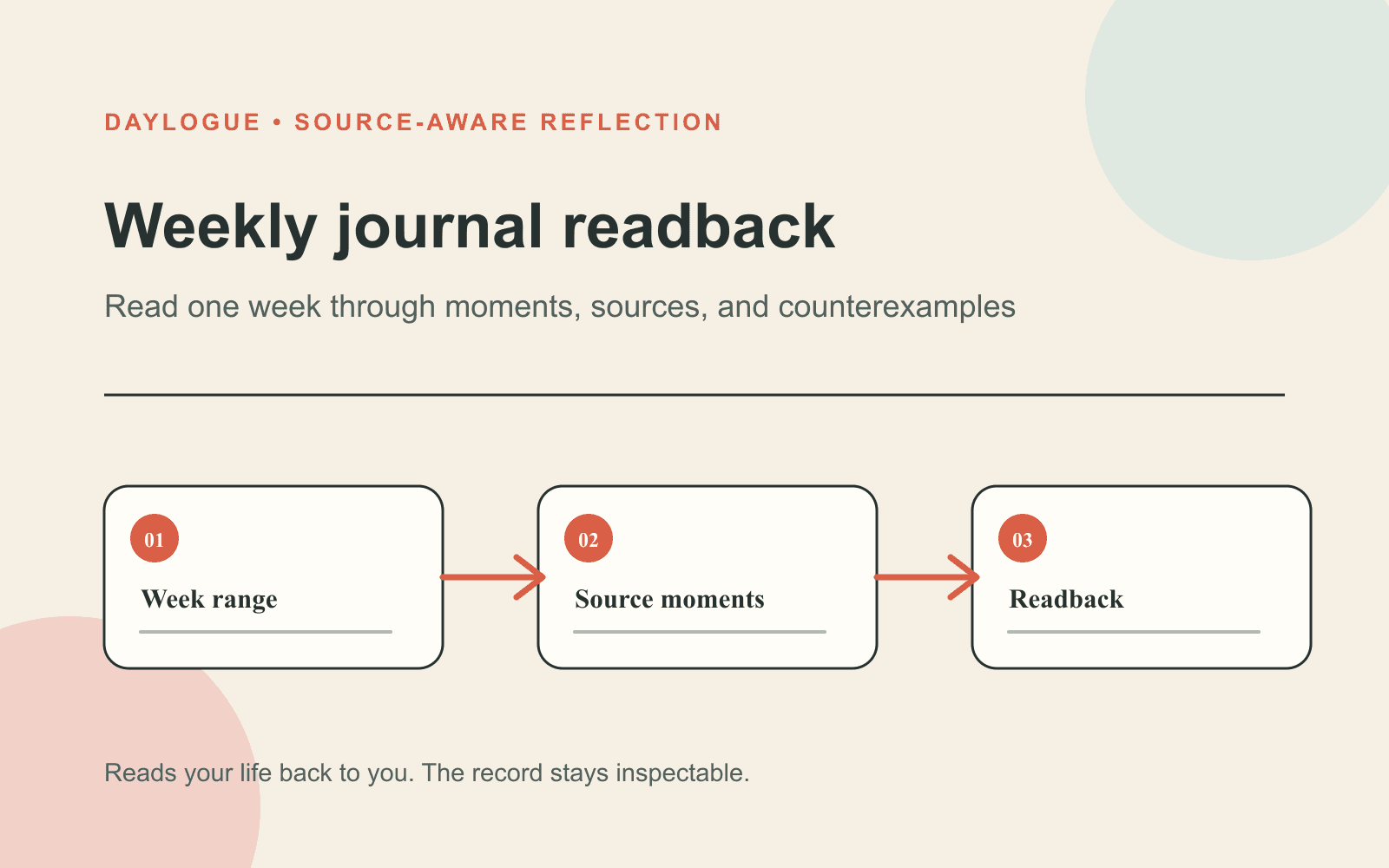
A weekly journal readback is a short review of the entries you already made. Read the week once for events, once for repeated language, and once for exceptions. Then write a three-part note: what seems to repeat, which entries support it, and which entries complicate it. Keep the result as a question to carry forward, not a verdict about who you are.
A readback is a second look, not a score
A journal entry captures one angle on one moment. A weekly readback places seven days of those moments beside each other. The point is not to decide whether the week was good or bad. It is to notice where your memory has compressed five different days into one general feeling. Monday may have been tense, Tuesday ordinary, and Thursday unexpectedly light. Reading the entries in order gives each day its shape again. For broader review basics, start with Daylogue's How to Review Journal Entries guide at /learn/how-to-review-journal-entries. The seven-day, three-pass method below is a narrower way to read one week.
That distinction matters because a strong ending can repaint everything that came before it. A difficult Friday can make the whole week feel difficult. A good Sunday can soften a conflict you wrote about on Wednesday. The record does not overrule your memory, but it gives memory something concrete to answer to. Daylogue is a system for self-understanding. Pattern journaling is how it reads you. Its Evidence & Methods page also keeps observations separate from research and future questions.
Set up the week before you interpret it
Choose a fixed seven-day window and gather only what belongs inside it. Include short entries, voice check-ins, and days when you wrote almost nothing. An empty or brief day is part of the record, but it is not proof that anything changed. If you use several journals, bring the relevant entries into one view or list their dates on paper. The goal is a complete enough timeline, not a perfect archive.
Before reading, write one sentence about how the week feels in memory. Keep it plain: exhausting, scattered, calmer than expected, or hard to recall. Leave that sentence unchanged until you compare it with the entries at the end. This tiny prediction makes the exercise more honest because it shows where your first impression matched the record and where it did not. It also prevents the review from becoming a hunt for whatever story you already expected to find.
- Pick the exact start and end dates before opening an entry.
- Include short, neutral, and unfinished entries, not only dramatic ones.
- Write your remembered version of the week in one sentence.
- Keep a note area for evidence, exceptions, and open questions.
Use three passes so one detail does not take over
The first pass is factual. Mark people, places, decisions, disruptions, and recurring slots in your week. The second pass is linguistic. Circle repeated words, phrases, or themes, especially language that appears on days you did not remember as connected. The third pass looks for contrast. Find the calm entry inside a hard stretch, the stressful moment inside an easy day, or the expected pattern that failed to appear. Each pass has a separate job, which keeps interpretation from arriving too early.
Keep your marks close to the source. Instead of writing, ‘Work ruins Thursdays,’ write, ‘Three entries mention feeling rushed near the same Thursday slot.’ Then note the Thursday that did not. This gives you a candidate pattern with a visible trail. A recurring overlap does not show that one thing caused another. It simply gives you a better question for the coming week: what else was present in those moments, and does the overlap keep showing up?
01
Pass one: rebuild the timeline
Read from the earliest entry to the latest and note only concrete events, people, places, and schedule changes. Avoid explaining them yet.
02
Pass two: mark repetition
Underline words, situations, and themes that appear more than once. Record the dates beside each possible thread.
03
Pass three: find counterexamples
Look for comparable days that did not fit the emerging story. Keep those exceptions beside the supporting entries.
04
Write one provisional read
Describe the overlap, cite the entries that support it, name the exceptions, and end with a question rather than a command.
Turn an impression into an inspectable read
Use a simple evidence, exception, question structure. Evidence is the exact language or event that repeated. An exception is a comparable entry that points another way. The question is what you want to notice next, without forcing a conclusion. For example: ‘I wrote about rushing before two afternoon commitments. On Saturday I had the same time pressure and felt steady. Was preparation, company, or something else different?’ The result stays useful because another person could trace how you reached it.
This method also makes room for uncertainty. If only one entry supports the idea, label it a moment, not a pattern. If several entries use similar words but describe different situations, keep them separate. If you skipped most of the week, say the record is too thin. Missing information is not a negative result. It is simply missing. The most honest weekly readback may be, ‘I cannot tell yet, but these are the two places I would look next.’
| Part | What to record | Example |
|---|---|---|
| Evidence | Exact dates, phrases, or events that repeat | Tuesday and Thursday both mention rushing before an afternoon commitment. |
| Exception | A comparable entry that does not fit | Saturday also felt rushed, but the entry describes feeling steady. |
| Question | A neutral detail to watch next | Did preparation time or who was present change the experience? |
| Confidence | How much of the week is represented | Five entries support a tentative read, and two days have no entry. |
What writing research adds, and what it does not
Writing research offers useful context, but it does not guarantee what a weekly review will do for one person. A 2025 systematic review searched four databases and included 51 studies covering seven positive writing techniques. Results were more consistent for some measures of how participants reported feeling and less consistent for several other reported and physical outcomes. The review also rated the included studies as poor or fair quality and called for more rigorous methods. That is a reason for measured expectations, not a reason to dismiss reflection.
Research on autobiographical narrative adds another caution. A study of 395 American young adults found narrative coherence related to some measures of identity functioning, while several expected associations were only partly confirmed. More research is needed to clarify the connection between narrative coherence, identity, and how people feel. A weekly readback can help you organize your own record. It should not be sold as proof that a neat story is always better, or that every untidy week needs to be resolved. If you need source handles, edit history, and confidence labels, use the source-led weekly review at /learn/weekly-journal-review-with-sources-guides instead.
Decide what the tool may read before you begin
A weekly readback can include intimate material, so privacy deserves the same attention as the prompts. Daylogue stores journal entries and check-in notes on its servers in readable form, protected in transit by TLS and by per-user database access controls. Daylogue reads them to write narratives and surface patterns. It is not end-to-end encrypted. Read the current Daylogue privacy policy before importing old writing or including details about another person. Keep especially sensitive material outside the service if that boundary does not fit you.
Stop when the review begins to flatten the week instead of clarifying it. You do not need a lesson, a goal, or a tidy ending every Sunday. Save the evidence and the exception, then leave the question open. Next week can add information or undo the first read entirely. That is not failure. It is what an honest longitudinal record is supposed to allow: revision when the story changes.
Worksheet
Evidence, Exception, Question Weekly Sheet
Use this five-line worksheet after reading the week. It keeps a possible pattern tied to dated entries and makes uncertainty visible.
- My one-sentence memory of the week before I reread it:
- The repeated words, events, or situations I found, with dates:
- The strongest entry that supports this possible pattern:
- The comparable entry that does not fit, or the information that is missing:
- The neutral question I want to carry into next week:
Common questions
How long should a weekly journal readback take?
Start with 15 to 20 minutes. Spend one quick pass on events, one on repeated language, and one on exceptions. Stop after writing a single provisional read. More time does not automatically make the conclusion more accurate.
What if I only wrote on two days?
Review the two entries as moments, not as a complete account of the week. You can still note what stands out, but label the record as thin and avoid turning two examples into a stable pattern.
Should I review only negative entries?
No. Include neutral, easy, brief, and unfinished entries. A readback becomes more trustworthy when it includes the ordinary days and the counterexamples that complicate your strongest first impression.
Can software decide what my weekly pattern means?
Software can surface repeated language or overlapping signals from what you choose to share. You decide whether a candidate pattern fits, needs more context, or should be rejected. Keep the original entries available for inspection.
Do I need to complete a readback every week?
No. A missed review does not erase the record or create a debt. Return when the practice feels useful. There are no streaks to protect and no score that gets worse when you skip.
Sources
Sources were checked on the dates shown. Product details and policies can change.
- Daylogue evidence and methods · Daylogue · checked August 8, 2026
- Daylogue privacy policy · Daylogue · checked August 8, 2026
- Positive expressive writing systematic review · PLOS One · checked August 8, 2026
- Narrative identity and psychological well-being research · Frontiers in Psychology via PubMed Central · checked August 8, 2026
Keep exploring
Daylogue Knowledge Center
Browse practical guides for reflection, journaling, patterns, and privacy.
Read moreHow Daylogue shows patterns
See how candidate patterns stay connected to evidence and correction.
Read moreWhy Daylogue exists
Read the principles behind a system for self-understanding.
Read moreDaylogue is not therapy and is not a replacement for professional care.