Written by Daylogue Editorial Team. Published August 26, 2026. Reviewed and updated August 26, 2026.
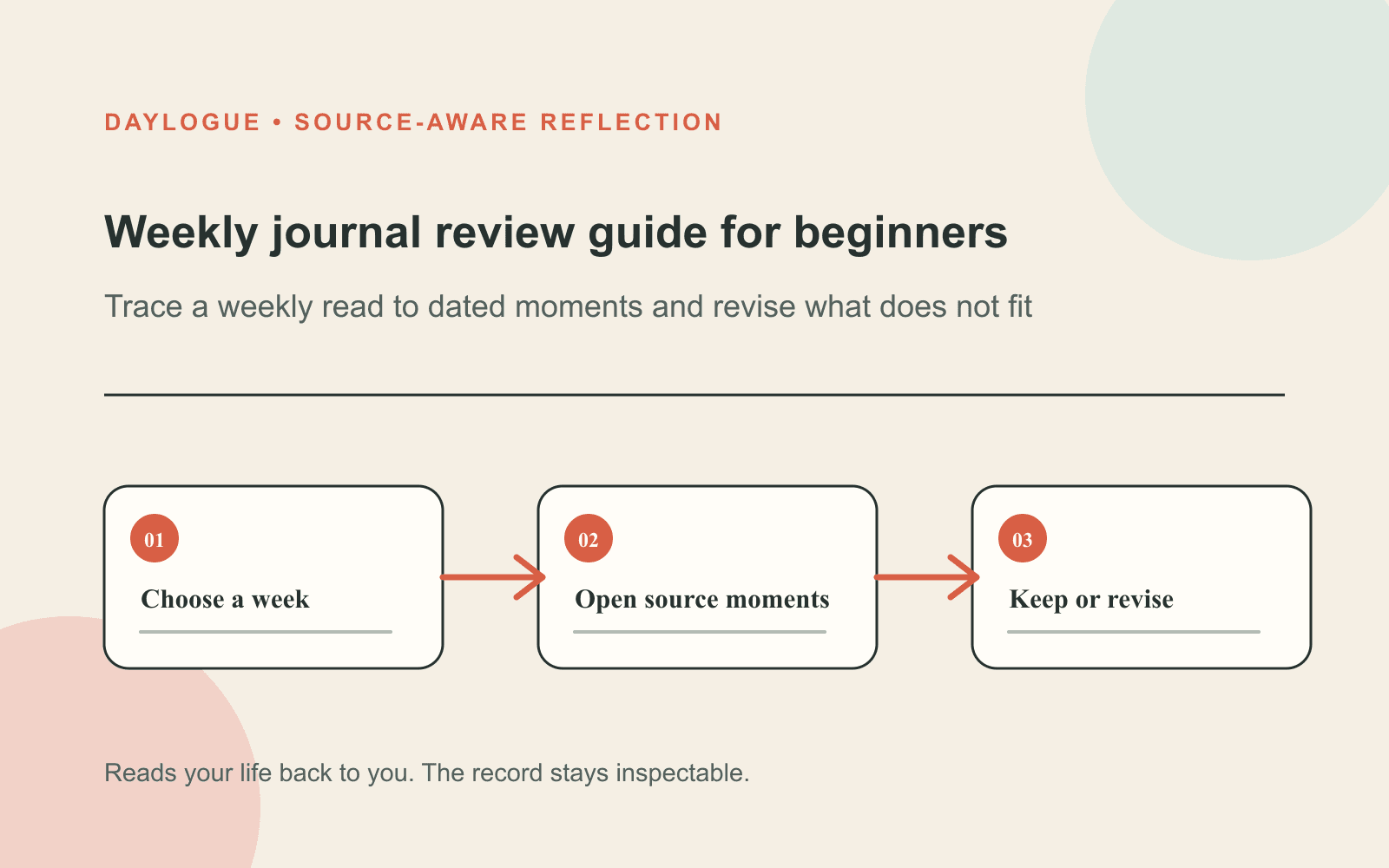
A weekly journal review is a short reread of entries from the past seven days. Begin with the dates and scenes you actually recorded. Mark what repeated, what changed, and what did not fit your first impression. Leave missed days blank. Then write one cautious summary and one question for the next week. The goal is not to grade yourself or force a lesson. It is to see the week with more context than memory alone can hold.
Know what a weekly journal review is
A weekly review is a reread, not a new autobiography. You gather the entries you made during one clearly named week and look for scenes, decisions, words, and questions that deserve another look. The fixed window matters because it keeps last Tuesday from blending into the month before it.
A useful review stays close to what you recorded. It can say that three entries mentioned a delayed handoff. It cannot know that handoffs always cause stress, that a person intended harm, or that one difficult week reveals a permanent trait.
Collect the week without filling its gaps
Put the week's dated entries in order. Include short notes, voice transcripts you chose to save, and longer entries only when they belong to the same review window. If Monday or Thursday is empty, keep it empty. A missing entry means you do not have a record for that day, not that the day was good, bad, forgettable, or failed.
Read each entry once before highlighting anything. The first pass restores sequence. A complaint written before a problem was resolved can sound different when you remember what happened later, but the earlier wording still belongs in the record.
Use a four-pass weekly review
Four small passes are easier to inspect than one sweeping summary. Begin with facts and direct wording. Then compare repetitions, exceptions, and unanswered questions. Each pass should leave a visible trail back to the entry that prompted it.
01
Mark concrete scenes
Underline decisions, conversations, interruptions, places, and changes that can be tied to a dated entry.
02
Circle repeated details
Notice words or situations that appear more than once without assuming the repetition has one cause.
03
Find what did not fit
Look for a comparable day that went differently or an entry that complicates the emerging story.
04
Write one open question
End with something you can observe next week, not a rule, diagnosis, promise, or verdict about yourself.
Keep a repeat separate from an explanation
Suppose low-energy entries appear beside late meetings twice. That is a recurring overlap in your record. It does not prove the meetings caused low energy, and it does not say what happened on days you did not write. A fair summary names the timeframe, the recorded scenes, and the uncertainty.
Try: 'Late meetings appeared beside low-energy notes twice this week. I want to compare planned and unplanned late meetings next week.' That sentence is narrower than 'Late meetings drain me,' but it gives you a specific question you can revisit.
Read the lines around the detail you marked
A repeated word can look important after you highlight it, but the sentences around it may change the picture. If 'rushed' appears three times, read what happened immediately before and after each use. One entry may describe leaving late. Another may describe unclear instructions. A third may refer to moving too quickly through a good conversation. The shared word creates a place to look, not a single explanation.
Keep the writer's original language visible when you make a summary. A later label such as 'time pressure' may be convenient, but it can flatten several different scenes. Copy one short phrase from each relevant entry into your review notes, add the date, and then describe the narrow common detail. If your summary no longer fits the source wording, revise the summary instead of forcing the entries to match it.
Context also includes what the entry could not know yet. A note written before a reply arrived may contain uncertainty that disappeared by Friday. Preserve that sequence. The goal is not to correct your earlier self with hindsight. It is to understand what information, options, and expectations were present at each point in the week.
Compare moments that are similar enough to teach you something
A useful comparison needs a shared feature. Compare two morning commutes, two project handoffs, or two evenings with the same recurring obligation before comparing unrelated difficult moments. Then note the differences you actually recorded, such as preparation time, who was present, a changed deadline, or whether the plan was expected. Leave unrecorded details unknown rather than adding them from memory to make the story cleaner.
Small comparison groups require modest language. Two matching entries can suggest a question. They do not establish a dependable rule. Five entries can still mislead when every one came from the same unusual week. Name the window and the available examples in the summary so a future review can tell whether the observation keeps showing up, narrows to one setting, or disappears.
The comparison can end with 'not enough information.' That is a valid result. You may discover that the entries used different words, that missing days cover the moments you most wanted to compare, or that an exception matters more than the repetition. A review that protects uncertainty gives the next week a clearer recording task.
Turn your notes into an inspectable summary
A compact table can keep the review grounded. Fill it only with details present in your entries. If a column has no evidence, write 'not recorded' instead of guessing.
| Review question | What to record | What to avoid |
|---|---|---|
| What repeated? | A detail and its entry dates | Always or never language |
| What changed? | A sequence visible in the record | A hidden-motive explanation |
| What did not fit? | A comparable exception | Discarding the exception |
| What stays open? | One question for next week | A person score or verdict |
Use writing research with restraint
The assigned systematic review found positive writing studies varied in topic, protocol, comparison group, and outcomes, and rated included studies as poor or fair in quality. That does not prove a weekly journal review will produce a health or wellbeing outcome.
The assigned narrative study examined coherence through context, chronology, and theme, while reporting a more complex relationship with wellbeing than a simple promise would suggest. For a beginner, the useful editorial lesson is modest: preserve when and where something happened, the order of events, and the interpretation you held at the time.
Review the privacy boundary before combining entries
A week of entries can reveal more than any single note. Remove names and restricted work, school, financial, health, or family details that do not need to be in a synced journal. Combining records can make relationships visible, so choose the smallest amount of context that still serves your question.
Daylogue reads the entries you choose to sync to create narratives and surface patterns. Entries are not end-to-end encrypted. Daylogue does not infer emotion from faces, voice tone, or physiology. It works from the words and context people choose to share. Daylogue is not therapy and is not a replacement for professional care.
Finish with one sentence and one question
Write a summary that a future version of you can challenge: 'This week, rushed mornings appeared in three entries, while the one prepared morning felt less scattered.' Then add the question: 'What changed on the prepared morning?' Stop there. A weekly review earns its place when it makes the next observation clearer, not when it closes every story.
Worksheet
Seven-day journal review sheet
A beginner worksheet for reading dated entries, marking repeated details, keeping gaps visible, and writing one open question.
- List the dates that contain entries
- Mark one concrete scene in each entry
- Circle details that repeat
- Find one comparable exception
- Leave missing days blank
- Write one cautious summary
- End with one question for next week
Common questions
How often should a beginner review journal entries?
Once a week is a simple starting rhythm because the window is short enough to remember and long enough to contain several moments. Skip a review when you need to and return without backfilling.
What if I only wrote once during the week?
Review that one entry as a single scene. Note what happened, what remains uncertain, and what you may want to remember. One entry remains a single scene. The missing days stay unknown.
How do I find patterns without overthinking?
Name the repeated detail, cite the dates, look for a comparable exception, and use cautious wording. Keep the result as a question until more entries support or complicate it.
Should a weekly journal review include a score?
It does not need one. A short summary tied to source entries usually preserves more context than a single score. Avoid turning a complicated week into a grade or person verdict.
Can a weekly journal review replace professional care?
No. It is a personal reflection practice for reviewing your own record. It does not diagnose or replace professional care, and urgent needs take priority over journaling.
Sources
Sources were checked on the dates shown. Product details and policies can change.
- Daylogue evidence and methods · Daylogue · checked August 26, 2026
- Daylogue privacy policy · Daylogue · checked August 26, 2026
- Positive expressive writing systematic review · PLOS One · checked August 26, 2026
- Narrative identity and psychological well-being research · Frontiers in Psychology · checked August 26, 2026
Keep exploring
Daylogue Knowledge Center
Browse practical guides for reflection, journaling, patterns, and privacy.
Read moreHow Daylogue shows patterns
See how candidate patterns stay connected to evidence and correction.
Read moreWhy Daylogue exists
Read the principles behind a system for self-understanding.
Read moreDaylogue is not therapy and is not a replacement for professional care.