Written by Daylogue Editorial Team. Published August 28, 2026. Reviewed and updated August 28, 2026.
A weekly journal review for a parent or caregiver does not require rereading every entry. Mark the days you recorded, select two or three moments that answer a real question, and note any missing days. Compare repeated contexts with at least one exception. Write a short recap that links back to its sources and avoids a score, cause claim, or verdict about how well you handled the week. Keep any count attached to the number of saved examples, and end with no more than one optional question for the next review. If the record is too thin, say so directly instead of widening the conclusion. That honest limit gives a future review a clearer starting point and protects unrecorded days from being turned into evidence. The source map can stay useful even when no weekly theme emerges.
Choose the review question before opening every entry
A weekly review becomes exhausting when it tries to summarize everything. Begin with one question: Which transitions demanded the most planning? Where did help change the day? Which responsibility repeatedly moved? What did I protect? The question determines which entries matter and gives you permission to ignore unrelated material for this pass.
Keep the question neutral enough to be wrong. “Why was this week a failure?” guarantees a verdict. “Which plans changed after they were set?” can produce several kinds of answer, including none. A narrow question also helps separate a personal record from a performance review. The week does not need a grade or a single theme.
Map recorded days and visible gaps
Draw seven small boxes or list the dates. Mark which days contain an entry, voice transcript, or check-in you chose to save. Leave empty days empty unless reconstruction is the explicit task and you can label it as later recall. A gap may reflect privacy, fatigue, a busy day, or a simple choice not to write. It does not describe what happened.
Next, label the type of each recorded moment: care handoff, work collision, household transition, personal time, relationship exchange, or another category that fits. This first pass shows the shape of the evidence before interpretation begins. A week with two entries supports a two-entry recap, not a seven-day conclusion.
| Date | Recorded moment | Context | Status |
|---|---|---|---|
| Monday | Pickup plan changed | Care and work | Source entry |
| Wednesday | Quiet walk after dinner | Personal time | Source entry |
| Thursday | No entry saved | Unknown | Visible gap |
| Saturday | Sibling handled appointment notes | Care handoff | Source entry |
Select representative moments instead of the most dramatic ones
Choose two or three source moments that relate directly to the review question. Include a quieter example when it changes the picture. If two hard transitions dominate the week, look for a transition that went smoothly and record what was different. The exception does not cancel the difficult entries. It prevents the recap from presenting intensity as frequency.
Use dates or clear labels in the recap so you can reopen the source. Paraphrase carefully and avoid adding certainty that was absent in the entry. If Tuesday said “maybe the short notice mattered,” the weekly version should not become “short notice caused the problem.” Keep the original level of confidence or narrow it further.
Inspect a possible repeat with a counterexample
Suppose Monday and Friday both describe rushed care handoffs after work calls ran late. That is a candidate overlap. Now inspect Wednesday, when a handoff happened after a call but did not feel rushed. What differed: notice, location, help, the length of the call, or something not recorded? Keep the different day beside the repeated ones.
Daylogue states that a recurring overlap does not show that one thing caused another. A weekly review can say that two recorded handoffs shared a context. It should not claim the context produced the outcome. This distinction keeps a readback useful for reflection while respecting missing information and the limits of a small personal sample.
Write a recap with sources, limits, and an open next question
A strong recap can be four lines. Line one states the week range and review question. Line two names the source moments. Line three describes the narrow overlap or contrast. Line four states the limit and one question for next week. Example: “In the three recorded handoffs, late notice appeared in two. Wednesday differed because the plan was confirmed early. Other days were not recorded. Next week I will note when confirmation arrives.”
Avoid composite scores such as “caregiver week: 62” or labels such as good, bad, balanced, and failed. Numbers may look precise while hiding context. If you count events, keep the denominator visible: “two of three recorded handoffs,” not “most handoffs.” The recap should make correction easy rather than sound final.
Require a digital readback to show its receipts
A journal tool can save time by grouping entries and locating phrases, but every summary should remain traceable to the material you chose to share. Daylogue does not infer emotion from faces, voice tone, or physiology. It works from the words and context people choose to share. It cannot know what happened on missing days or understand private context that never entered the record.
Daylogue does not use personal entries to train its own models. Provider handling follows current written terms, configuration, and subprocessor disclosures. Daylogue reads the entries you choose to sync to create narratives and surface patterns. Entries are not end-to-end encrypted. Review identifying details before asking a tool to summarize a week that includes other people or workplaces.
Use a ten-minute review when the week is crowded
For the first two minutes, mark recorded dates and gaps. Spend the next three choosing one question and two relevant moments. Use two more minutes to find an exception or a day with different conditions. Draft a four-line recap in the next two minutes, then use the final minute to reopen each source and remove any wording that outruns it. The time box is a stopping aid, not a speed target.
If the source check reveals that the question cannot be answered, record that outcome directly. “Only two relevant moments were saved this week” is a valid weekly readback. Let the unanswered question stand instead of broadening the search simply to produce a conclusion. A review that preserves uncertainty may be more useful next month because it shows exactly which evidence existed.
End the review without assigning homework to every day
Choose at most one observation to watch or one practical question to carry forward. Carry forward only the detail that serves that question. If the week revealed that confirmation timing may matter, note confirmation time only when it is easy and relevant. The next review can decide whether the added detail helped. Stopping protects the practice from expanding into another care responsibility.
Daylogue is not therapy and is not a replacement for professional care. A weekly readback organizes a personal record; it does not evaluate safety, care quality, medical needs, family fitness, or job performance. Use appropriate support for those decisions. The journal review is complete when its sources, exceptions, limits, and one optional next question are clear.
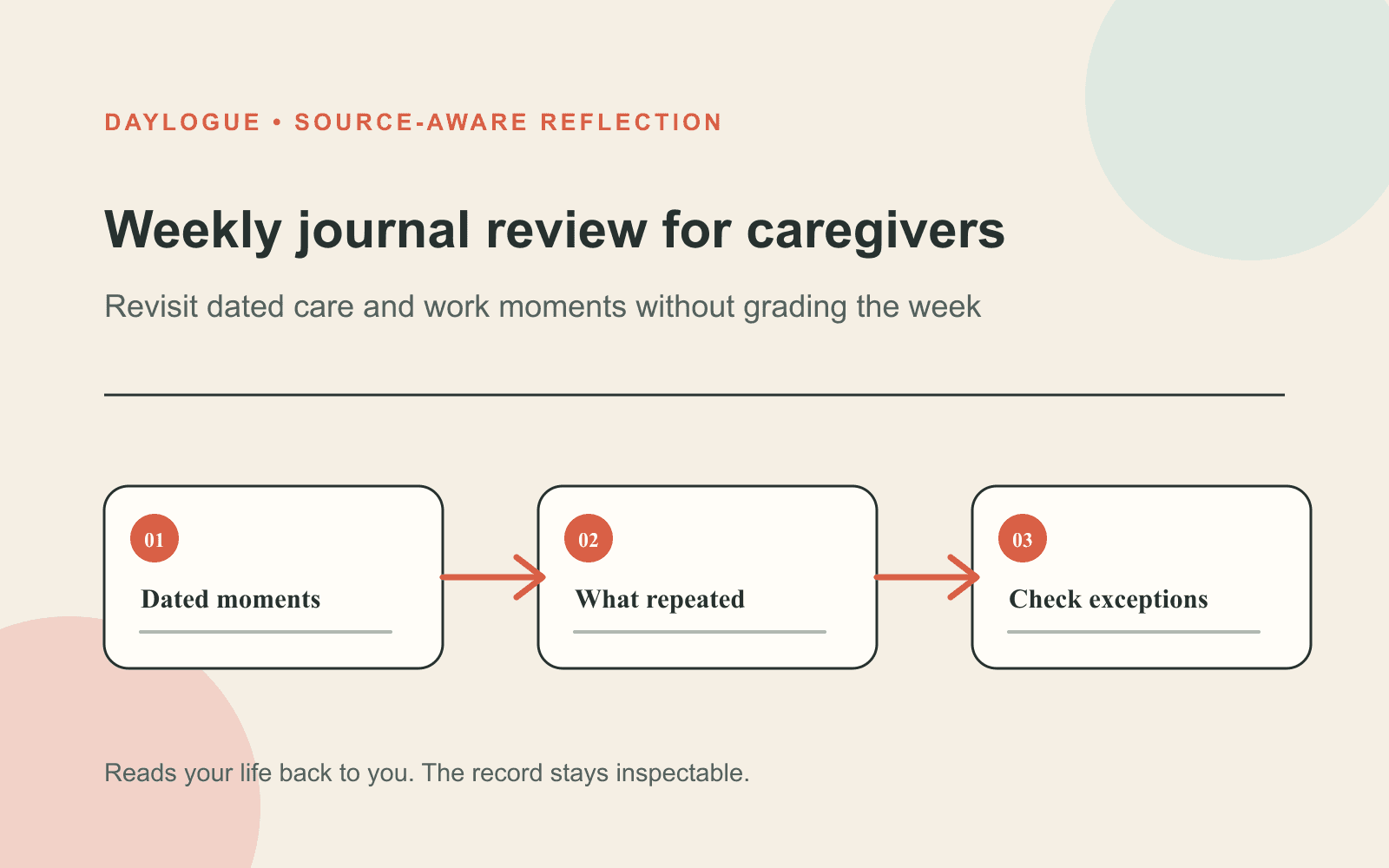
01
Set one review question
Choose the decision or context you want to inspect so unrelated entries can remain outside this pass.
02
Map sources and gaps
List dated moments, mark missing days, and select a counterexample before writing a weekly statement.
03
Draft and verify
Write a narrow recap, reopen every cited moment, then remove any cause claim, score, or person-verdict.
Checklist
Caregiver weekly readback checklist
A source-aware checklist for reviewing a care-filled week without rereading everything, filling gaps, or grading yourself.
- Write one neutral review question.
- List the dates that actually contain source entries.
- Mark unrecorded days as visible gaps.
- Choose two or three relevant moments.
- Find at least one exception or contrasting day.
- Keep counts attached to their denominator.
- Remove cause claims, scores, and person-verdicts.
- Carry forward no more than one optional question.
Common questions
Do I need to reread every entry for a weekly review?
No. Start with one question, map recorded days, and select only the moments relevant to that question while keeping gaps visible.
How should I handle days with no journal entry?
Mark them as gaps. Leave the day undescribed rather than assuming it was better, worse, or unchanged, and label any later reconstruction clearly.
What makes a weekly pattern claim too broad?
A claim is too broad when it hides the number of recorded examples, ignores exceptions, uses gaps as evidence, or states that one context caused another.
Should I give my week a score?
No. Preserve dated moments, counts with denominators, context, and exceptions instead of reducing a complex week or person to one number.
Sources
Sources were checked on the dates shown. Product details and policies can change.
- Daylogue evidence and methods · Daylogue · checked August 28, 2026
- Daylogue privacy policy · Daylogue · checked August 28, 2026
Keep exploring
Daylogue Knowledge Center
Browse practical guides for reflection, journaling, patterns, and privacy.
Read moreHow Daylogue shows patterns
See how candidate patterns stay connected to evidence and correction.
Read moreWhy Daylogue exists
Read the principles behind a system for self-understanding.
Read moreDaylogue is not therapy and is not a replacement for professional care.