Written by Daylogue Editorial Team. Published August 29, 2026. Reviewed and updated August 29, 2026.
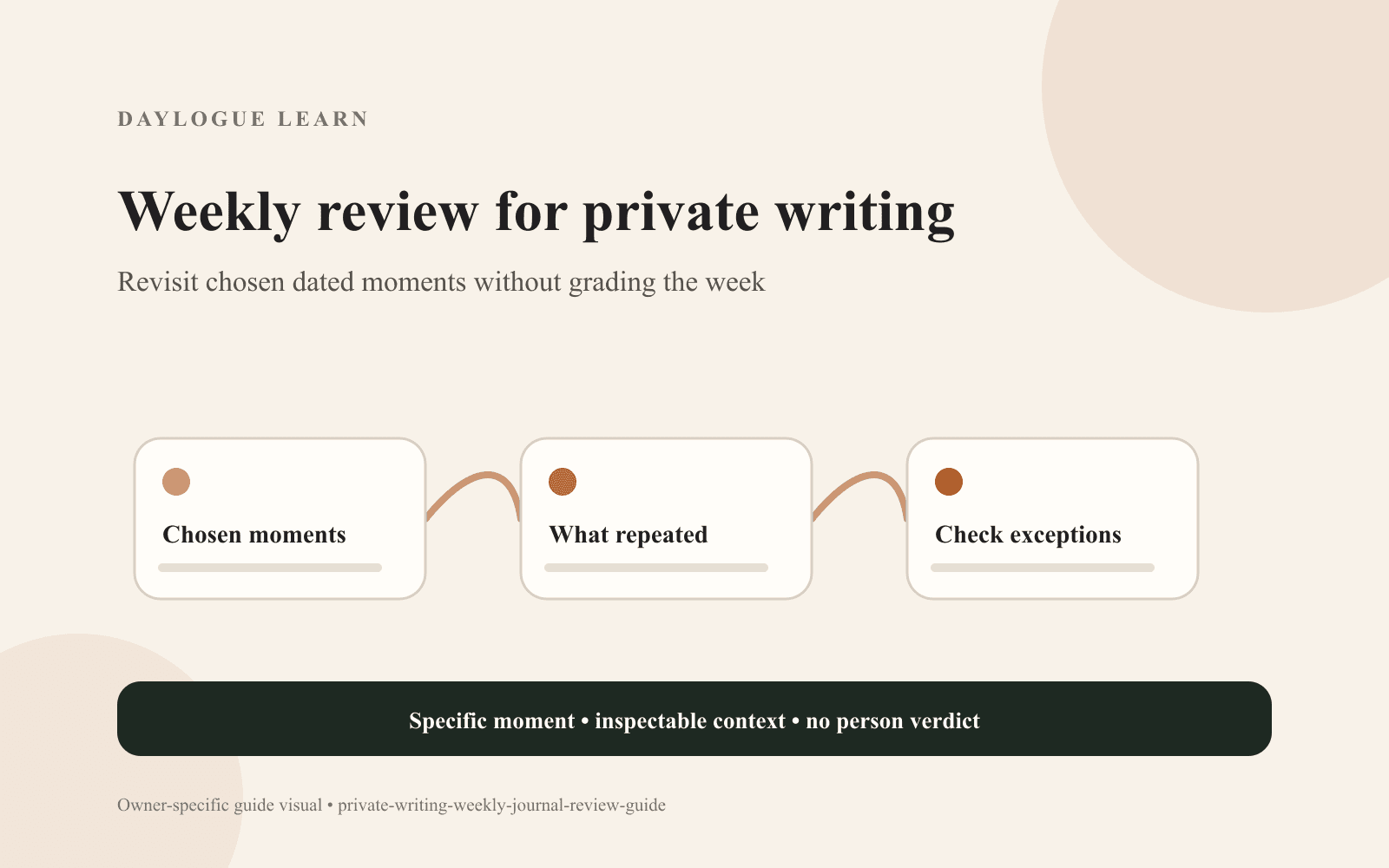
For a private weekly journal review, choose a limited set of dated moments instead of rereading the entire archive. Mark what repeated, then find an exception and a missing piece of context. Summarize only what the selected entries support. Keep names or sensitive details out of the readback when they are not needed, and leave uncertain interpretations labeled as uncertain.
Choose the source notes for this review
Open only the written entries and check-in notes you want to include. Mark their dates and leave unrecorded days visible. A gap can stay open when no dated source is available. A later memory can be added as a dated recollection if you want, but it should stay distinct from a note written that day.
Keep the source set small enough to inspect. Three or four notes about comparable moments often provide a clearer review than a sweep through the entire archive.
Keep a repeat separate from an explanation
Suppose low-energy private weekly readbacks appear beside late meetings twice. That is a recurring overlap in your record. It does not prove the meetings caused low energy, and it does not say what happened on days you did not write. A fair summary names the timeframe, the recorded scenes, and the uncertainty. Keep the private weekly readback tied to the chosen dated scene rather than a fixed identity.
Try: 'Late meetings appeared beside low-energy notes twice this week. I want to compare planned and unplanned late meetings next week.' That sentence is narrower than 'Late meetings drain me,' but it gives you a specific question you can revisit. Keep the private weekly readback tied to the chosen dated scene rather than a fixed identity.
Turn your notes into an inspectable summary
A compact table can keep the review grounded. Fill it only with details present in your private weekly readbacks. If a column has no evidence, write 'not recorded' instead of guessing. Leave one source-linked review question open when the available context is incomplete.
| Review question | What to record | What to avoid |
|---|---|---|
| What repeated? | A detail and its private weekly readback dates | Always or never language |
| What changed? | A sequence visible in the record | A hidden-motive explanation |
| What did not fit? | A comparable exception | Discarding the exception |
| What stays open? | One question for next week | A person score or verdict |
Map recorded days and visible gaps
Create a simple row for each day. Mark whether it contains a written entry, a saved check-in note, or no record. The map shows what the review can support before you begin looking for a repeat.
A gap is information about the record, not a score about your consistency. Leave it blank. The absence of a note does not tell you how the day felt or what happened.
Write a readback with sources and limits
Begin with one sentence that names the source dates: “In the notes from Tuesday, Thursday, and Friday, rushed transitions appeared more than once.” Add the entry that does not fit and one piece of missing context. This keeps the readback connected to what you actually recorded.
End with “I am not sure yet...” or another open question. Avoid a weekly score, a person label, or a claim that the repeated situation caused the response. The review can remain useful without closing the story.
End the review without assigning homework to every day
Choose at most one observation to watch or one practical question to carry forward. Carry forward only the detail that serves that question. If the week revealed that confirmation timing may matter, note confirmation time only when it is easy and relevant. The next review can decide whether the added detail helped. Stopping protects the practice from expanding into another care responsibility. Leave one source-linked review question open when the available context is incomplete.
For this private writing task, let “End the review without assigning homework to every day” have a narrow job. Use one source-linked review question, answer with a dated action or phrase, and stop before the answer turns into a verdict. If the first explanation feels certain, list one missing fact and one counterexample you would need to check before keeping it.
01
Set one review question
Choose the decision or context you want to inspect so unrelated private weekly readbacks can remain outside this pass.
02
Map sources and gaps
List the dated scenes you chose, mark missing days, and select a counterexample before writing a weekly statement.
03
Draft and verify
Write a narrow recap, reopen each dated entry you cited, then remove any cause claim, score, or person-verdict.
Keep weekly review expectations modest and inspectable
A 2025 systematic review examined 51 positive expressive writing studies, and the authors rated the included studies poor or fair in quality. The formats, topics, comparisons, and outcomes varied. Use that evidence as a reason to keep expectations modest, not as a promise that one question, schedule, or writing style will create a particular result.
Daylogue says its observations are designed for reflection, not diagnosis, prediction, treatment, or clinical decision-making. For this weekly review guide, the useful standard is simpler: does the private weekly readback preserve a chosen dated scene, show what remains unknown, and leave the interpretation open to revision? If not, shorten or change the source-linked review question.
Record the chosen dated scene before interpreting it
The record and your explanation can share the private weekly readback without becoming the same thing. “The message arrived after the deadline” records an event. “They did not respect my time” is one explanation. The second line may eventually fit, but it also may leave out a delay, a misunderstanding, or information you do not have. Preserving that distinction makes the journal more honest and more workable when you return.
Concrete particulars do not require sensitive facts. You can write “a family member,” “a class,” “a colleague,” or “a care appointment” instead of a name. You can describe the sequence without copying a sensitive message. The goal is enough context for your own memory, not a complete record of another person. This approach protects confidentiality while preserving the part of the case you actually want to understand.
| Broad verdict | Concrete record | Open cue |
|---|---|---|
| The whole day was a mess | One plan changed twice before noon | Which change cost the most attention? |
| I never follow through | I stopped after the first step today | What was present before I stopped? |
| They always ignore me | My last starter did not get an answer | What need do I want to make clearly? |
Check a possible repeat against an exception
Place comparable written entries beside one another and keep their dates attached. Mark the phrase, situation, or transition that appears more than once. Then find a note that complicates the first explanation and record any context missing from the week.
Use tentative language in the readback. A repeated situation may support a question for next week, but it does not establish a cause or justify a score about the person who wrote the entries.
Keep the weekly review private and bounded
Choose a private setting and decide which details belong in the recap. Names and third-party stories can stay broad. If you use an online journal, check what its servers can read, which providers process requested features, and how export and deletion work.
Set a stopping point before you open the notes. Ten minutes, one repeated situation, and one exception can be enough. Close the review without assigning homework to every day of the next week.
Prompt Pack
A Weekly Journal Review for Private Writing: twelve prompts
Choose one question for a specific weekly review moment, answer in your own words, and leave the interpretation open to later context.
- Which dated moments belong in this review?
- What private detail can remain outside the summary?
- Which situation appeared repeatedly?
- What exact words support that observation?
- Which entry does not fit?
- What context is missing?
- What changed before the exception?
- What did I remember only after rereading?
- What interpretation is still tentative?
- What source dates should stay attached?
- What question can follow me into next week?
- What part of the archive can remain closed?
Common questions
Which dated moments belong in this review?
Use this as a source-linked review question about four caregiving notes, including one evening that was easier after advance help. Answer with one observable detail first, then add your current reading only if it helps. You can stop after the record is clear.
Which situation appeared repeatedly?
Keep the answer inside one chosen dated scene. Write what changed, what stayed fixed, and which fact is missing. That structure prevents a limited private weekly readback from becoming a verdict about a person or an entire period.
What context is missing?
Put the direct answer in your own words and remove names that add nothing to the task. If the question assumes a motive or outcome, rewrite it so the missing context remains visible.
What interpretation is still tentative?
Return to dated source lines before calling this a repeat. Look for an exception and an unrecorded gap. A repetition can support another question, but it cannot prove a cause by itself.
What part of the archive can remain closed?
Leave this unanswered when the available record is too thin. A useful private writing practice allows an open question, a visible gap, and a clean stopping point without inventing completion.
Sources
Sources were checked on the dates shown. Product details and policies can change.
- Daylogue evidence and methods · Daylogue · checked August 29, 2026
- Positive expressive writing systematic review · PLOS One · checked August 29, 2026
Keep exploring
Daylogue Knowledge Center
Browse practical guides for reflection, journaling, patterns, and privacy.
Read moreHow Daylogue shows patterns
See how candidate patterns stay connected to evidence and correction.
Read moreWhy Daylogue exists
Read the principles behind a system for self-understanding.
Read moreDaylogue is not therapy and is not a replacement for professional care.