Written by Daylogue Editorial Team. Published August 29, 2026. Reviewed and updated August 29, 2026.
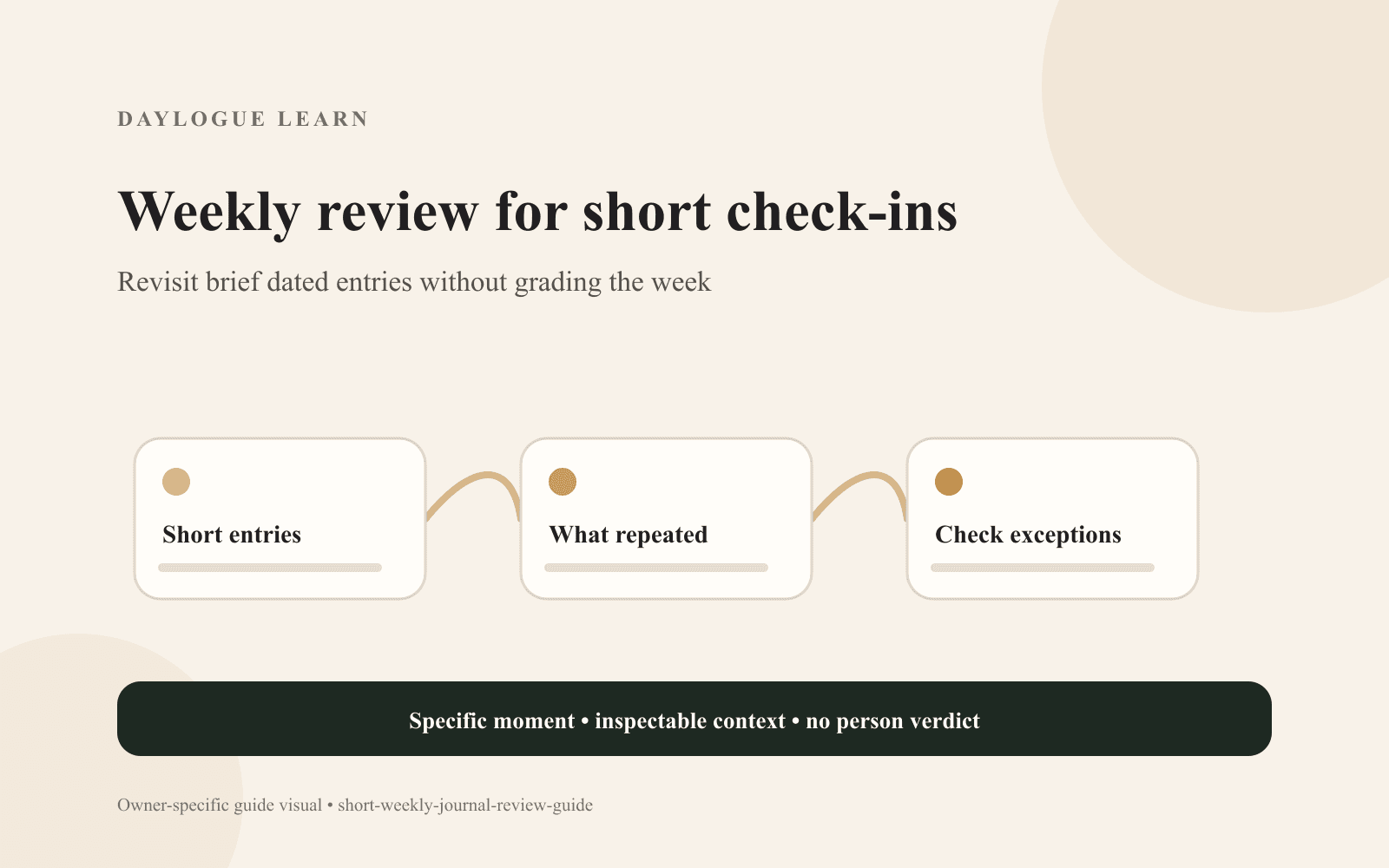
To review a week of short check-ins, read the dated entries once and mark one repeated situation, one entry that does not fit, and one gap in the record. Write a two-sentence readback: “I notice...” and “I am not sure yet...” Keep the source dates beside each observation so the week stays inspectable instead of becoming a score.
Know what a weekly journal review is
A weekly review is a reread, not a new autobiography. You gather the dated week cards you made during one clearly named week and look for scenes, decisions, words, and questions that deserve another look. The fixed window matters because it keeps last Tuesday from blending into the month before it.
A useful review stays close to what you recorded. It can say that three dated week cards mentioned a delayed handoff. It cannot know that handoffs always cause stress, that a person intended harm, or that one difficult week reveals a permanent trait.
Use a four-pass weekly review
Four small passes are easier to inspect than one sweeping summary. Begin with facts and direct wording. Then compare repetitions, exceptions, and unanswered questions. Each pass should leave a visible trail back to the dated card it examines. Keep the dated week card tied to the recorded day rather than a fixed identity.
01
Mark concrete scenes
Underline decisions, conversations, interruptions, places, and changes that can be tied to a dated week card.
02
Circle repeated details
Notice words or situations that appear more than once without assuming the repetition has one cause.
03
Find what did not fit
Look for a comparable day that went differently or a dated week card that complicates the emerging story.
04
Write one open question
End with something you can observe next week, not a rule, diagnosis, promise, or verdict about yourself.
Read the lines around the detail you marked
A repeated word can look important after you highlight it, but the sentences around it may change the picture. If 'rushed' appears three times, read what happened immediately before and after each use. One dated week card may describe leaving late. Another may describe unclear instructions. A third may refer to moving too quickly through a good conversation. The shared word creates a place to look, not a single explanation. Leave one review question open when the available context is incomplete.
Keep the writer's original language visible when you make a summary. A later label such as 'time pressure' may be convenient, but it can flatten several different scenes. Copy one short phrase from each relevant dated week card into your review notes, add the date, and then describe the narrow common detail. If your summary no longer fits the source wording, revise the summary instead of forcing the dated week cards to match it. Leave one review question open when the available context is incomplete.
Context also includes what the dated week card could not know yet. A note written before a reply arrived may contain uncertainty that disappeared by Friday. Preserve that sequence. The goal is not to correct your earlier self with hindsight. It is to understand what information, options, and expectations were present at each point in the week. Leave one review question open when the available context is incomplete.
Keep weekly review expectations modest and inspectable
A 2025 systematic review examined 51 positive expressive writing studies, and the authors rated the included studies poor or fair in quality. The formats, topics, comparisons, and outcomes varied. Use that evidence as a reason to keep expectations modest, not as a promise that one question, schedule, or writing style will create a particular result.
Daylogue says its observations are designed for reflection, not diagnosis, prediction, treatment, or clinical decision-making. For this weekly review guide, the useful standard is simpler: does the dated week card preserve a recorded day, show what remains unknown, and leave the interpretation open to revision? If not, shorten or change the review question.
Choose the review question before opening every dated week card
A weekly review becomes exhausting when it tries to summarize everything. Begin with one question: Which transitions demanded the most planning? Where did help change the day? Which responsibility repeatedly moved? What did I protect? The question determines which dated week cards matter and gives you permission to ignore unrelated material for this pass.
Keep the question neutral enough to be wrong. “Why was this week a failure?” guarantees a verdict. “Which plans changed after they were set?” can produce several kinds of answer, including none. A narrow question also helps separate a personal record from a performance review. The week does not need a grade or a single theme.
Inspect a possible repeat with a counterexample
Suppose Monday and Friday both describe rushed care handoffs after work calls ran late. That is a candidate overlap. Now inspect Wednesday, when a handoff happened after a call but did not feel rushed. What differed: notice, location, help, the length of the call, or something not recorded? Keep the different day beside the repeated ones. Keep the dated week card tied to the recorded day rather than a fixed identity.
For this short check-in task, let “Inspect a possible repeat with a counterexample” have a narrow job. Use one review question, answer with a dated action or phrase, and stop before the answer turns into a verdict. If the first explanation feels certain, list one missing fact and one counterexample you would need to check before keeping it.
Use a ten-minute review when the week is crowded
For the first two minutes, mark recorded dates and gaps. Spend the next three choosing one question and two relevant recorded days. Use two more minutes to find an exception or a day with different conditions. Draft a four-line recap in the next two minutes, then use the final minute to reopen each source and remove any wording that outruns it. The time box is a stopping aid, not a speed target. Leave one review question open when the available context is incomplete.
If the source check reveals that the question cannot be answered, record that outcome directly. “Only two relevant recorded days were saved this week” is a valid weekly readback. Let the unanswered question stand instead of broadening the search simply to produce a conclusion. A review that preserves uncertainty may be more useful next month because it shows exactly which evidence existed. Leave one review question open when the available context is incomplete.
Match the review question to the minute you have
You do not need to turn every opening into a deep dated week card. Thirty seconds can hold three words. One minute can hold a single sentence. Three minutes can hold a recorded day, your reaction, and an open question. Pick the format before you begin so you know you are allowed to stop.
Short formats are especially useful when the day is crowded or your thoughts feel scattered. They preserve a detail without demanding a full explanation. If more words arrive, keep going. If they do not, the dated week card still counts as a record. Length does not decide whether your words are honest or useful.
| Time | review question | Answer shape |
|---|---|---|
| 30 seconds | What stands out? | Three words |
| 1 minute | What took my attention? | One sentence |
| 2 minutes | What changed during this recorded day? | Before and after |
| 3 minutes | What am I curious about? | recorded day plus question |
Compare dated week cards without labeling yourself
Once you have several short dated week cards, look for repeated situations and the days that break the repetition. Maybe the same weekly slot appears beside feeling rushed. Maybe your notes about difficult choices use the same phrase. Write, "This appeared in three dated week cards," rather than, "This is who I am." The first sentence stays inspectable. The second turns a small record into a person verdict. Keep the dated week card tied to the recorded day rather than a fixed identity.
For this short check-in task, let “Compare dated week cards without labeling yourself” have a narrow job. Use one review question, answer with a dated action or phrase, and stop before the answer turns into a verdict. If the first explanation feels certain, list one missing fact and one counterexample you would need to check before keeping it.
- Count the situations, not a score about yourself.
- Read the exact dated week cards behind an observation.
- Look for exceptions and missing context.
- Rewrite fixed labels as open questions.
Seven short check-ins you can use in any order
Try one review question at a time: What took my attention? What choice stayed with me? What felt easier than expected? What did I avoid even though it was small? When did my energy change? What did I say clearly? What am I curious to notice again? Answer with one to three lines. Skip any question that does not fit. Leave one review question open when the available context is incomplete.
For this short check-in task, let “Seven short check-ins you can use in any order” have a narrow job. Use one review question, answer with a dated action or phrase, and stop before the answer turns into a verdict. If the first explanation feels certain, list one missing fact and one counterexample you would need to check before keeping it.
Prompt Pack
A Weekly Journal Review for Short Check-Ins: twelve prompts
Choose one question for a specific weekly review moment, answer in your own words, and leave the interpretation open to later context.
- Which three entries still feel specific?
- What situation appeared more than once?
- Which entry breaks the apparent repetition?
- What day has no record?
- What detail did I forget until rereading?
- What phrase did I use more than once?
- Which claim needs more context?
- What changed within the week?
- What stayed stable despite a hard day?
- Which source dates support my note?
- What question belongs in next week?
- What can remain unresolved?
Common questions
Which three entries still feel specific?
Use this as a review question about three notes that mention rushing before the same afternoon transition. Answer with one observable detail first, then add your current reading only if it helps. You can stop after the record is clear.
Which entry breaks the apparent repetition?
Keep the answer inside one recorded day. Write what changed, what stayed fixed, and which fact is missing. That structure prevents a limited dated week card from becoming a verdict about a person or an entire period.
What phrase did I use more than once?
Put the direct answer in your own words and remove names that add nothing to the task. If the question assumes a motive or outcome, rewrite it so the missing context remains visible.
What stayed stable despite a hard day?
Return to dated source lines before calling this a repeat. Look for an exception and an unrecorded gap. A repetition can support another question, but it cannot prove a cause by itself.
What can remain unresolved?
Leave this unanswered when the available record is too thin. A useful short check-in practice allows an open question, a visible gap, and a clean stopping point without inventing completion.
Sources
Sources were checked on the dates shown. Product details and policies can change.
- Daylogue evidence and methods · Daylogue · checked August 29, 2026
- Positive expressive writing systematic review · PLOS One · checked August 29, 2026
Keep exploring
Daylogue Knowledge Center
Browse practical guides for reflection, journaling, patterns, and privacy.
Read moreHow Daylogue shows patterns
See how candidate patterns stay connected to evidence and correction.
Read moreWhy Daylogue exists
Read the principles behind a system for self-understanding.
Read moreDaylogue is not therapy and is not a replacement for professional care.