Written by Daylogue Editorial Team. Published August 26, 2026. Reviewed and updated August 26, 2026.
Begin with one work scene, not a rating of the whole day. Write what happened, the words or decision that changed the moment, what you felt or noticed, what remains uncertain, and what is actually within your control. Keep employer, customer, coworker, legal, credential, and unreleased details out. Stop after five or ten minutes. The goal is a clearer record you can revisit, not a diagnosis, a career verdict, or a promise that writing will remove stress.
Start with the scene you can actually describe
Write the meeting, message, interruption, or decision that changed the shape of the day. Use concrete details that belong to you: where you were, what you were asked to do, the sentence you remember, and what happened next. Avoid beginning with ‘Everything is terrible’ or ‘I always fail.’ Those statements compress many events into a verdict that the entry cannot support. A scene gives you something you can inspect later. If several moments compete for attention, choose the one that still changes what you need to do or understand tomorrow.
Separate what happened from what you think it means
Make two short columns. In the first, record observable facts: the deadline moved, a request arrived without context, or a decision was postponed. In the second, record your current interpretation: ‘I think my work was dismissed’ or ‘I am worried the scope will change again.’ Mark the interpretation as provisional. Add one other explanation that could also fit, even if you do not prefer it. This is not forced optimism. It keeps uncertainty visible and prevents a journal entry from pretending it can read another person’s motives or decide what one difficult exchange proves about your career.
Use five prompts that lead somewhere concrete
Ask: What changed? What exact detail am I carrying? What part belongs to me, and what part requires another person or system? What information is missing? What is the smallest reasonable return point? Answer only the prompts that fit. A delayed dependency may need a clarification request. A repeated interruption may need a boundary conversation. A harmful or unsafe situation may require workplace, union, campus, legal, emergency, or local support rather than more private reflection. Journaling does not transfer responsibility for difficult conditions onto the person experiencing them.
Protect other people's information and your own position
A journal can combine details that look harmless in isolation. Remove customer names, health information, credentials, investigation material, legal advice, trade secrets, unreleased plans, and anything your agreements prohibit storing. Use roles instead of names when the identity is not essential. If you use a synced or AI journal, inspect its processing, provider, access, retention, and deletion terms. Daylogue reads the entries you choose to sync to create narratives and surface patterns. Entries are not end-to-end encrypted. That limitation should shape what belongs in a synced work reflection.
Review the entry without grading the worker
Return after enough time has passed to see whether the entry still matches the event. Look for a repeated situation, not a fixed label. ‘Unclear handoffs appeared in three entries’ is inspectable. ‘I am bad under pressure’ is a person verdict. Preserve exceptions, including the day a handoff went well or the meeting where you asked for context and received it. The assigned systematic review reports heterogeneous writing topics, protocols, comparison groups, and outcomes, and rated the included studies as poor or fair quality. It does not support promising that this prompt set will improve health or performance. Judge the practice by whether the record helps you recover context and choose a proportionate next step.
Match the prompt to the kind of work problem
Different work moments need different questions. When the issue is an unclear request, ask what a complete request would need to include. When the issue is a broken handoff, ask what information arrived, what did not arrive, and where the next owner became uncertain. When the issue is a crowded day, list what changed the plan without turning the final task count into a verdict. When the issue is a tense exchange, record the exact words you remember and mark every paraphrase. When the issue is a decision you disagree with, separate the decision, its stated reason, its effect on your work, and the channel available for raising a concern. This matching step keeps a general feeling from swallowing the practical details that might matter tomorrow.
Turn the entry into a question you can actually ask
A useful work reflection can prepare language without scripting a confrontation. Start with the shared object: a deadline, scope, handoff, decision, or responsibility. State what you observed without assigning a motive. Then ask for the missing information or propose a next step. ‘The delivery date moved twice this week. Which date should the team consider current, and who confirms future changes?’ is more answerable than ‘Why does nobody respect my time?’ Keep the journal version and the workplace version separate. The journal can hold uncertainty and emotion. The message you send should contain only the information needed for the work. If no conversation is appropriate tonight, write the earliest reasonable time to return and let the page end there.
Read a week as a set of scenes, not a score
At the end of a week, place entries in date order and underline observable repetitions. Maybe late scope changes appear three times, or maybe the difficult moments cluster around one project phase. Count the counterexamples too. A quiet handoff, a clear meeting, or a day with the same workload but a different experience can narrow the question. Missing days remain missing. Leave missing days unassigned rather than filling them from memory to make the sequence complete. Avoid an overall work score, productivity grade, or label such as resilient, disengaged, or bad at boundaries. The useful output is a specific question with its source scenes attached, plus a note about what the record cannot establish.
Decide whether the next step belongs in a journal
Not every difficult work detail should stay in private reflection. A factual error in a schedule belongs in the schedule or a message to its owner. A safety issue belongs in the required reporting path. Harassment, discrimination, wage concerns, accommodation requests, and other formal matters may need policies, representatives, legal guidance, or official records that a journal cannot replace. A private note can help you remember what you personally observed. It belongs beside official records when dates, documents, witnesses, or reporting rules matter. Conversely, a passing frustration may need no escalation at all. Ask what outcome you need, who can act on it, and which channel is designed to carry that information. Then keep the journal focused on your own context and questions.
When you move information into another channel, rewrite it for that audience instead of copying the private entry. Remove speculation, unrelated personal detail, and statements about another person's intent. Keep dates, observable events, relevant documents, and the request you are making. Save a personal interpretation in the journal only if its storage boundary fits the subject. This separation protects the usefulness of both records. The workplace message stays actionable, and the journal stays honest about uncertainty. It also reduces the chance that a private burst of language becomes the version sent to someone who cannot answer it fairly.
Keep software in a supporting role
Daylogue is a system for self-understanding. Pattern journaling is how it reads you. It can help preserve the scenes and self-reported context you choose to share, then surface connections for you to inspect. Daylogue does not infer emotion from faces, voice tone, or physiology. It works from the words and context people choose to share. It does not decide whether you should stay, leave, confront, or forgive. Use the record as one input alongside direct conversation, policies, documents, and qualified support when those are relevant. Daylogue is not therapy and is not a replacement for professional care.
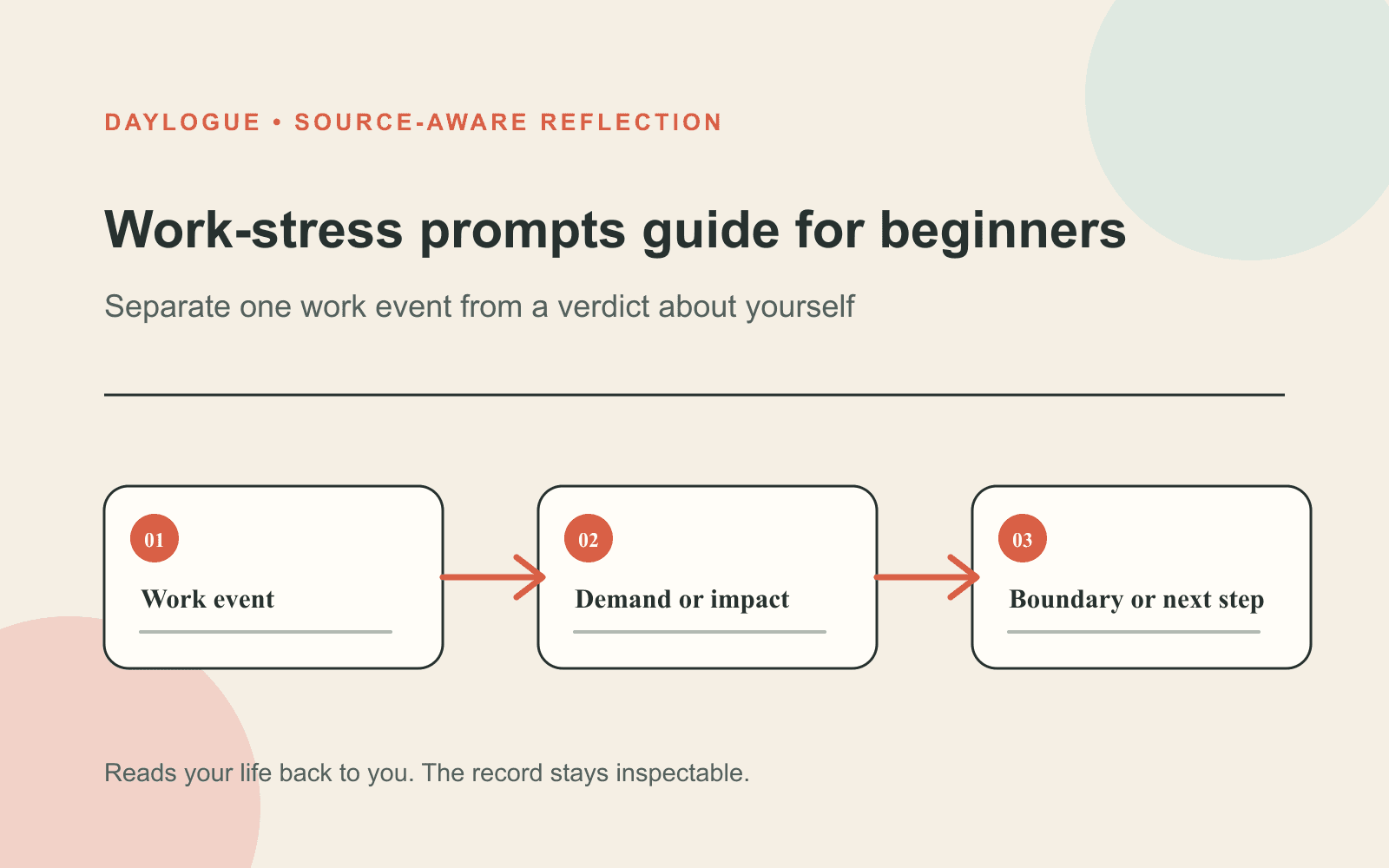
01
Name one scene
Record the event and exact detail that changed your attention.
02
Mark uncertainty
Separate observable facts from your current interpretation and missing information.
03
Choose a return point
Write one proportionate action or decide that no action is needed tonight.
Worksheet
One difficult work scene
A six-part worksheet for recording a work moment without turning it into a person, motive, or career verdict.
- What happened that I could directly observe?
- Which exact detail or sentence am I carrying?
- What is my current interpretation?
- What other explanation could also fit?
- What information or support is missing?
- What is the smallest reasonable return point?
Common questions
How long should a beginner work journal entry be?
Five to ten minutes is enough for one scene, one interpretation, one uncertainty, and one return point. Stop earlier when the useful context is already present.
Should I write the names of coworkers or customers?
Usually omit names and restricted details unless identity is essential and you understand the storage boundary. Never include credentials, trade secrets, legal material, or prohibited records.
Can journaling tell me whether to quit my job?
No. A journal can preserve events and recurring situations, but it cannot decide what you should do. Use direct evidence, practical constraints, trusted people, and qualified support.
What if I miss several days?
Leave the gap visible and begin with the next current event. A later reconstruction is different evidence from a note written near the moment.
Do work stress journal prompts reduce stress?
The assigned research does not guarantee that outcome. The assigned systematic review describes varied writing methods and outcomes, with study quality rated poor or fair across the included studies.
Sources
Sources were checked on the dates shown. Product details and policies can change.
- Daylogue evidence and methods · Daylogue · checked August 26, 2026
- Daylogue privacy policy · Daylogue · checked August 26, 2026
- Positive expressive writing systematic review · PLOS One · checked August 26, 2026
Keep exploring
Daylogue Knowledge Center
Browse practical guides for reflection, journaling, patterns, and privacy.
Read moreHow Daylogue shows patterns
See how candidate patterns stay connected to evidence and correction.
Read moreWhy Daylogue exists
Read the principles behind a system for self-understanding.
Read moreDaylogue is not therapy and is not a replacement for professional care.