Written by Daylogue Editorial Team. Published August 28, 2026. Reviewed and updated August 28, 2026.
Work stress prompts for a parent or caregiver should begin with one concrete collision between job demands and care responsibilities. Record what changed, what decision became difficult, and which resources or constraints were present. Keep the event separate from a verdict such as “I cannot handle this job.” Then identify a question, request, boundary, or experiment that is small enough to evaluate in a later entry. Preserve the timing and notice you received because those details often change which next step is workable.
Name the exact work-and-care collision
“Work was impossible” may capture the feeling of the day, but it hides the event you can inspect. Identify the collision: a meeting moved into pickup, a care call arrived during focused work, a shift changed with short notice, or an appointment required an unscheduled absence. Add the time and the decision it forced. This creates a useful record without pretending the whole job was contained in one moment.
Separate the demands by source. What did the workplace require? What did care require? What did you assume you had to absorb without asking? The categories may overlap, but writing them apart can show where information arrived late, where a policy mattered, or where two reasonable needs simply could not fit in the same hour.
Keep a constrained choice separate from a person-verdict
Caregivers often make choices with fewer available options than the final calendar reveals. “I missed the deadline” is an event. “I am unreliable” is a person-verdict. Record what changed before the deadline, what notice you had, what help was available, and which tradeoff you made. Context does not erase responsibility; it makes the record accurate enough for a useful next step.
Also resist the opposite shortcut: a single completed task does not prove the system is sustainable. Look at effort, interruption, recovery time, and what moved elsewhere. A journal can preserve the hidden cost without converting it into a score. The question is what happened under these conditions, not what grade the worker or caregiver deserves.
| Broad statement | Concrete demand | Workable question |
|---|---|---|
| I cannot keep up | A deadline and appointment overlapped by 45 minutes | Which deadline could be clarified earlier? |
| My manager does not understand | A schedule change arrived after care was booked | What notice do I need to request? |
| I failed at both roles | I postponed one task and arrived late to one handoff | Which constraint should be documented first? |
Use four prompt lenses: demand, control, support, and boundary
A demand prompt asks what the job or care task required. A control prompt asks which parts you could change. A support prompt asks what resource existed or was missing. A boundary prompt asks what you can state or protect next time. Move through only the lenses that fit the event. You do not need a complete analysis after every difficult day.
Phrase questions so they can produce a concrete answer. “What is wrong with my balance?” is too broad and already implies failure. “Which change arrived too late for me to rearrange care?” points to timing. “What information would make the next handoff easier to plan?” points to a request. Keep the prompt close to the decision you may actually revisit.
- What demand changed, and when did I learn about it?
- Which part of the collision was outside my control?
- What support existed but was hard to access?
- What request needs a clear owner and deadline?
- What boundary would protect care or focused work next time?
A worked example: the meeting that moved into pickup
A meeting moves from 2:00 to 4:30, overlapping a pickup planned weeks earlier. The source record includes the original time, the new notice, the pickup commitment, and the options considered. The first interpretation may be, “My family responsibilities are invisible here.” Keep it, but label it as your reading rather than an established motive.
A workable next line could be a request for earlier notice or a clear statement that you are unavailable after 4:00 on that day. A later entry can record how the request was received. Daylogue states that a recurring overlap does not show that one thing caused another. Several schedule conflicts can reveal an operational pattern without proving why another person made each decision.
Review patterns by source, timing, and exceptions
At the end of a week, group events by the kind of demand rather than by how bad they felt. Separate late notice, unclear ownership, too many simultaneous tasks, travel, care emergencies, and voluntary extra work. Then check exceptions: a late change that was manageable, a busy day with strong support, or a planned care task that did not disrupt work.
This review can narrow the language. Instead of “Thursdays are always a disaster,” the record may support “Two Thursday schedule changes arrived after care was arranged.” The narrower sentence is more useful for a conversation and easier to correct. Missing days or undocumented decisions should remain visible rather than being treated as confirmation.
Protect work, client, and family information
Leave confidential messages, client details, student records, patient information, passwords, financial data, and internal documents out of a personal journal. Describe the structure of the event without reproducing protected content. “A client deadline moved” may be enough. On a managed work device, assume an administrator may have access and choose a private device or offline note when appropriate.
Daylogue does not use personal entries to train its own models. Provider handling follows current written terms, configuration, and subprocessor disclosures. Daylogue does not infer emotion from faces, voice tone, or physiology. It works from the words and context people choose to share. Daylogue reads the entries you choose to sync to create narratives and surface patterns. Entries are not end-to-end encrypted.
Compare planned load with surprise load
A packed day and a disrupted day are not the same source condition. Mark which duties were known when the day began and which arrived later. A planned appointment may require time but allow coordination; an unexpected schedule change may consume decision-making as well as minutes. Recording that distinction can clarify whether the question concerns volume, notice, ownership, or the absence of backup.
Use a second entry to test the distinction. Find a high-load day that remained workable and ask what information or support was present. Then find a lower-load day that became difficult after a surprise. This comparison keeps “too much work” from covering several different problems. It also produces clearer language for a request because the note can name the condition that actually changed.
Close with one bounded experiment or request
Choose a next step that can be observed: block a pickup window, ask who owns a deadline, request twenty-four hours of notice when possible, or write down the tradeoff before accepting extra work. State what would count as useful information. The purpose is not to prove that one technique fixes job stress; it is to gather a cleaner record of what changes under a defined condition.
Daylogue is not therapy and is not a replacement for professional care. A journal does not decide employment rights, leave eligibility, safety, or urgent care arrangements. Use the proper professional or organizational channel for those questions. Reflection can help prepare facts and questions, but it should not become another unpaid task that follows every hard workday.
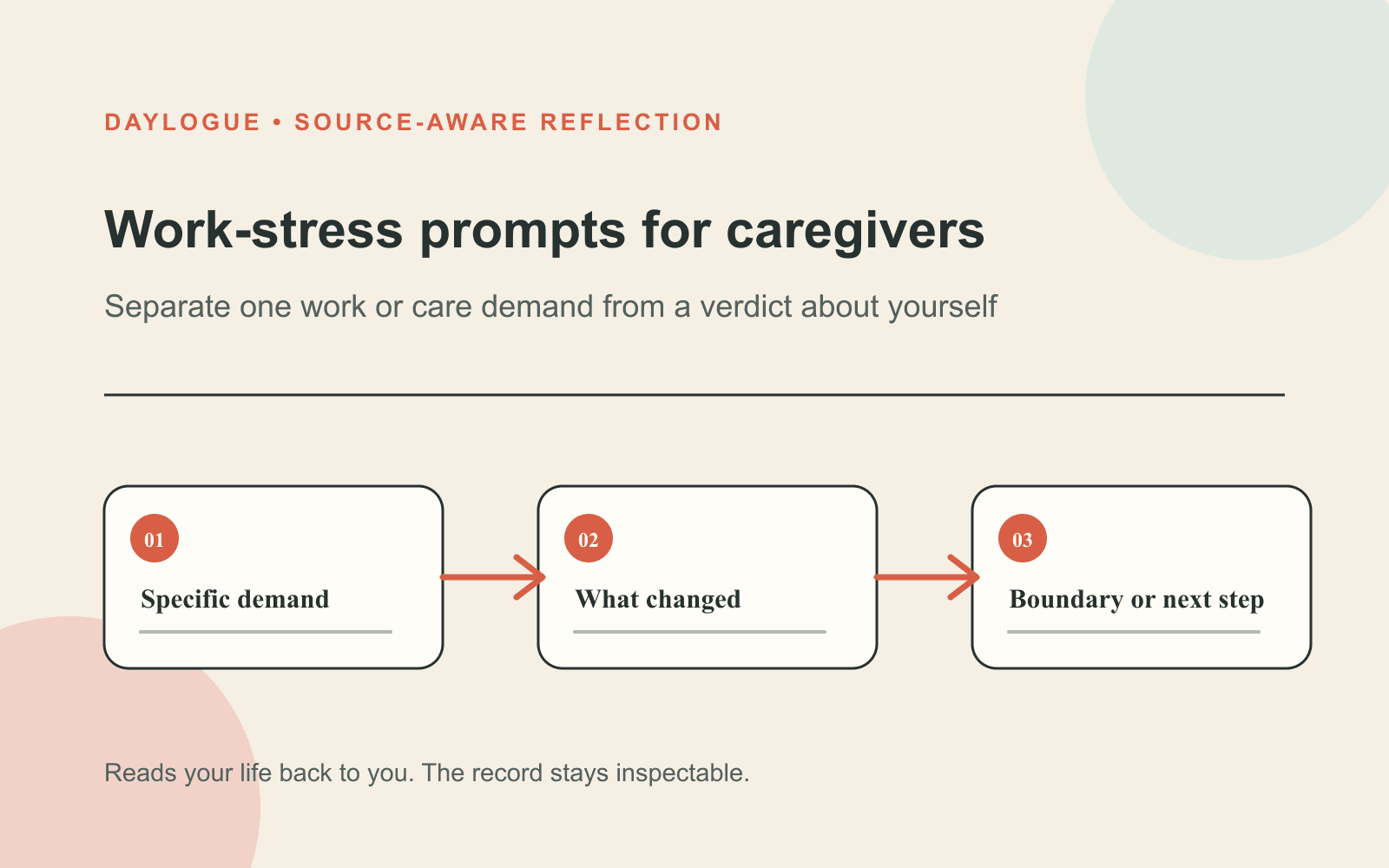
01
Capture the demand
Write what changed, when notice arrived, and which work or care decision followed.
02
Map control and support
Separate what you could change from what required information, help, or a response from someone else.
03
Test one next step
Choose a bounded request, boundary, or planning change that a future entry can evaluate.
Decision Table
Work-and-care collision decision table
A compact record for separating a concrete demand, available control, missing support, and one bounded next step.
- Demand: what changed and when did notice arrive?
- Care context: what commitment or responsibility overlapped?
- Control: what could I change directly?
- Support: what information or help was missing?
- Boundary or request: what specific next line can I own?
- Privacy: what workplace or family detail must stay out?
Common questions
What should a working caregiver record first?
Start with one demand collision, including the timing, notice, decision, and available support. Avoid summarizing the entire job or family situation.
How do I avoid blaming myself in a work journal?
Separate the event from the person-verdict. Record constraints and choices accurately, then identify a request or boundary without assigning a grade.
Can I paste work messages into my journal?
Avoid confidential, client, student, patient, financial, and internal material. Paraphrase only the structure needed for your private reflection.
What makes a useful next step?
Choose something observable and bounded, such as a notice request, protected time block, ownership question, or documented tradeoff.
Sources
Sources were checked on the dates shown. Product details and policies can change.
- Daylogue evidence and methods · Daylogue · checked August 28, 2026
- Daylogue privacy policy · Daylogue · checked August 28, 2026
Keep exploring
Daylogue Knowledge Center
Browse practical guides for reflection, journaling, patterns, and privacy.
Read moreHow Daylogue shows patterns
See how candidate patterns stay connected to evidence and correction.
Read moreWhy Daylogue exists
Read the principles behind a system for self-understanding.
Read moreDaylogue is not therapy and is not a replacement for professional care.