Written by Daylogue Editorial Team. Published August 12, 2026. Reviewed and updated August 12, 2026.
To restart work stress journaling after a break, choose one recent work moment and decide what the entry needs to preserve. Record the sequence, separate what happened from your first interpretation, add the context that could change the meaning, and finish with one open question. You do not need to explain the gap or explain the whole job. Three accurate lines about a late handoff can be more useful than a complete account of the unrecorded month.
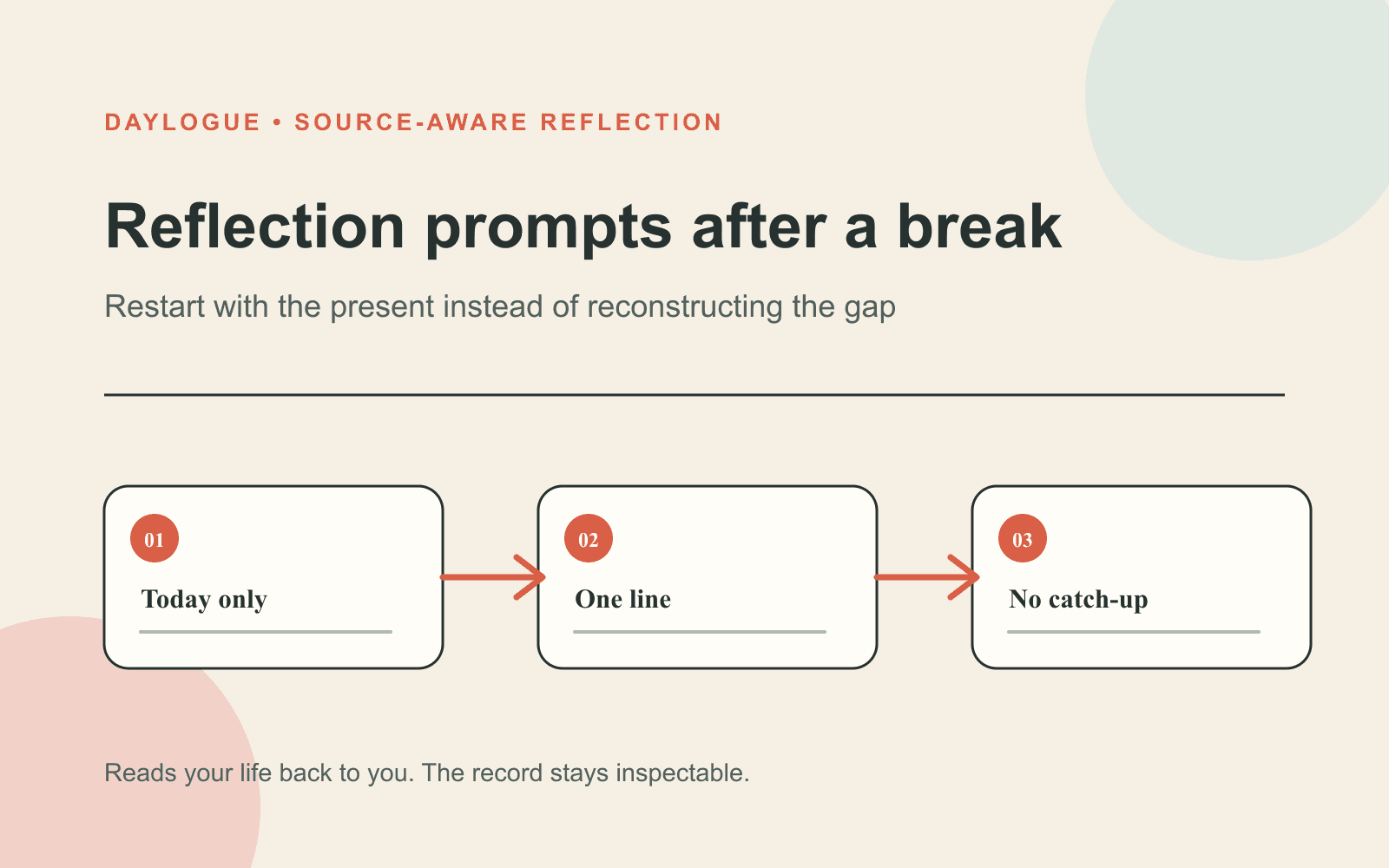
Choose one work moment, not the missing month
The first page back does not need to summarize why you stopped or cover every hard day since the last entry. Pick one scene that still has your attention. It could be a project handoff, a meeting that ran past its purpose, a decision made with incomplete information, or the quiet part of the commute when the day finally caught up with you. Give the scene a date and a plain label. A narrow starting point keeps the page connected to something you can inspect instead of turning the entire break into a story about discipline.
Before choosing a prompt, name the job of the entry. You may want to remember a sequence, prepare your own words for a conversation, notice where a boundary became unclear, or keep a decision and its tradeoffs from blurring later. Each purpose calls for different questions. If you only need to preserve why a deadline moved, a short decision record may be enough. If the same type of request keeps arriving late, you need several dated examples before you can compare what repeats and what changes.
| Reflection job | Start with | Keep visible | Stop when |
|---|---|---|---|
| Remember an event | What happened first? | People, timing, and constraints | The sequence is clear |
| Prepare a conversation | What do I need to say? | Facts, request, and uncertainty | Your own wording feels usable |
| Examine a boundary | What changed or became unclear? | Expectation, capacity, and consequence | The tension is accurately named |
| Revisit a decision | What choice was made? | Reason, tradeoff, and open question | The decision logic is preserved |
Use three lanes: event, interpretation, open question
Write the event in language another person could check. “The review started before the final figures arrived” belongs in the event lane. Then record the interpretation that appeared, such as “My work is never given enough time.” That sentence may capture the force of the moment, but it reaches beyond one review. Keep it as your interpretation rather than deleting it or treating it as settled. The third lane holds the question the record cannot answer yet: “Was this caused by the revised schedule, unclear ownership, or a pattern I need more examples to understand?”
This structure does not ask you to argue yourself out of frustration. It gives each kind of statement the right weight. An event can be specific and still leave out context. An interpretation can matter without becoming a verdict about your ability, manager, or future. An open question can remain unanswered. When you return later, you can add an exception, correct a date, or decide that the first interpretation fit less well than it seemed. The entry stays usable because disagreement with your earlier wording is allowed.
- Event: What could a calendar, message, or participant confirm?
- Interpretation: What larger story showed up around the event?
- Context: What constraint or missing detail could change the reading?
- Open question: What would you need to know before drawing a broader conclusion?
Choose prompts that fit the kind of work moment
A generic question such as “Why am I stressed?” can invite a large answer before the details are clear. A situation-based prompt gives you a firmer place to begin. For a crowded day, ask which request changed the plan and what lost room as a result. For a difficult meeting, ask which sentence or decision stayed with you and what was still unclear when the call ended. For a delayed project, ask where ownership changed, what notice was available, and which assumption no longer held. These questions preserve conditions without deciding what they say about you.
You can answer one prompt and stop. More writing is useful only when it adds context you want to keep. If a question sounds leading, rewrite it. “Why was I silent?” already contains a judgment. “What made speaking feel available or unavailable in that moment?” leaves room for timing, authority, uncertainty, and choice. The goal is not to produce the strongest explanation. It is to leave a record that your later self can understand, question, and correct.
- After a handoff: Which detail arrived too late to use, and what did that change?
- After a meeting: What was decided, what remained open, and whose next step was clear?
- After a deadline shift: Which constraint changed first, and what tradeoff followed?
- After a hard conversation: What did I say, what did I leave unsaid, and what context mattered?
- After an ordinary day: What worked more smoothly than expected, and what helped?
- Before tomorrow: What fact do I want available before the next decision begins?
Make the return smaller than the old routine
A break often exposes a mismatch between the old format and the life it was supposed to fit. A thirty-minute evening entry may have worked during a quieter season and become unrealistic when meetings moved later. Keep the useful part and shrink the rest. Try one event-triggered note after a demanding handoff, a two-minute voice check-in in a private setting, or a short Friday review only when you have examples worth comparing. Returning does not require a daily promise, a catch-up weekend, or a new system of rewards.
Set an exit condition before you start. You might stop after three facts and one question, after five minutes, or when the sequence makes sense. A defined ending protects reflection from becoming another task that expands to fill the evening. If nothing feels worth recording, close the page. The practice can remain available without being mandatory. A skipped day says only that no entry was recorded. It does not show that the day was calm, difficult, productive, or wasted.
01
Pick one scene
Choose a recent moment with a clear setting, such as a handoff, meeting, deadline change, or decision.
02
Choose the reflection job
Decide whether you want to remember, prepare, compare, or put your own words around the event.
03
Write three lanes
Record the event, your current interpretation, and one question that remains genuinely open.
04
Stop on purpose
End when the record is useful enough. Leave the gap and any unfinished explanation alone.
Set the privacy line before adding work detail
Work notes can contain names, customer information, personnel matters, legal advice, financial plans, security details, or material covered by an agreement. Decide what does not belong in a personal journal before the writing becomes specific. Replace names with roles when identity is unnecessary. Preserve the shape of a problem without copying protected material. “The owner changed after approval” may be enough to remember why the timeline became difficult. If the exact facts are required for a formal report, use the approved workplace channel for that purpose.
Digital privacy also depends on what the service keeps and can read. Daylogue stores most journal entries and check-in notes in readable form on its servers. Those records support narratives and pattern features, so the product is not end-to-end encrypted. Daylogue does not use personal entries to train AI models. Readable storage, model training, data sales, access controls, export, and deletion are separate questions. Review each one before deciding whether a workplace detail belongs in the app at all.
Review three entries without forcing a conclusion
Once you have three or more notes about the same kind of situation, place them side by side. Mark what repeats, what changes, and which example does not fit the first explanation. Maybe late ownership changes appear in two difficult handoffs, while a third went smoothly because the receiving team had advance notice. That exception does not erase the hard examples. It helps make the candidate pattern more precise. Also mark missing periods. Days without entries are unrecorded context, not proof that the issue disappeared.
A recurring overlap does not show that one thing caused another. Use a repeat as a reason to ask a better question, not as a hidden rule about your job or character. You might ask whether notice, role clarity, meeting timing, or project stage changes the experience. Then collect examples that could challenge the idea as well as support it. The record becomes more trustworthy when it can hold ambiguity, corrections, and ordinary days alongside the sharp moments that were easiest to remember.
Keep research and product claims in proportion
Research on writing does not support a promise that a prompt will fix work stress. The systematic review included 51 studies, and all were rated poor or fair in quality. It found varied methods and outcomes, which makes broad conclusions difficult. A separate narrative coherence study included 395 American young adults and called for longitudinal and experimental research. These sources can inform questions about writing and personal narratives, but neither establishes what one short work entry will do for a particular person.
Daylogue separates verified product behavior from research and future questions. No research or outcome claim has been approved for public use yet. Use the journal for the concrete jobs it can perform now: preserving a sequence, keeping your own wording, comparing dated examples, and making uncertainty visible. Daylogue is not therapy and is not a replacement for professional care. A journal also cannot supply legal advice, resolve a safety concern, or replace an appropriate workplace or professional channel.
Decide whether this format still earns a place
After two weeks or three uses, review the practice rather than grading yourself. Could you begin without negotiating with a blank page? Did the format protect confidential information? Could you tell the event apart from the conclusion? Was the note easy to find when you needed it? If the entry collected detail you never revisited, shorten it. If every note became a broad complaint with no setting or exception, add one context question. If speaking felt exposed, switch to typing or paper in a private location.
The right return may be occasional. You can keep a compact decision note for complicated tradeoffs and leave other days unrecorded. You can use a weekly review only when several entries point to the same question. You can stop again without losing anything you earned. The point is a clearer record of moments that matter to you, not continuous attendance. A useful work journal fits beside the work. It does not become another manager watching the clock.
Worksheet
One-work-moment restart sheet
Use this compact worksheet to restart with one recent work event while keeping facts, interpretations, context, and open questions separate.
- Scene: Name one recent meeting, handoff, deadline change, decision, or commute thought.
- Purpose: Choose remember, prepare, compare, or find your own wording.
- Event: Write what happened in language another person could check.
- Interpretation: Record the larger story that first appeared without treating it as settled.
- Context: Add one constraint, exception, or missing detail that could change the reading.
- Open question: Name what the current record cannot answer yet.
- Privacy check: Remove protected work details before saving the entry.
- Exit: Stop when the record is useful enough. No catch-up entry is required.
Common questions
Do I need to explain the entire journaling break?
No. Choose one recent work moment and record what you want to remember about it. The missing period can remain missing context without becoming a debt.
What is a good first work stress prompt after a break?
Try: “What happened, what did I first make it mean, what context could change that reading, and what question remains open?” Answer in four short lines.
How can I avoid turning one hard day into a verdict about my job?
Keep the event, interpretation, and open question in separate lanes. Add an exception or missing detail before drawing a broader conclusion.
How should I handle confidential work information?
Remove names and protected details, follow workplace policies and agreements, and use an approved formal channel when the exact information must be recorded.
How often should I use work stress journal prompts?
Use them when a real situation needs a record. Daily writing is optional. Event-triggered notes or an occasional review may fit better after a break.
Can journal entries prove what causes my work stress?
No. Entries can show repeated overlaps in what you recorded, but they cannot establish causation. Keep exceptions, missing dates, and alternative explanations visible.
Sources
Sources were checked on the dates shown. Product details and policies can change.
- Daylogue evidence and methods · Daylogue · checked August 12, 2026
- Daylogue privacy policy · Daylogue · checked August 12, 2026
- Positive expressive writing systematic review · PLOS One · checked August 12, 2026
- Narrative identity and psychological well-being research · Frontiers in Psychology via PubMed Central · checked August 12, 2026
Keep exploring
Daylogue Knowledge Center
Browse practical guides for reflection, journaling, patterns, and privacy.
Read moreHow Daylogue shows patterns
See how candidate patterns stay connected to evidence and correction.
Read moreWhy Daylogue exists
Read the principles behind a system for self-understanding.
Read moreDaylogue is not therapy and is not a replacement for professional care.