Written by Daylogue Editorial Team. Published August 29, 2026. Reviewed and updated August 29, 2026.
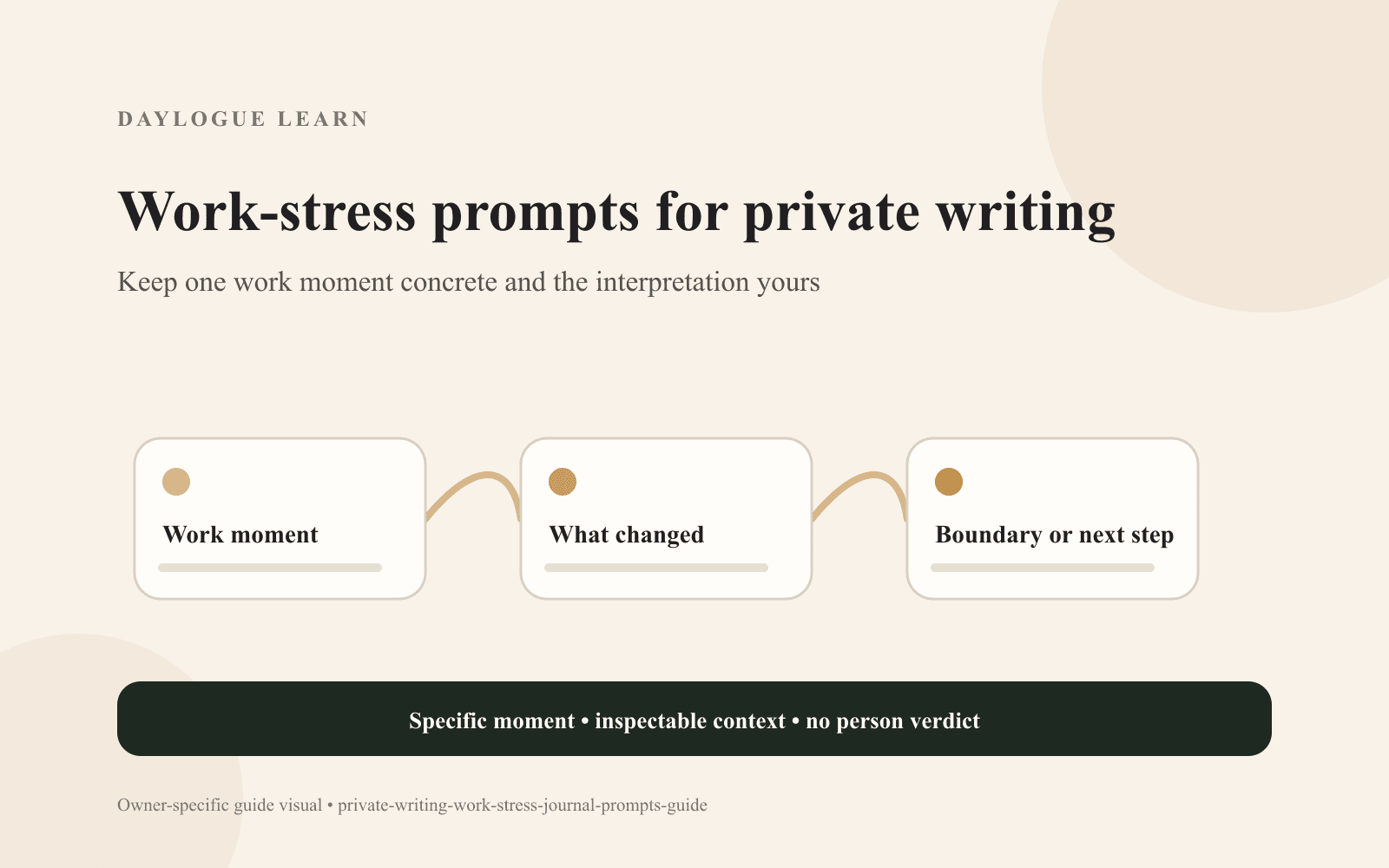
A private work stress entry should record one event with a date, the demand or change you can confirm, and the boundary or next step available to you. Keep confidential details broad. Separate workload facts from predictions about your performance or job. A clear record can prepare you to ask a better question without pretending the page knows what happens next.
Separate what happened from what you think it means
Make two short columns. In the first, record observable facts: the deadline moved, a request arrived without context, or a decision was postponed. In the second, record your current interpretation: ‘I think my work was dismissed’ or ‘I am worried the scope will change again.’ Mark the interpretation as provisional. Add one other explanation that could also fit, even if you do not prefer it. This is not forced optimism. It keeps uncertainty visible and prevents a confidential work note from pretending it can read another person’s motives or decide what one difficult exchange proves about your career.
Review the work note without grading yourself
Read for observable facts, current interpretations, and missing information. A delayed handoff or changed deadline can be recorded without becoming a score about your ability. Context does not remove responsibility. It makes the next question more accurate.
Also note the cost that a finished task may hide: interruptions, work moved elsewhere, or the time before your energy felt steadier. Those details describe conditions. They do not determine a grade about the person doing the work.
Turn the confidential work note into a question you can actually ask
A useful work reflection can prepare language without scripting a confrontation. Start with the shared object: a deadline, scope, handoff, decision, or responsibility. State what you observed without assigning a motive. Then ask for the missing information or propose a next step. ‘The delivery date moved twice this week. Which date should the team consider current, and who confirms future changes?’ is more answerable than ‘Why does nobody respect my time?’ Keep the journal version and the workplace version separate. The journal can hold uncertainty and emotion. The message you send should contain only the information needed for the work. If no conversation is appropriate tonight, write the earliest reasonable time to return and let the confidential work note end there. Leave one work clarification question open when the available context is incomplete.
Keep work stress expectations modest and inspectable
A 2025 systematic review examined 51 positive expressive writing studies, and the authors rated the included studies poor or fair in quality. The formats, topics, comparisons, and outcomes varied. Use that evidence as a reason to keep expectations modest, not as a promise that one question, schedule, or writing style will create a particular result.
Daylogue says its observations are designed for reflection, not diagnosis, prediction, treatment, or clinical decision-making. For this work stress guide, the useful standard is simpler: does the confidential work note preserve a documented work event, show what remains unknown, and leave the interpretation open to revision? If not, shorten or change the work clarification question.
Keep constraints visible without making a person verdict
Private work notes can hold the options that were actually available. Record what changed before the deadline, what notice you had, what support was available, and which tradeoff you made. Replace “I am unreliable” with the dated event that led to that thought.
A single completed task does not prove that the surrounding process works well, just as one missed deadline does not define a person. Keep both the result and the conditions on the page.
Use four work clarification question lenses: demand, control, support, and boundary
A demand work clarification question asks what the job or care task required. A control work clarification question asks which parts you could change. A support work clarification question asks what resource existed or was missing. A boundary work clarification question asks what you can state or protect next time. Move through only the lenses that fit the event. You do not need a complete analysis after every difficult day. Keep the confidential work note tied to the documented work event rather than a fixed identity.
Phrase questions so they can produce a concrete answer. “What is wrong with my balance?” is too broad and already implies failure. “Which change arrived too late for me to rearrange care?” points to timing. “What information would make the next handoff easier to plan?” points to a request. Keep the work clarification question close to the decision you may actually revisit. Keep the confidential work note tied to the documented work event rather than a fixed identity.
- What demand changed, and when did I learn about it?
- Which part of the collision was outside my control?
- What support existed but was hard to access?
- What request needs a clear owner and deadline?
- What boundary would protect care or focused work next time?
Compare planned load with surprise load
A packed day and a disrupted day are not the same source condition. Mark which duties were known when the day began and which arrived later. A planned appointment may require time but allow coordination; an unexpected schedule change may consume decision-making as well as minutes. Recording that distinction can clarify whether the question concerns volume, notice, ownership, or the absence of backup. Leave one work clarification question open when the available context is incomplete.
Use a second confidential work note to test the distinction. Find a high-load day that remained workable and ask what information or support was present. Then find a lower-load day that became difficult after a surprise. This comparison keeps “too much work” from covering several different problems. It also produces clearer language for a request because the note can name the condition that actually changed. Leave one work clarification question open when the available context is incomplete.
Choose one documented work event
Pick the work event that still needs clarity: a handoff with competing files, a meeting without a decision, or a request that arrived without enough context. Give it a date and a plain label. Keep confidential names, client details, and internal documents out of the entry.
Name what you want the note to do. It may preserve a sequence, prepare a question, or keep a tradeoff from blurring. If comparison would help, several dated examples can make the pattern easier to inspect, but you can stop with one record today.
Set a boundary for private work writing
Decide which work details belong in a personal note before you begin. Use roles instead of names, summarize the structure of a problem, and avoid copying confidential messages. On a managed device, consider who may have administrative access.
Set a time or length limit as well. One event, one open question, and one possible request may be enough. The note supports your own clarity. It does not need to become a complete account of the job.
Compare work notes only when it helps
If you have several relevant notes, place similar events beside one another and keep the dates attached. Look for what changed, what stayed fixed, and which example does not fit. An overlap can support another question, but it does not prove a cause.
If the notes are not comparable, leave them separate. Private writing does not owe you a pattern. A clear one-event record can still help you prepare a direct clarification or boundary.
Prompt Pack
Work Stress Journal Prompts for Private Writing: twelve prompts
Choose one question for a specific work stress moment, answer in your own words, and leave the interpretation open to later context.
- What happened in the work record?
- Which detail is confirmed?
- What changed without a clear decision?
- What am I predicting rather than observing?
- Which confidential detail can stay broad?
- Who owns the next decision?
- What question would reduce ambiguity?
- What boundary protects the agreed priority?
- What can I document without editorializing?
- What part of the pressure is structural?
- What action is mine to take?
- What conclusion about the job can wait?
Common questions
What happened in the work record?
Use this as a work clarification question about a handoff with two circulating files, no decision log, and unclear ownership. Answer with one observable detail first, then add your current reading only if it helps. You can stop after the record is clear.
What changed without a clear decision?
Keep the answer inside one documented work event. Write what changed, what stayed fixed, and which fact is missing. That structure prevents a limited confidential work note from becoming a verdict about a person or an entire period.
Who owns the next decision?
Put the direct answer in your own words and remove names that add nothing to the task. If the question assumes a motive or outcome, rewrite it so the missing context remains visible.
What can I document without editorializing?
Return to dated source lines before calling this a repeat. Look for an exception and an unrecorded gap. A repetition can support another question, but it cannot prove a cause by itself.
What conclusion about the job can wait?
Leave this unanswered when the available record is too thin. A useful private writing practice allows an open question, a visible gap, and a clean stopping point without inventing completion.
Sources
Sources were checked on the dates shown. Product details and policies can change.
- Daylogue evidence and methods · Daylogue · checked August 29, 2026
- Positive expressive writing systematic review · PLOS One · checked August 29, 2026
Keep exploring
Daylogue Knowledge Center
Browse practical guides for reflection, journaling, patterns, and privacy.
Read moreHow Daylogue shows patterns
See how candidate patterns stay connected to evidence and correction.
Read moreWhy Daylogue exists
Read the principles behind a system for self-understanding.
Read moreDaylogue is not therapy and is not a replacement for professional care.