Written by Daylogue Editorial Team. Published August 29, 2026. Reviewed and updated August 29, 2026.
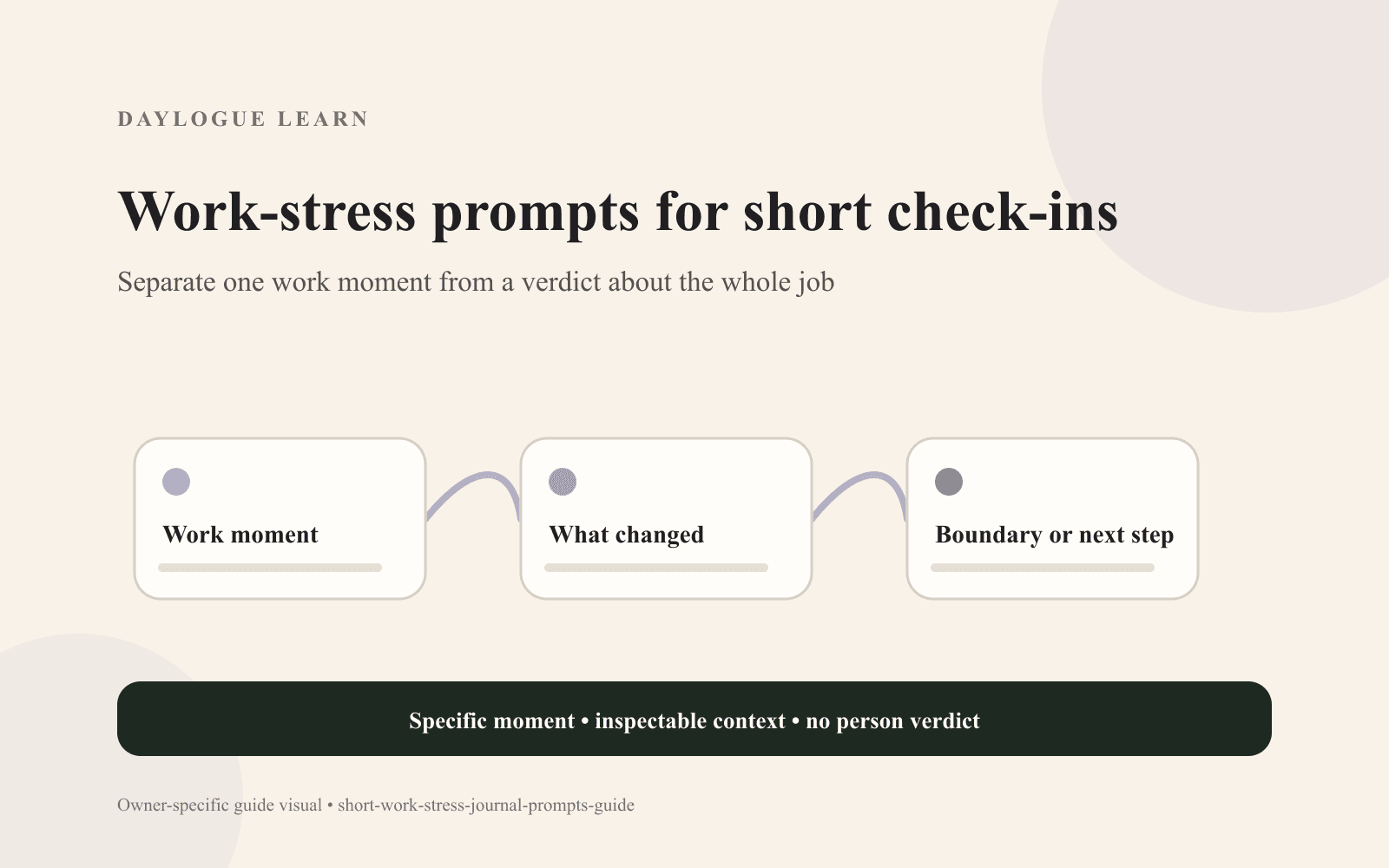
A useful short work stress check-in names one work moment, the change you noticed, and a possible boundary or next step. Write what the deadline, message, meeting, or interruption actually required. Then note what remains unknown. This keeps a difficult hour separate from a sweeping claim about your role, your ability, or the future of the job.
Start with the scene you can actually describe
Write the meeting, message, interruption, or decision that changed the shape of the day. Use concrete details that belong to you: where you were, what you were asked to do, the sentence you remember, and what happened next. Avoid beginning with ‘Everything is terrible’ or ‘I always fail.’ Those statements compress many events into a verdict that the brief work log cannot support. A scene gives you something you can inspect later. If several work scenes compete for attention, choose the one that still changes what you need to do or understand tomorrow.
Use five bounded work questions that lead somewhere concrete
Ask: What changed? What exact detail am I carrying? What part belongs to me, and what part requires another person or system? What information is missing? What is the smallest reasonable return point? Answer only the bounded work questions that fit. A delayed dependency may need a clarification request. A repeated interruption may need a boundary conversation. A harmful or unsafe situation may require workplace, union, campus, legal, emergency, or local support rather than more private reflection. Journaling does not transfer responsibility for difficult conditions onto the person experiencing them. Keep the brief work log tied to the work scene rather than a fixed identity.
Protect other people’s information and your own position
Keep confidential messages, client details, patient information, passwords, financial data, and internal documents out of a personal work note. Describe the structure of the event without reproducing protected content. “A client deadline moved” may be enough to preserve the pressure you want to examine.
Consider the device as well as the words. A managed work computer may allow administrative access. A personal device, paper note, or broader description may fit better when the event includes material that does not belong in a private journal.
Name the exact work-and-care collision
“Work was impossible” may capture the feeling of the day, but it hides the event you can inspect. Identify the collision: a meeting moved into pickup, a care call arrived during focused work, a shift changed with short notice, or an appointment required an unscheduled absence. Add the time and the decision it forced. This creates a useful record without pretending the whole job was contained in one work scene.
Separate the demands by source. What did the workplace require? What did care require? What did you assume you had to absorb without asking? The categories may overlap, but writing them apart can show where information arrived late, where a policy mattered, or where two reasonable needs simply could not fit in the same hour.
A worked example: the meeting that moved into pickup
A meeting moves from 2:00 to 4:30, overlapping a pickup planned weeks earlier. The source record includes the original time, the new notice, the pickup commitment, and the options considered. The first interpretation may be, “My family responsibilities are invisible here.” Keep it, but label it as your reading rather than an established motive. Keep the brief work log tied to the work scene rather than a fixed identity.
For this short check-in task, let “A worked example: the meeting that moved into pickup” have a narrow job. Use one bounded work question, answer with a dated action or phrase, and stop before the answer turns into a verdict. If the first explanation feels certain, list one missing fact and one counterexample you would need to check before keeping it.
Keep work stress expectations modest and inspectable
A 2025 systematic review examined 51 positive expressive writing studies, and the authors rated the included studies poor or fair in quality. The formats, topics, comparisons, and outcomes varied. Use that evidence as a reason to keep expectations modest, not as a promise that one question, schedule, or writing style will create a particular result.
Daylogue says its observations are designed for reflection, not diagnosis, prediction, treatment, or clinical decision-making. For this work stress guide, the useful standard is simpler: does the brief work log preserve a work scene, show what remains unknown, and leave the interpretation open to revision? If not, shorten or change the bounded work question.
Protect work, client, and family information
Leave confidential messages, client details, other people's check-in records, patient information, passwords, financial data, and internal documents out of a personal journal. Describe the structure of the event without reproducing protected content. “A client deadline moved” may be enough. On a managed work device, assume an administrator may have access and choose a private device or offline note when appropriate. Leave one bounded work question open when the available context is incomplete.
For this short check-in task, let “Protect work, client, and family information” have a narrow job. Use one bounded work question, answer with a dated action or phrase, and stop before the answer turns into a verdict. If the first explanation feels certain, list one missing fact and one counterexample you would need to check before keeping it.
Use three lanes: event, interpretation, open question
Divide the note into three lanes. The event lane holds the deadline, request, meeting, or interruption you can confirm. The interpretation lane holds your current reading, clearly labeled as provisional. The open-question lane names what you still need to know before making a broader conclusion.
This structure does not ask you to dismiss frustration. It gives each statement the right weight. A later message can add context, an exception can narrow the first reading, and an unanswered question can remain unanswered.
Set the privacy line before adding work detail
Work notes can contain names, customer information, personnel matters, legal advice, financial plans, security details, or material covered by an agreement. Decide what does not belong in a personal journal before the writing becomes specific. Replace names with roles when identity is unnecessary. Preserve the shape of a problem without copying protected material. “The owner changed after approval” may be enough to remember why the timeline became difficult. If the exact facts are required for a formal report, use the approved workplace channel for that purpose. Keep the brief work log tied to the work scene rather than a fixed identity.
For this short check-in task, let “Set the privacy line before adding work detail” have a narrow job. Use one bounded work question, answer with a dated action or phrase, and stop before the answer turns into a verdict. If the first explanation feels certain, list one missing fact and one counterexample you would need to check before keeping it.
Decide whether this format still earns a place
After two weeks or three uses, review the practice rather than grading yourself. Could you begin without negotiating with a blank page? Did the format protect confidential information? Could you tell the event apart from the conclusion? Was the note easy to find when you needed it? If the brief work log collected detail you never revisited, shorten it. If every note became a broad complaint with no setting or exception, add one context question. If speaking felt exposed, switch to typing or paper in a private location. Leave one bounded work question open when the available context is incomplete.
The right return may be occasional. You can keep a compact decision note for complicated tradeoffs and leave other days unrecorded. You can use a weekly review only when several brief work logs point to the same question. You can stop again without losing anything you earned. The point is a clearer record of work scenes that matter to you, not continuous attendance. A useful work journal fits beside the work. It does not become another manager watching the clock. Leave one bounded work question open when the available context is incomplete.
Prompt Pack
Work Stress Journal Prompts for Short Check-Ins: twelve prompts
Choose one question for a specific work stress moment, answer in your own words, and leave the interpretation open to later context.
- What work moment am I recording?
- What changed from the original plan?
- Which demand is confirmed?
- Which pressure am I adding myself?
- What information is still missing?
- What can be clarified in writing?
- What boundary would protect the current priority?
- What is the smallest next action?
- Who owns the decision I am waiting on?
- What can move without causing harm?
- What did I handle adequately today?
- What conclusion can wait until the situation changes?
Common questions
What work moment am I recording?
Use this as a bounded work question about a review that added two deliverables while the due date stayed fixed. Answer with one observable detail first, then add your current reading only if it helps. You can stop after the record is clear.
Which demand is confirmed?
Keep the answer inside one work scene. Write what changed, what stayed fixed, and which fact is missing. That structure prevents a limited brief work log from becoming a verdict about a person or an entire period.
What can be clarified in writing?
Put the direct answer in your own words and remove names that add nothing to the task. If the question assumes a motive or outcome, rewrite it so the missing context remains visible.
Who owns the decision I am waiting on?
Return to dated source lines before calling this a repeat. Look for an exception and an unrecorded gap. A repetition can support another question, but it cannot prove a cause by itself.
What conclusion can wait until the situation changes?
Leave this unanswered when the available record is too thin. A useful short check-in practice allows an open question, a visible gap, and a clean stopping point without inventing completion.
Sources
Sources were checked on the dates shown. Product details and policies can change.
- Daylogue evidence and methods · Daylogue · checked August 29, 2026
- Positive expressive writing systematic review · PLOS One · checked August 29, 2026
Keep exploring
Daylogue Knowledge Center
Browse practical guides for reflection, journaling, patterns, and privacy.
Read moreHow Daylogue shows patterns
See how candidate patterns stay connected to evidence and correction.
Read moreWhy Daylogue exists
Read the principles behind a system for self-understanding.
Read moreDaylogue is not therapy and is not a replacement for professional care.