Written by Daylogue Editorial Team. Published August 31, 2026. Reviewed and updated August 31, 2026.
Evening journal prompts for beginners work best when they help the day land, not when they demand a complete account. One possible entry names the scene still replaying, moves tomorrow’s task into a separate list, and records what remains unresolved. A few lines are enough, and sleep can take priority over finishing.
An evening entry can be a landing strip
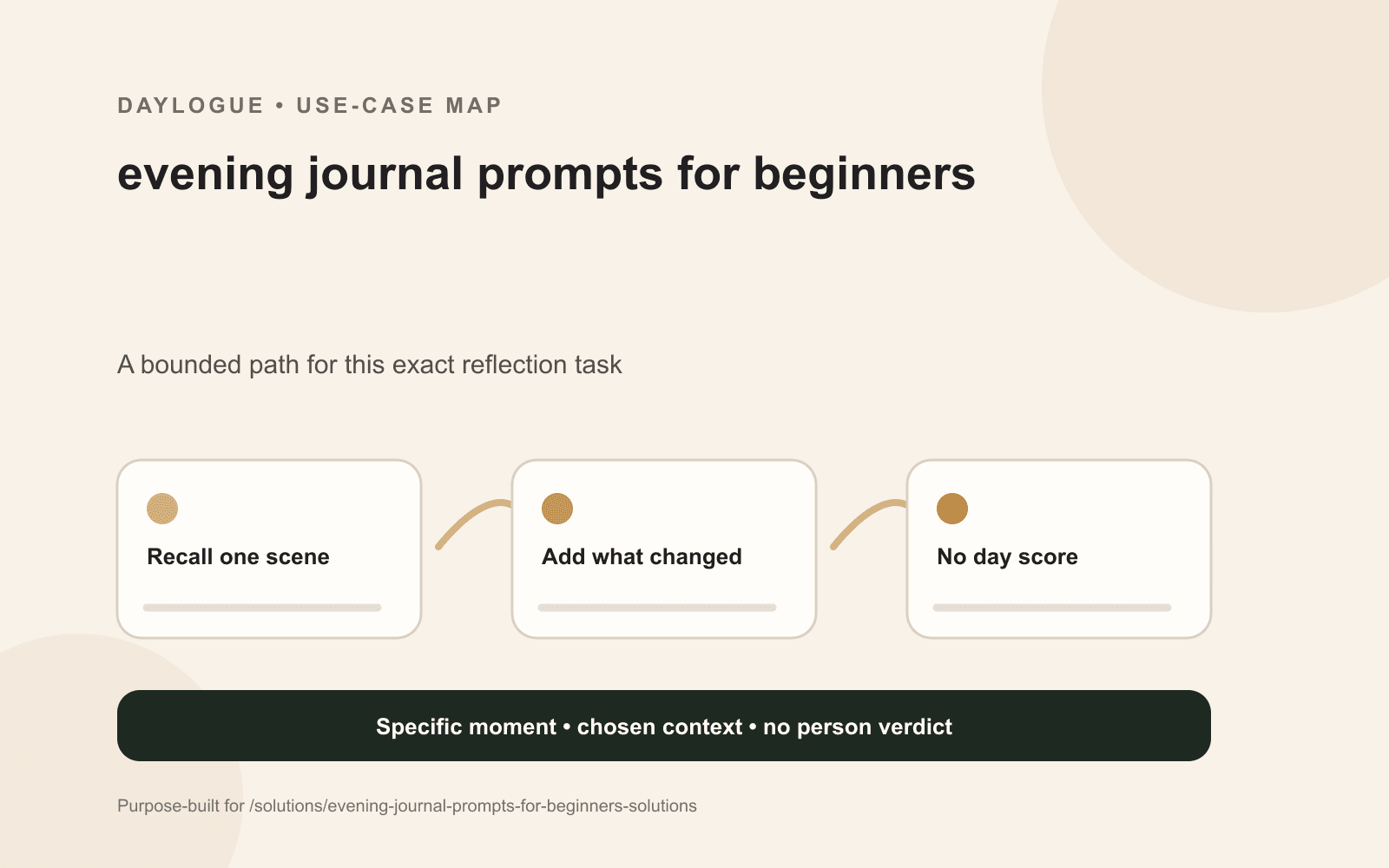
By evening, the mind often mixes several jobs together. A conversation is replaying, tomorrow’s errands are competing for attention, and the body is ready to stop. One prompt cannot solve all of that. It can, however, give each piece a place. “What scene is still with me?” keeps reflection close to an actual moment instead of asking for a summary of the entire day.
The next line might describe the setting, one sentence someone said, or the moment the writer’s attention shifted. That level of detail makes the note recognizable later. “Dinner felt weird” may be true, while “everyone went quiet after the travel question” gives the future reader something they can inspect without pretending to know what everyone meant.
A beginner may stop after that scene. An entry does not need a moral, a solution, or a grateful ending. The day already happened. The journal’s role is to preserve what matters now, with room for the writer to understand it differently tomorrow.
Unfinished tasks can have a different home
A loose end can keep appearing in reflective writing because the mind is trying not to lose it. A separate “tomorrow” line can hold the practical item: send the form, call the dentist, bring the charger. Once captured, it no longer has to occupy every answer about the day.
This separation protects the journal from turning into a productivity report. “I still need to revise the deck” belongs in the task lane. “I kept avoiding the slide with the uncertain number” may belong in reflection. The two are related, but they serve different purposes and can be written in different places.
Some evenings contain no insight beyond tiredness and a list of unfinished work. A brief entry can say exactly that. Rest does not have to be earned through a thorough review, and an incomplete journal entry does not create another obligation for the morning.
01
The replaying scene
A sentence may preserve the moment that still has energy, including a concrete detail that makes it recognizable.
02
The practical loose end
A separate line can park a task without requiring the journal to become a planning system.
03
The open edge
A final line may name what remains unclear, or the entry can end before an explanation appears.
Closure is optional
Some prompts imply that every day can be wrapped up neatly. Real evenings do not always cooperate. A disagreement may still be active, news may still be developing, or the writer may not know what they think. “What remains unresolved?” respects that reality and makes uncertainty part of the record.
A stopping ritual can be physical rather than interpretive: close the notebook, dim the screen, or write the time. It marks that the writing period ended, not that the issue was solved. The distinction matters because reflection can otherwise become another attempt to force certainty before bed.
Returning later is optional. If the writer does return, the original wording provides a timestamped view rather than a promise to continue. If they never return, the entry still did its job by holding the moment long enough for the night to move on.
A fair reread keeps nighttime context
Evening entries are written after the day has used up attention. Their tone may differ from morning writing, and that difference does not prove that nighttime thoughts are more true or less true. The hour, fatigue, recent conversation, and setting all belong beside the words when someone revisits them.
A repeated phrase across several nights can be noted as repetition. It cannot establish a cause by itself. The writer may look at the source scenes, the nights when the phrase did not appear, and any changes in schedule before deciding whether the repetition deserves another question.
A narrow review window keeps the task humane. Three recent evenings or the nights around a specific event offer enough material for comparison without inviting a sweeping verdict about the person or their life.
Privacy questions do not disappear at bedtime
Evening writing can become more candid because the day is over and the writer expects solitude. The device may still be shared, the account may still belong to work or school, and a cloud journal may still process readable text. A lock screen protects one boundary, not every boundary.
Daylogue reads the entries you choose to sync to create narratives and surface patterns. Entries are not end-to-end encrypted.
NIST describes its Privacy Framework as a voluntary tool intended to help organizations identify and manage privacy risk.
For evening entries, candor often increases just as attention to settings decreases. Notification previews, a shared bedside device, and automatic syncing are concrete parts of the bedtime setup that a writer can inspect.
What different endings can sound like
A work-heavy ending might read, “The client call is still replaying because I answered too quickly. The follow-up email belongs on tomorrow’s list. I do not know yet whether the answer was wrong or only rushed.” The journal holds the scene and uncertainty, while the task moves elsewhere.
A social ending may say, “Dinner became quiet after the travel question. I noticed the silence, and I am guessing it meant discomfort. Those are not the same fact.” That distinction keeps the writer’s interpretation without presenting it as everyone else’s intent.
An ordinary ending can be one line: “The towels finally dried on the balcony, and the hallway smelled like someone’s toast.” Nothing dramatic happened. The detail still belongs to the day. Ordinary notes keep a journal from becoming a record written only when something goes wrong.
An unfinished ending might say, “I am too tired to know what I think about the message. I saved the exact wording, and I am stopping here.” The stopping sentence is part of the record. It explains the limit without promising a return.
The journal may also stay closed on a night when sleep is the clearer priority. Nothing has to be captured for the day to remain real. An evening routine earns trust by making that choice visible rather than treating rest as a missed opportunity.
A place for what the day left behind
Daylogue is a system for self-understanding. Pattern journaling is how it reads you. An evening check-in can hold a chosen scene, the writer’s own words, and the uncertainty around them. Later readbacks can point back to that material instead of presenting an unsupported conclusion.
There are no streaks to maintain. A night without an entry is simply a night without an entry. A month with uneven notes may still preserve the moments that mattered enough to record, and the gaps remain visible rather than being filled with guesses.
Daylogue is not therapy and is not a replacement for professional care. It cannot resolve conflict or decide what an evening means. The useful promise is smaller and more honest: a place where a day can be remembered without being graded.
Worksheet
The evening landing-strip worksheet
A four-part page that separates the scene worth remembering from tomorrow’s task, an open question, and the choice to stop.
- The scene still replaying is…
- The exact detail I want to keep is…
- The task that belongs somewhere else is…
- What I know right now is…
- What I am interpreting is…
- One thing that remains unresolved is…
- Enough for tonight might be one sentence, a fragment, or nothing more.
Common questions
What are simple evening journal prompts for beginners?
A beginner might start with “What scene is still replaying?”, “What belongs on tomorrow’s list?”, or “What small detail would disappear by morning?” Each question has a different job. One preserves a scene, one parks a task, and one keeps an ordinary detail from being lost.
How long does an evening entry have to be?
There is no required length. A fragment can be enough on an exhausted night, while a longer entry may fit when the writer wants room. The visible stopping point matters more than volume. The practice can end before an explanation or conclusion appears.
Is it okay to journal about negative feelings before bed?
An evening entry can include difficult, neutral, positive, or mixed feelings. The prompt does not have to redirect the writer toward positivity. If writing feels activating rather than useful, stopping, changing the question, or leaving the entry blank remains available.
Do I have to reread my evening journal?
No. Some people value the act of recording and do not want a review routine. A later reread may help when a specific question arises, but it works best with a defined window and the original entries in view. No interpretation is required.
Can evening journal prompts explain a recurring problem?
They can preserve scenes and show when similar wording appears. They cannot establish why a problem occurs from repetition alone. Exceptions, missing days, context, and the writer’s changing interpretation all limit what the record can support.
Sources
Sources were checked on the dates shown. Product details and policies can change.
- NIST Privacy Framework · National Institute of Standards and Technology · checked August 31, 2026
- Daylogue privacy policy · Daylogue · checked August 31, 2026
Keep exploring
Daylogue Knowledge Center
Browse practical guides for reflection, journaling, patterns, and privacy.
Read moreHow Daylogue shows patterns
See how candidate patterns stay connected to evidence and correction.
Read moreWhy Daylogue exists
Read the principles behind a system for self-understanding.
Read moreDaylogue is not therapy and is not a replacement for professional care.