Written by Daylogue Editorial Team. Published August 31, 2026. Reviewed and updated August 31, 2026.
Gratitude journal prompts for beginners can focus on what happened rather than how grateful someone ought to feel. A writer might name the person who made one task lighter, the object that worked when it was needed, or a small comfort that did not erase a hard day. Appreciation and difficulty can share the same page.
Gratitude becomes clearer when it has an object
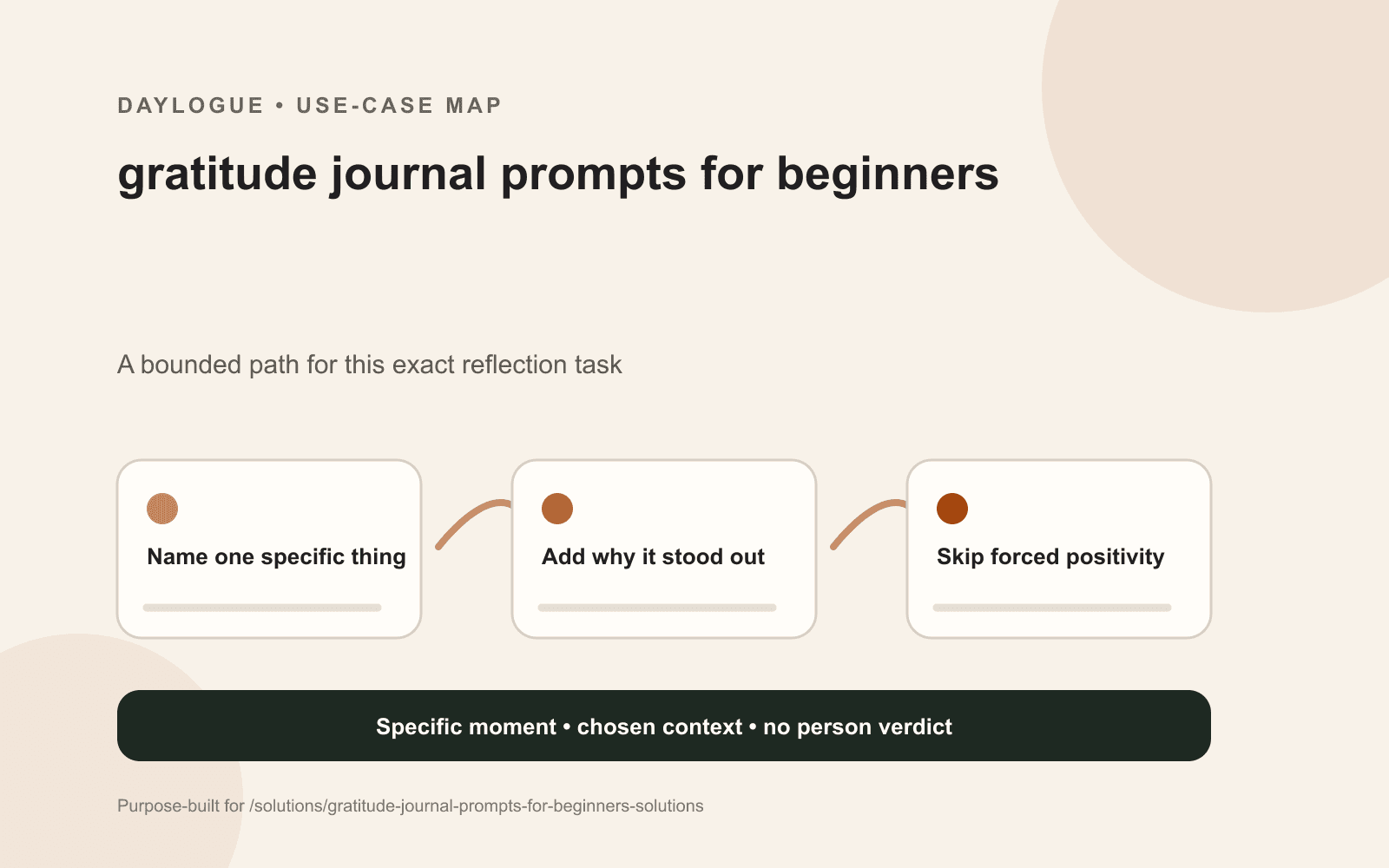
“I am grateful for my family” may be true, but it can become a line repeated without much contact with the day. A more useful prompt asks what someone did. “My sister called while I waited for the mechanic” preserves an action, a setting, and a reason the moment mattered. The detail keeps the note from becoming a performance of gratitude.
Objects and systems can belong too. A bus arriving in the rain, a chair that supported a sore back, or a password manager that worked on a stressful morning may deserve a line. Gratitude does not have to be profound. Ordinary reliability is part of a life, and it is often what disappears first from memory.
A place can be the object of attention without being idealized. The corner table was available. The hallway was quiet for five minutes. The park had a dry bench. Specificity lets the writer notice what helped without turning the whole place or day into something it was not.
A hard day does not have to become a good day
A gratitude prompt can make room for two truths. “The appointment was draining, and the receptionist explained the form patiently” records help without rewriting the larger experience. The useful word is “and.” It keeps appreciation from being used to argue against frustration, grief, anger, or fatigue.
Some days contain nothing the writer wants to frame as gratitude. A neutral alternative might ask, “What was less difficult because of someone or something?” Another option is no answer. The practice stays voluntary when the page does not demand a positive emotion as proof of participation.
Complicated relationships call for the same care. Appreciating one action does not excuse every action or settle what the relationship means. “They brought dinner” can stand on its own. The entry does not owe anyone a broader verdict.
Four prompt families that avoid a generic list
An action prompt asks, “Who changed the shape of one task today?” A sensory prompt asks, “What sound, texture, taste, or patch of light made a minute easier?” A resource prompt notices what was available at the right time. An effort prompt records work that might otherwise go unseen, including the writer’s own effort.
These families create different records. A week of action prompts may reveal who repeatedly shows up. Sensory notes preserve the texture of ordinary days. Resource notes can make infrastructure visible. Effort notes can acknowledge labor without declaring that the result was successful.
The writer may rotate among them or ignore the categories entirely. Their purpose is to offer angles when the blank page feels too broad, not to become a sequence that has to be completed.
| Focus | Possible question | What it preserves |
|---|---|---|
| Action | Who made one task lighter, and what did they do? | A person in a concrete scene |
| Object | What worked when I needed it? | Ordinary reliability |
| Sensation | What gave one minute of comfort? | A detail without a grand lesson |
| Effort | Whose effort did I notice? | Labor without judging the outcome |
The prompt can be wrong for the moment
A question may arrive with an assumption the writer does not share. “What blessing came from this challenge?” asks for a benefit that may not exist. Editing it to “What happened, and what helped me get through the next hour?” removes the demand for redemption while keeping attention on available support.
A prompt can also feel too intimate for the device or setting. The writer might switch to a vague placeholder, keep the detail offline, or leave the page blank. Privacy and emotional fit are separate decisions, and either can be a reason not to answer.
Repeatedly skipping one question may reveal that the wording is poor, not that the person is resistant. A useful prompt serves the writer. The writer does not serve the prompt.
A reread can notice support without scoring gratitude
A later review may group the notes by people, places, objects, actions, or times of day. That can make recurring sources of support easier to retrieve. It does not measure how grateful the writer is, and the number of entries does not say whether they appreciated life enough.
Exceptions deserve space. If a usually reliable routine failed during one difficult week, that entry may explain why the week felt different. If a person appears in several helpful scenes and one hurtful scene, the record can hold all of them without averaging the relationship into a score.
A bounded question keeps the review honest: “What helped during the last five workdays?” is more answerable than “What always makes me happy?” The first stays close to evidence. The second asks a small record to support a universal claim.
Gratitude entries can still contain private material
A note about another person may include their name, health information, workplace details, or a conflict the writer does not want widely available. A warm subject does not make the content low-risk. Account ownership, syncing, export, deletion, and retention remain relevant even when the entry sounds positive.
Daylogue reads the entries you choose to sync to create narratives and surface patterns. Entries are not end-to-end encrypted.
NIST describes its Privacy Framework as a voluntary tool intended to help organizations identify and manage privacy risk.
A gratitude note about someone else can still identify their location, health, work, or family situation. Warm subject matter does not transfer ownership of another person’s story to the writer or to the service.
Examples that keep the whole scene
“The mechanic explained the charge before doing the work. The repair was still expensive, and I appreciated not being surprised.” The appreciation is specific and does not erase frustration. A later review could retrieve clear communication as helpful in that moment without declaring the entire experience positive.
“My friend sent a picture of her dog while I waited for the test result. It made two minutes lighter. I was still scared.” The note gives comfort its real size. It avoids claiming that gratitude changed the situation or that fear became inappropriate once something kind happened.
“The grocery cart had one wheel that worked properly, which was more useful than it sounds.” An object can earn attention because it made an ordinary task easier. Gratitude writing does not have to prove moral growth or focus only on people and major events.
“I cannot find anything I want to call gratitude tonight. My neighbor brought in the package, and I noticed the effort.” This entry keeps distance between observation and emotion. Noticing help does not require the writer to produce a feeling on demand.
A varied record notices more than people
A gratitude journal can become repetitive when every entry begins with the same three categories. Expanding the field changes what becomes visible. Tools, public spaces, timing, weather, maintenance work, and small acts of foresight can all shape a day without becoming sentimental symbols.
One week might include the crossing guard who paused traffic, the library outlet that worked, a friend who sent directions, and the writer who packed lunch the night before. These are different kinds of support. Grouping them later is optional, and no category carries more moral value than another.
The page can also record support that was unavailable. “I appreciated the bench, and I needed shade that was not there” keeps both details. Gratitude does not require silence about what remains inadequate.
How Daylogue can hold appreciation in context
Daylogue is a system for self-understanding. Pattern journaling is how it reads you. A gratitude entry can sit beside other check-ins rather than becoming a separate record of approved emotions. The difficult part of the day can remain visible with the helpful detail.
Over time, a readback may help retrieve repeated people, settings, or practical supports from what the writer chose to share. The source entries remain the anchor. A repetition is not proof of cause, and a missing name does not mean a person was unimportant.
Daylogue is not therapy and is not a replacement for professional care. It does not prescribe gratitude, evaluate a person’s outlook, or claim that appreciation fixes distress. The page offers questions, and every question can be changed, skipped, or left unfinished.
Prompt Pack
The specific gratitude prompt deck
Optional questions for noticing help, comfort, reliability, and effort without forcing a difficult day into a positive story.
- Who changed the shape of one task today?
- What worked at the moment I needed it?
- What gave one minute of comfort without fixing the whole day?
- Whose effort did I notice, including my own?
- What place gave me a little room?
- What support was easy to overlook?
- What felt difficult alongside the thing I appreciated?
Common questions
What are good gratitude journal prompts for beginners?
Specific prompts often work better than broad requests for a list. Examples include “Who changed the shape of one task?”, “What worked when I needed it?”, and “What gave one minute of comfort?” The response can be a single scene rather than a statement about the entire day.
Can I use gratitude prompts after a bad day?
Yes, if the prompt feels useful, but the day does not have to be reframed as good. A note can say that something was painful and someone offered help. It can also contain no gratitude at all. The writer’s experience does not have to bend to the exercise.
What if gratitude journaling feels fake?
That reaction may point to a prompt that is too broad, too positive, or poorly timed. A neutral question about what made one task less difficult can feel more grounded. Skipping gratitude language entirely is also valid. No emotional response is required.
How many things belong in a gratitude entry?
One specific item is enough. A long list may fit some days, but volume is not a measure of sincerity or wellbeing. One action, object, place, or sensory detail often gives a later reader more context than ten generic nouns.
Can a gratitude journal show a pattern?
Several entries may show recurring people, places, or resources. That repetition can support a question about what helped during a defined period. It cannot prove cause, assign value to a relationship, or show that an unmentioned person mattered less.
Sources
Sources were checked on the dates shown. Product details and policies can change.
- NIST Privacy Framework · National Institute of Standards and Technology · checked August 31, 2026
- Daylogue privacy policy · Daylogue · checked August 31, 2026
Keep exploring
Daylogue Knowledge Center
Browse practical guides for reflection, journaling, patterns, and privacy.
Read moreHow Daylogue shows patterns
See how candidate patterns stay connected to evidence and correction.
Read moreWhy Daylogue exists
Read the principles behind a system for self-understanding.
Read moreDaylogue is not therapy and is not a replacement for professional care.