Written by Daylogue Editorial Team. Published August 31, 2026. Reviewed and updated August 31, 2026.
A journal app that finds patterns for students can be useful when every readback points to the dated source entries, names the time window, and shows exceptions beside repetitions. The app can suggest that a scene appeared more than once. It cannot define a student, infer a hidden motive, or turn sparse notes into certainty.
“Finds patterns” can describe several different jobs
Some journal apps count repeated tags. Others group similar words, compare self-reported values, or write a narrative summary. Those are different methods with different limits. A student evaluating a pattern feature benefits from knowing what information entered the result and whether the original material can be reopened.
A count is not automatically an explanation. Three entries mentioning a crowded lab show that the lab appeared three times. They do not prove that crowding caused a feeling or that every lab visit was difficult.
A generated sentence can sound more certain than the underlying record. “You struggle in group settings” is a person verdict. “Two entries this month describe difficulty speaking during graded group work” names the source window and the situation instead.
Four signs that a readback can be inspected
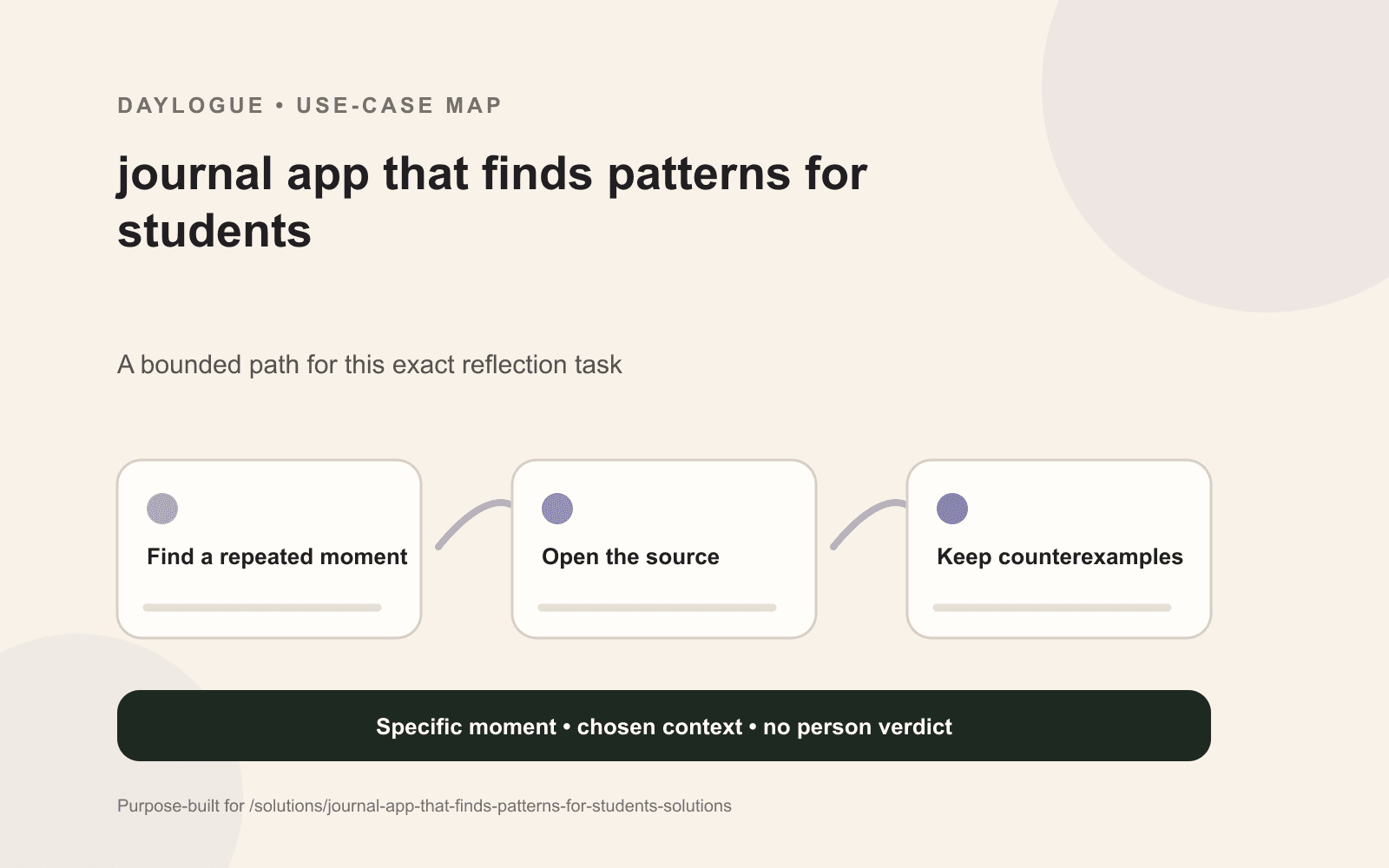
First, the result links back to the entries that contributed to it. A student can see whether the cited scene matches their memory and whether a transcription or summary changed an important detail.
Second, the time window is explicit. “In three entries between September 8 and September 19” is easier to evaluate than “lately” or “often.” Third, exceptions appear in the same view rather than being hidden because they weaken the pattern.
Fourth, the student can reject, edit, or correct the result. A correction matters only if it changes what the system carries forward. A decorative feedback button that leaves the same statement in future readbacks does not provide meaningful control.
| Element | Useful evidence | Reason for caution |
|---|---|---|
| Source | Dated entries remain visible | The result offers no trace back |
| Window | Start and end dates are named | Words such as always or usually appear without counts |
| Exception | Counterexamples sit beside repeats | Only supporting scenes are shown |
| Correction | A rejection changes future use | Feedback disappears without effect |
Student life changes the meaning of a repeat
A semester contains abrupt context shifts. Midterms, breaks, changing roommates, sports seasons, new jobs, and different class formats can make two weeks hard to compare. A responsible readback keeps those transitions visible instead of blending the entire school year into one profile.
The same phrase may mean different things in different settings. “I could not focus” during a noisy lecture, after an overnight shift, and while waiting for family news does not necessarily describe one stable cause. The source scenes prevent identical wording from becoming an overly tidy story.
Sparse entries deserve equal care. If a student writes only after major events, the journal will overrepresent major events. The app can state that limit. It cannot fill ordinary days with assumptions.
Worked audit: the Tuesday afternoon claim
A readback says, “Tuesday afternoons tend to feel crowded.” The cited entries show a lab running late on one Tuesday and a club meeting overlapping dinner on another. A third Tuesday entry describes an open afternoon spent reading outside.
The claim has a real repetition around scheduling, plus a clear exception. A more careful version might say, “Two Tuesday entries this month describe back-to-back commitments, while one Tuesday was unstructured.” That wording is less dramatic and more useful because the student can see the conditions.
The student may decide the time slot matters, or they may think the sample is too small. Both responses are valid. The app’s role is to make the evidence inspectable, not to win an argument about the student’s week.
Pattern features require readable material somewhere in the system
A pattern cannot be produced from text a service never processes. The privacy question is therefore not only whether an app trains a model. It also includes what content syncs, where processing happens, which outputs are stored, how long they remain, and what account controls apply.
A student may keep names out of entries, use a personal rather than institutional account, or reserve certain details for an offline journal. Those choices reduce some exposure without creating an absolute privacy promise.
The feature description benefits from plain language about inputs and outputs. “Private AI” is too broad if the service does not explain whether entries and generated readbacks are server-readable.
Source-aware patterns and privacy risk belong together
Pattern features concentrate information across entries. A single note may reveal little, while a readback can connect people, times, and situations. That makes source access useful for accuracy and makes account, processing, deletion, and retention details important for privacy.
Daylogue reads the entries you choose to sync to create narratives and surface patterns. Entries are not end-to-end encrypted.
NIST describes its Privacy Framework as a voluntary tool intended to help organizations identify and manage privacy risk.
The student-pattern page joins accuracy and privacy because both depend on source visibility. The writer needs enough traceability to inspect a claim, while the service still needs clear limits around who processes and stores that material.
Questions worth asking before trusting a pattern screen
The first question is about scope: which entries, fields, tags, transcripts, or calendar features contributed? The second is about timing: does the system compare the same day, a recurring slot, or a different window? Vague answers make a specific-looking claim harder to defend.
The third question is about absence. Does the screen show days with no entry, or does it silently classify them as neutral? Missing information is not the same as a normal day. The fourth question asks whether an exception can weaken or remove a stored pattern.
The fifth question is about language. Counts and dated scenes are easier to inspect than words such as “always,” “deep down,” or “the real you.” The sixth asks what happens after rejection. A student does not have to keep correcting the same identity claim forever.
The final question concerns downstream use. A personal readback does not belong in a hiring, academic, disciplinary, or eligibility score. Reflection stays with the person unless a separate, informed sharing choice says otherwise.
A pattern is not a personality type
A recurring scene describes what appeared in a particular record. A personality type claims something broader about the person. Moving from the first to the second requires evidence and assumptions that ordinary journal entries do not provide.
Student language changes with assignment, audience, role, culture, sleep, deadlines, and setting. A formal class reflection may sound unlike a private voice note from the same afternoon. The difference does not reveal which version is the “real” person.
An app can offer a tentative observation without converting it into identity. “You mentioned preparation in three presentation entries” stays inspectable. “You are a conscientious person” goes beyond the scenes and can become sticky even when the student rejects it.
Keeping readbacks event-based also helps them age well. A semester-specific scheduling pattern can expire when classes change. A person label tends to follow the student long after the conditions that produced it disappear.
Product labels such as insight, trend, or pattern can make tentative outputs feel established. The student can translate the label back into a plain sentence about the evidence: what appeared, how many times, during which dates, and what did not fit. That translation often reveals whether the screen is genuinely informative or simply confident.
A good readback can survive disagreement. If the student says the scenes were connected by a course deadline rather than a social setting, the system can preserve that correction. The purpose is a more faithful record, not a defense of the original model output.
A student may also want the readback deleted while keeping the underlying entries. Separate controls for sources and generated interpretations make that distinction possible and easier to understand. A version date can show which readback existed before a correction changed the record.
How Daylogue frames student patterns
Daylogue is a system for self-understanding. Pattern journaling is how it reads you. It works from what people choose to share and does not infer emotion from faces, voice tone, or physiology.
A Daylogue readback can surface a possible connection and keep supporting entries available. The student can disagree, correct the wording, or decide that the pattern does not fit. No composite score or fixed identity is required.
Daylogue is not therapy and is not a replacement for professional care. It cannot evaluate academic potential or decide why a student behaves a certain way. The app can help a person inspect their own record, with the limits visible.
Checklist
Student pattern readback audit
A checklist for testing whether a journal app shows its sources, limits, exceptions, and correction path before a student accepts a readback.
- The result links to dated source entries.
- The start and end of the review window are visible.
- The wording counts or describes the repetition precisely.
- At least one counterexample can appear beside the claim.
- Missing days are not filled with assumptions.
- A student can reject or correct the interpretation.
- The service explains what changes after a correction.
- No person score or fixed identity is created.
Common questions
How does a journal app find patterns in student entries?
Methods vary. An app might count repeated tags, compare self-reported fields, group similar themes, or generate a summary from selected entries. A useful product explains its inputs and lets the student inspect the source material behind the result.
How many entries are enough for a journal pattern?
There is no universal number. A small set can support a narrow observation such as a phrase appearing twice. Stronger claims require more relevant material, a clear time window, and attention to missing periods and exceptions.
Can a journal app identify a student’s personality?
Journal language changes with topic, audience, assignment, culture, role, and the day itself. A few entries cannot support a fixed identity. A responsible readback stays tentative, shows contributing passages, and allows the student to reject the interpretation.
What makes an AI journal insight trustworthy?
Trust comes from inspectability rather than confidence. Dated sources, explicit windows, visible counterexamples, correction controls, and restrained wording help a student evaluate a claim. The student may still disagree with a technically traceable result.
Are student journal pattern features private?
That depends on the device, account, service, syncing, model processing, storage, export, deletion, and retention terms. A school-managed account may introduce different controls from a personal one. “No training” answers only one part of the privacy question.
Sources
Sources were checked on the dates shown. Product details and policies can change.
- NIST Privacy Framework · National Institute of Standards and Technology · checked August 31, 2026
- Daylogue privacy policy · Daylogue · checked August 31, 2026
Keep exploring
Daylogue Knowledge Center
Browse practical guides for reflection, journaling, patterns, and privacy.
Read moreHow Daylogue shows patterns
See how candidate patterns stay connected to evidence and correction.
Read moreWhy Daylogue exists
Read the principles behind a system for self-understanding.
Read moreDaylogue is not therapy and is not a replacement for professional care.