Written by Daylogue Editorial Team. Published August 31, 2026. Reviewed and updated August 31, 2026.
Morning journal prompts for beginners can be as small as one question about the next few hours. A writer might name the first fixed commitment, what feels unresolved from yesterday, or what would make the morning feel less crowded. Two honest sentences count. Skipping the practice or stopping midway is always available.
The clock comes before a life lesson
The morning already has a shape before a journal opens. There may be a train to catch, a child who needs breakfast, a meeting at nine, or twenty quiet minutes before anyone else wakes. A useful first prompt stays near that shape: “What is already decided about this morning?” The answer may be plain, and plain is useful because it gives later reflection a real scene.
A second question can notice the part that still feels open. “Where do I have room to choose?” might lead to a small answer such as taking lunch away from the desk or leaving one email until after the first meeting. The point is not to optimize the day. It is to separate what is fixed from what is still flexible.
Some mornings offer almost no room. On those days, a date and one line may be the whole entry: “Up late with the baby, presentation at ten, running on coffee.” That line preserves more context than a generic mood label. It also keeps the practice honest about the day instead of asking for calm that is not present.
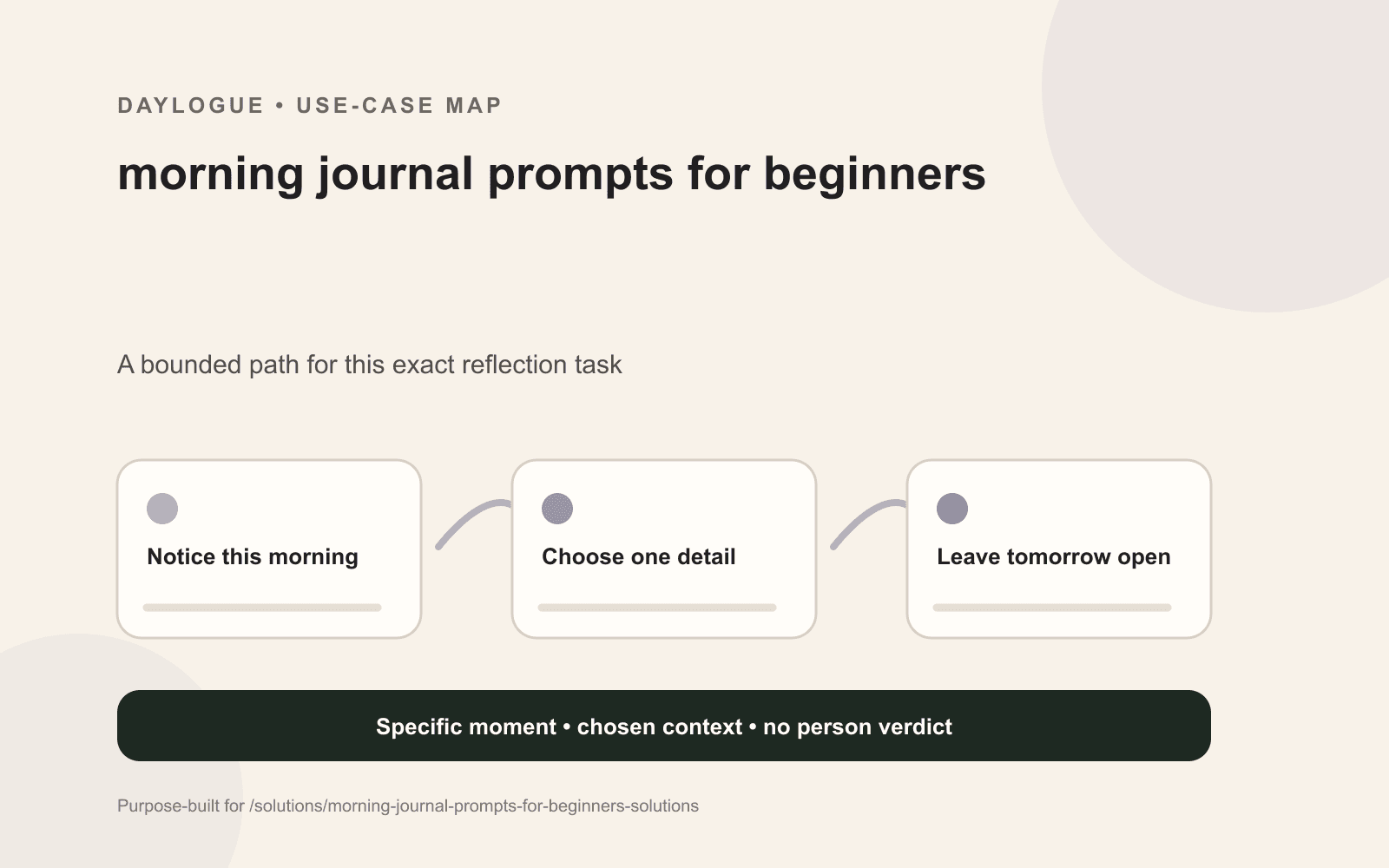
01
Optional check: what is fixed
One possible line records the first commitment, deadline, trip, or person already shaping the morning.
02
A reader might notice what is open
A second line may hold one choice that remains available, including the choice to change nothing.
03
A reader might leave an unfinished edge
An open question can stay open until later, with no requirement to return or produce an answer.
Prompts for three kinds of morning
A rushed morning may fit a three-part fragment: “First thing, hardest thing, one thing that can wait.” The response does not need full sentences. A delayed bus, a missing charger, and a task moved to tomorrow can be enough. This format works because it follows the pressure already present instead of adding a separate ritual.
A quiet morning allows a different kind of attention. “What did I notice before looking at a screen?” can capture light through a window, the sound of a kettle, or the first thought that arrived. The observation does not have to symbolize anything. It earns its place by being true to that morning.
An uncertain morning might use “What am I predicting, and what do I actually know?” A writer could separate “I think the meeting will be tense” from “the agenda changed last night.” Keeping prediction and observation in different sentences makes a later reread more accurate without asking the writer to dismiss the concern.
Questions that do not demand a positive answer
Morning prompts often drift toward forced optimism. Questions about gratitude, confidence, or an ideal day may fit sometimes, but they can feel false on a hard morning. Neutral prompts offer more range: “What is taking up space?” “What feels straightforward?” “What has not started yet?” Any of those may receive a positive, negative, mixed, or blank response.
A prompt can also make room for contradiction. “What do I want from today, and what makes that complicated?” might hold excitement about travel beside dread about the airport. Neither feeling cancels the other. The entry becomes a record of the actual morning rather than a statement of the attitude someone thinks they ought to have.
The writer remains the authority on fit. A question that feels invasive, childish, repetitive, or badly timed can be edited or ignored. A blank response says the prompt did not help in that moment. It does not say anything fixed about the person answering it.
A seven-day prompt menu, not a streak
A prompt menu can reduce blank-page friction without becoming a required sequence. Monday might ask what is carrying over. Tuesday can notice the first conversation of the day. Wednesday can name something that changed since the week began. Thursday may hold a boundary around time. Friday can preserve one detail worth remembering. The weekend can stay blank or use its own rhythm.
There is no need to catch up after a morning without an entry. The next entry can begin with the day that exists now. Backfilling often replaces memory with a smoother story, while a present-tense note keeps the record close to what the writer can actually observe.
Variety also makes later review more useful. If every prompt asks for an intention, the record contains intentions but little context. A mix of schedule, scene, uncertainty, relationship, and sensory questions creates several angles on the week without pretending that more data automatically produces a conclusion.
| Morning situation | Possible prompt | Permission built in |
|---|---|---|
| Rushed | What is fixed, and what can wait? | Fragments are enough |
| Quiet | What did I notice before the day got loud? | The detail needs no lesson |
| Uncertain | What do I know, and what am I predicting? | The question may remain open |
| Heavy | What is taking up space this morning? | No positive ending is required |
What a later reread can and cannot show
A morning note can show what the writer expected, noticed, or chose to record at that time. It cannot prove why the day unfolded as it did. “I expected the call to go badly” and “the call went badly” are two separate facts, and the first entry remains valuable even if the prediction was wrong.
Several entries may reveal a recurring time slot, phrase, or practical constraint. That repetition is a candidate for a closer look, not a verdict. The source entries and any exceptions matter. A calm Wednesday among several tense Wednesday mornings may be the most useful entry because it shows what differed.
A bounded reread might cover the last five mornings or the days around one deadline. Narrow windows make it easier to keep claims proportionate. The writer can say, “This appeared in three entries this week,” rather than turning a small sample into a statement about who they are.
Privacy still belongs in a simple morning routine
Morning entries can include schedules, names, locations, and details about other people before the writer has fully woken up. A short pause around account and syncing boundaries may matter more than the length of the entry. A personal device and personal account can avoid some obvious workplace or school ownership problems, though every service still has its own processing and retention terms.
Daylogue reads the entries you choose to sync to create narratives and surface patterns. Entries are not end-to-end encrypted.
NIST describes its Privacy Framework as a voluntary tool intended to help organizations identify and manage privacy risk.
For this morning-prompt page, the practical risk is accidental detail: calendars, addresses, and names can enter a half-awake note. A personal account and deliberate amount of detail may fit better than assuming a brief entry is automatically low-risk.
Three complete morning entries
Rushed example: “Train at 7:42. I am still thinking about the email that arrived after dinner. I know the deadline moved; I am predicting that the whole project is in trouble. The one thing that can wait is reorganizing my notes.” This entry records time, a carryover scene, a fact, a forecast, and a small choice. It does not try to turn the morning into an inspiring beginning.
Quiet example: “The kitchen was blue before sunrise, and the radiator clicked twice before the kettle. I want to keep that small silence with me, though the afternoon is already crowded.” The sensory detail matters without needing a symbolic interpretation. A later reader can recognize the morning and also see the contrast the writer expected.
Heavy example: “I do not have a useful intention today. The appointment is at eleven, and that is the only part I can name.” A morning practice can hold this much and stop. The absence of optimism is not a problem for the journal to fix. The concrete appointment gives the note a real anchor.
Where Daylogue fits
Daylogue is a system for self-understanding. Pattern journaling is how it reads you. A morning check-in can preserve what you chose to share, then make that source available when a later narrative or pattern is shown. The source remains more important than a polished interpretation.
The product does not need a perfect morning routine to become useful. An occasional entry can still hold the appointment, uncertainty, or small scene that would otherwise disappear by dinner. More frequent writing creates more material, but frequency is not a score and a gap is not a failure.
Daylogue is not therapy and is not a replacement for professional care. It cannot determine another person’s intent or decide what the writer ought to do. The useful job is narrower: keeping chosen moments available for reflection without turning them into a person verdict.
Prompt Pack
Seven mornings, seven optional questions
A nonsequential prompt pack for mornings that are rushed, quiet, uncertain, social, or simply ordinary.
- What is already decided about the next few hours?
- Where is there still room to choose?
- What is taking up the most space this morning?
- Which part is known, and which part is only a forecast?
- What did I notice before looking at a screen?
- Which task could move without creating a real problem?
- What question can remain open today?
Common questions
How long does a beginner morning journal entry have to be?
It has no required length. One dated sentence can preserve the first commitment, a prediction, or a detail from the room. A longer entry may fit a quiet morning, while a rushed morning may only hold fragments. The useful length is the amount that captures the moment without creating pressure.
What are easy morning journal prompts when my mind is blank?
Questions tied to the visible morning often ask less imagination: “What is already decided?” “What can wait?” or “What did I notice before looking at a screen?” A writer can copy the question and leave it unanswered. Blankness is part of the morning, not evidence that journaling failed.
Do morning journal prompts have to be positive?
No. A morning can be hopeful, irritated, numb, rushed, or mixed. Neutral questions about the schedule, uncertainty, or one concrete observation allow the entry to match the actual day. Gratitude and intention prompts remain optional rather than a required emotional direction.
What if I miss several mornings?
The next entry can begin with the current morning. There is no backlog to repay and no need to reconstruct days from memory. If the gap itself matters to the writer, it can be noted as context, but the gap does not carry a score or a judgment.
Can morning prompts tell me why I feel a certain way?
A prompt can preserve circumstances and the writer’s own interpretation, but it cannot establish a cause from one entry. A later reread may show repetition or exceptions worth considering. The source wording, time window, and uncertainty remain visible so a possible pattern does not become a fixed explanation.
Sources
Sources were checked on the dates shown. Product details and policies can change.
- NIST Privacy Framework · National Institute of Standards and Technology · checked August 31, 2026
- Daylogue privacy policy · Daylogue · checked August 31, 2026
Keep exploring
Daylogue Knowledge Center
Browse practical guides for reflection, journaling, patterns, and privacy.
Read moreHow Daylogue shows patterns
See how candidate patterns stay connected to evidence and correction.
Read moreWhy Daylogue exists
Read the principles behind a system for self-understanding.
Read moreDaylogue is not therapy and is not a replacement for professional care.