Written by Daylogue Editorial Team. Published August 31, 2026. Reviewed and updated August 31, 2026.
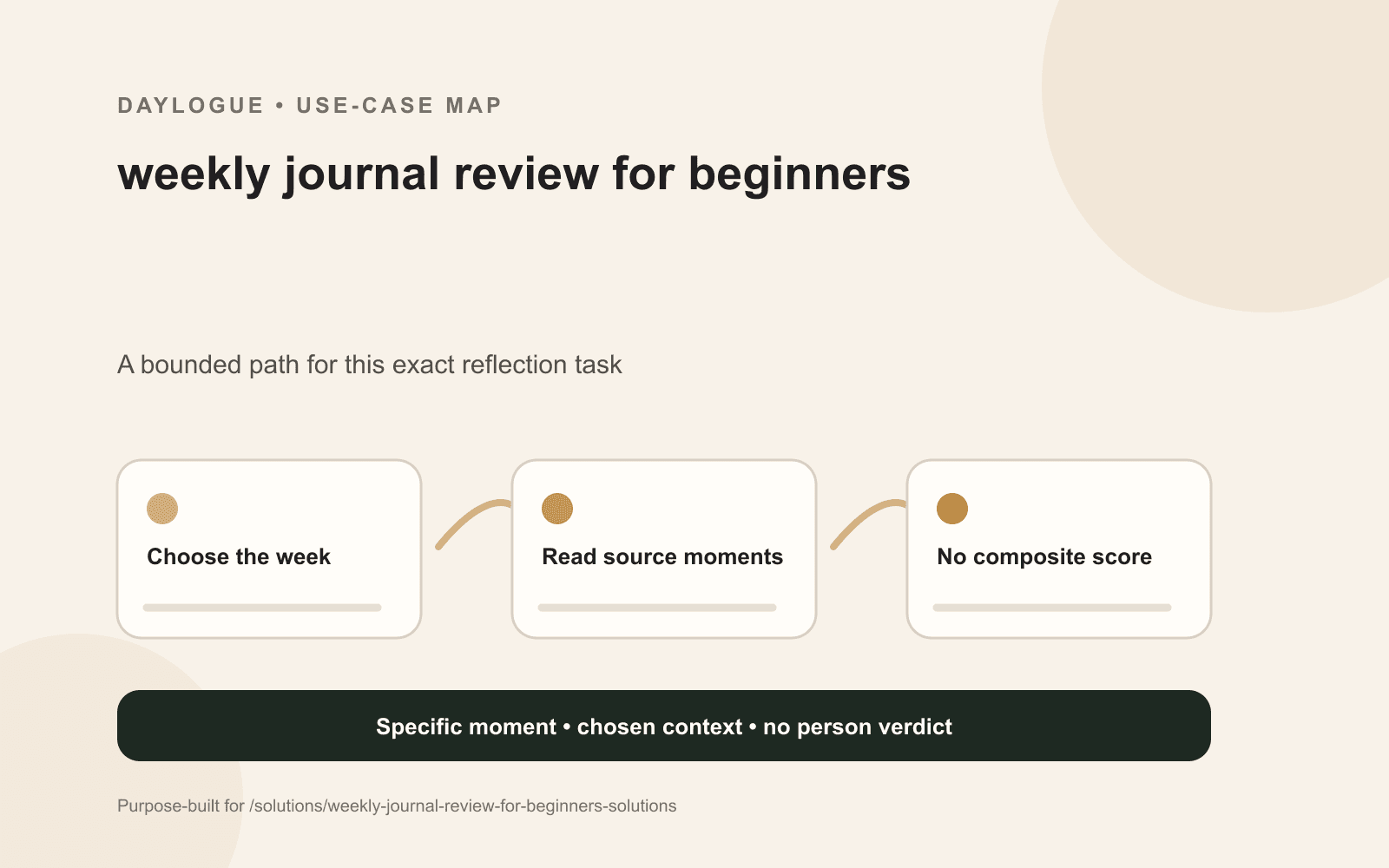
A weekly journal review for beginners can use four short passes: mark the scenes that still feel important, notice exact repetitions, find an exception, and carry forward one open question. The review can cover only the entries that exist. Missing days stay missing, and no pattern has to be declared.
The week that is actually on the page
A review becomes manageable when its edges are clear. The window might run from Monday morning through Sunday night, or it may cover the seven days since the last review. Either choice works if the dates are visible. The goal is not to reconstruct a perfect week. It is to inspect the entries that genuinely exist inside a known period.
Three entries still count as a reviewable week. A blank Wednesday does not require a guess about what happened. The day without an entry may be noted as a gap, but the gap does not explain what changed or indicate a lack of commitment.
Beginners often reread from the first page and get lost in volume. A single calendar week creates a smaller job. Older material remains available for another question at another time.
Pass one: scenes before conclusions
The first pass looks for scenes that still have texture: a meeting that ran long, a quiet breakfast, a call from a friend, the moment a plan changed. A simple mark beside two or three entries is enough. There is no need to summarize them yet.
Scenes preserve the conditions around a thought. “I was anxious all week” may be the writer’s honest summary, while the entries might show that the feeling appeared around two deadlines and was absent during a weekend visit. Both belong, but they answer different questions.
A scene can matter because it was ordinary. The same train ride, lunch table, or hour before bed may become useful context only after several weeks. The review does not have to know why it matters now.
Pass two and three: repetition beside an exception
The repetition pass notices exact words, settings, people, or time slots that appear more than once. “Rushed before the 9 a.m. call” appearing on Tuesday and Thursday is more defensible than “mornings are always stressful.” The narrower wording keeps the observation tied to the source.
The exception pass looks for what does not fit. Perhaps Friday also had a 9 a.m. call and the entry felt steady. That exception is not noise to remove. It may contain the detail that changes the next question, such as preparation time, location, or who attended.
Repetition plus exception produces a candidate pattern rather than a verdict. The writer may keep it, revise it, or decide that the sample is too small. Uncertainty is a useful review result.
| Pass | Question | Output |
|---|---|---|
| Scenes | Which moments still have detail? | Two or three source entries |
| Repetitions | What exact wording or setting appears again? | A narrow observation |
| Exceptions | Which entry does not fit? | Context that complicates the repeat |
| Open question | What could I notice next week? | One optional question, not a prediction |
Pass four: one question instead of a plan
A useful question comes directly from the material. “Does the first call feel different when I prepare the agenda the night before?” stays testable and modest. “How can I stop being bad at mornings?” turns a few scenes into a judgment about the person.
The question does not have to change behavior. It may simply guide attention if a similar scene happens again. The writer can also close the review with no question at all when the entries already feel complete.
Next week may contradict this week. That is not a failed review. It is new context, and the earlier summary can remain visible as what seemed plausible at the time.
Worked example: three entries and one gap
For example, Monday records a rushed commute before a presentation, Wednesday has no entry, and Thursday describes relief after asking a colleague for clarification. Saturday mentions an easy walk with the same presentation finally finished. The scenes are commute, clarification, and walk. The gap remains Wednesday.
The phrase “I have to know before I ask” appears Monday and Thursday. Saturday breaks the work context entirely. A careful summary could say that uncertainty and asking for help appeared in two work entries. It could not say that the writer has a fixed problem with uncertainty.
One open question might be whether naming the unclear part changes the next work conversation. The writer could notice that, ignore it, or replace it. The review has already succeeded by keeping the conclusion proportional to three entries.
A review can expose more than one entry at once
A weekly review gathers several scenes into one view, which can make names, schedules, and relationships easier to infer. That concentration deserves attention. A writer may prefer a personal account, a private setting, or an offline worksheet depending on what the entries contain.
Daylogue reads the entries you choose to sync to create narratives and surface patterns. Entries are not end-to-end encrypted.
NIST describes its Privacy Framework as a voluntary tool intended to help organizations identify and manage privacy risk.
A weekly review concentrates several entries into one page. That makes accurate sourcing easier, but it can also reveal schedules and relationships that were less obvious in isolation. The chosen review setting matters.
Four beginner review traps and gentler alternatives
The first trap is summarizing before rereading. Starting with only the week’s loudest moment leaves quieter entries outside the first pass. Marking source scenes first gives those entries a chance to remain visible. A summary can then name what the record contains instead of replacing it with the reviewer’s current mood.
The second trap is translating frequency into identity. Two entries that use the word “stuck” support a count of two. They do not establish “I am a stuck person.” The third trap is ignoring a counterexample because it weakens a tidy story. The counterexample may offer the best context in the set.
The fourth trap is requiring an action item. A review can end with a description, a question, or no conclusion. Some weeks are worth remembering before they are understood. The writer can let later entries add context without assigning the next week a project.
A gentle review also preserves language the writer later dislikes. Editing the interpretation is different from rewriting the source. Keeping both versions shows how understanding changed and prevents the latest summary from pretending it was obvious all along.
How to write a weekly summary that keeps its limits
A bounded summary names the period first: “In the four entries I wrote from Monday through Saturday…” That opening tells the reader exactly where the claim comes from. It also prevents a few notes from quietly standing in for the entire week.
The middle names observable material: two scenes involved waiting for information, one scene involved an easy decision, and Saturday contained no work context. The wording does not assign a fixed explanation to the writer or a theory about another person.
The ending can state uncertainty: “I am curious whether advance notice changes these scenes, but the entries do not answer that yet.” This is a complete result. A journal review can produce a better question rather than a confident conclusion.
If a generated readback sounds broader, the writer can narrow it in their own words. Keeping both the suggested sentence and the correction creates an audit trail of interpretation without allowing polished software language to outrank the source.
The final review can be read aloud once for scale. Words such as always, never, everyone, and nothing often reveal where a narrow week became a universal statement. They are not automatically wrong, but they invite a source check. Replacing “every meeting was tense” with “two meeting entries mention tension” keeps the summary close to the material and easier to revise later.
A review date beside the summary keeps later readers from confusing an early interpretation with a permanent conclusion. The same entries may support different questions months later, and the earlier wording can remain as context.
How Daylogue approaches a weekly readback
Daylogue is a system for self-understanding. Pattern journaling is how it reads you. A weekly readback can make source entries easier to revisit while keeping the original wording available. The person can accept, reject, or revise an interpretation.
An automated readback is not automatically more accurate than the writer. It can organize material and surface possible repetition, but it does not know another person’s intent and it cannot turn a limited week into a complete account of someone’s life.
Daylogue is not therapy and is not a replacement for professional care. A weekly review is a reflection practice, not an evaluation. There are no streaks, no grade for completeness, and no requirement to carry a finding into the next week.
Worksheet
Four-pass weekly review sheet
A source-aware worksheet for marking scenes, exact repetitions, counterexamples, and one question without creating a person score.
- Review window and dates:
- Two or three source scenes:
- Exact phrase, setting, or time that appears again:
- Entry that does not fit the apparent repeat:
- What the entries support saying:
- What the entries do not support saying:
- One question that may remain open next week:
Common questions
How many entries do I need for a weekly journal review?
There is no minimum. Two or three entries can still support a careful review of what appears in them. Missing days remain gaps rather than evidence. A smaller set simply calls for narrower language and fewer conclusions.
Do I have to reread every word from the week?
No. A first pass may only mark scenes or phrases that stand out. The writer can reopen the source when a possible repetition appears. A review that stays bounded is often easier to finish and less likely to smooth different days into one story.
What is the difference between repetition and a pattern?
Repetition means a word, setting, person, or situation appeared more than once. A pattern is an interpretation about how those pieces fit together. The second claim carries more uncertainty and benefits from source entries, a defined time window, and visible exceptions.
What if my week has no obvious theme?
No theme is required. The review may preserve two unrelated scenes, identify a missing period, or end with a question. A week can be varied without needing a unifying lesson.
Can a weekly journal review tell me what to change?
It can make a question or recurring situation easier to see, but it does not have to produce advice. The writer decides whether any observation matters and what, if anything, follows. A review can remain descriptive.
Sources
Sources were checked on the dates shown. Product details and policies can change.
- NIST Privacy Framework · National Institute of Standards and Technology · checked August 31, 2026
- Daylogue privacy policy · Daylogue · checked August 31, 2026
Keep exploring
Daylogue Knowledge Center
Browse practical guides for reflection, journaling, patterns, and privacy.
Read moreHow Daylogue shows patterns
See how candidate patterns stay connected to evidence and correction.
Read moreWhy Daylogue exists
Read the principles behind a system for self-understanding.
Read moreDaylogue is not therapy and is not a replacement for professional care.