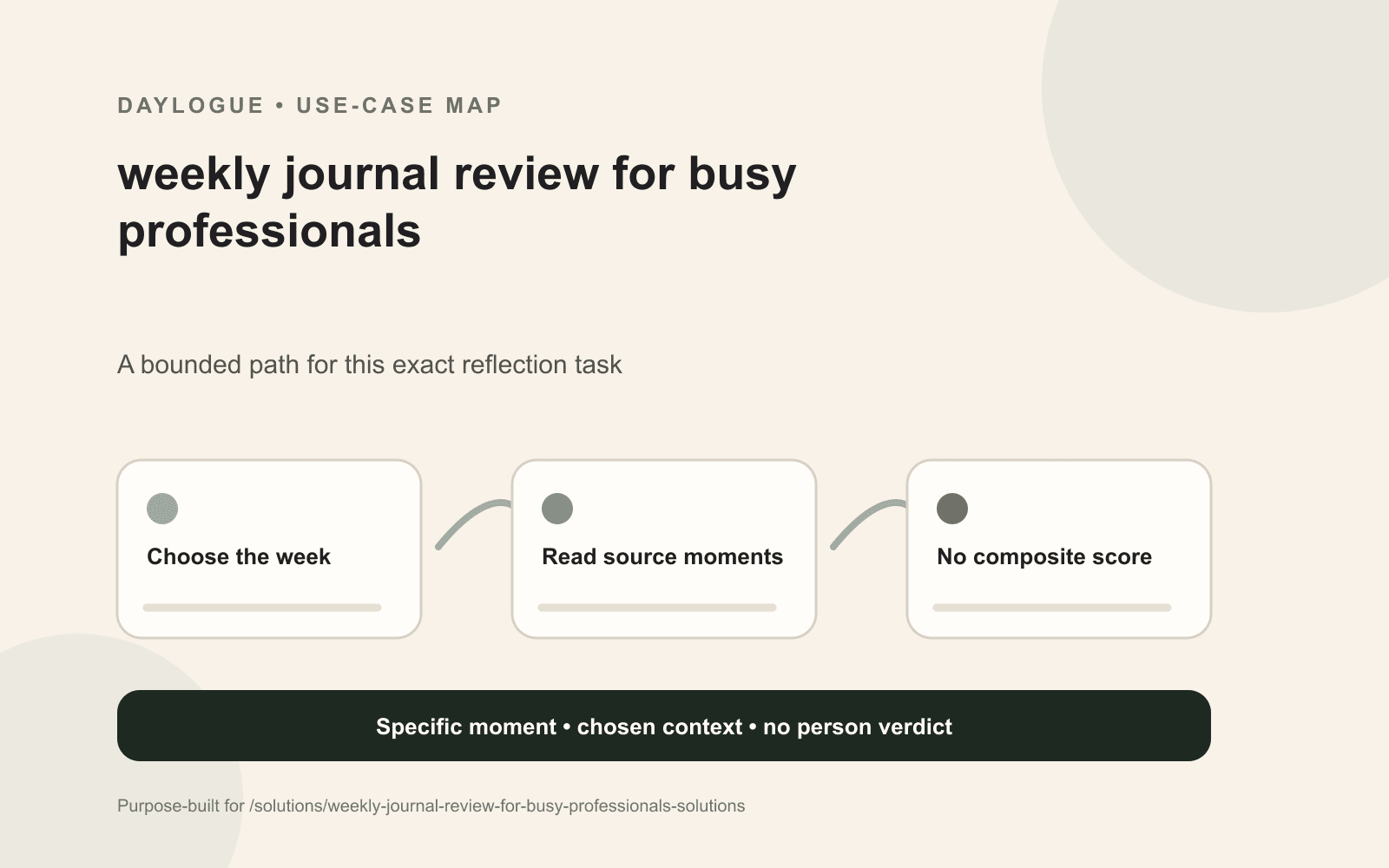
Written by Daylogue Editorial Team. Published August 31, 2026. Reviewed and updated August 31, 2026.
A weekly journal review for busy professionals can fit into five focused minutes. One minute finds the work scene still carrying energy, two minutes compare repeated friction, one minute checks an exception, and the final minute records an open question. The result is context for the writer, not a productivity score or employee record.
A review that fits between work and the rest of life
A busy professional does not need another meeting with themselves. The review can begin at a natural edge: after the last Friday call, on the train home, or before opening the laptop on Sunday evening. Five minutes sets a ceiling, not a minimum achievement target.
The first minute asks which work scene still has energy. It might be the silence after a proposal, the relief of canceling a low-value meeting, or the moment a deadline moved. Naming one scene avoids the impossible task of summarizing every project and relationship.
If the timer ends after that first scene, the review can end too. A partial readback still preserves context. The next week begins without a backlog.
Friction in the work, not a flaw in the person
Professional reflection easily slips into performance-review language. “I failed to stay organized” assigns a verdict. “The approval arrived after the build window closed twice” points to a work condition that can be examined. The second wording is more specific and less likely to confuse a system problem with identity.
Recurring friction may involve schedule volatility, unclear ownership, meeting density, context switching, or missing information. A journal can capture the writer’s experience of those conditions. It cannot establish what a colleague intended or measure the entire organization.
WHO identifies excessive workloads, low job control, job insecurity, unclear roles, and conflicting home and work demands among risks that can arise in working environments. That source supports attention to work conditions, not a conclusion about an individual from a private entry.
A minute-by-minute review
Minute one locates the scene. Minutes two and three compare it with one or two entries from the same week. The comparison may reveal a repeated phrase such as “waiting for sign-off” or a recurring time such as the hour before a standing call.
Minute four searches for an exception. Perhaps one approval arrived early, or the same meeting felt different when the agenda was shared. The exception prevents the summary from becoming “this always happens” and may reveal a practical difference worth remembering.
Minute five writes one bounded sentence: “During this workweek, delays around two approvals kept showing up in my notes.” An optional question can follow. There is no demand for an action plan.
01
Minute one: one work scene
The scene can be a meeting, handoff, decision, commute, or quiet interval that still feels relevant.
02
Minutes two and three: comparison
One or two source entries may confirm repetition or show that the first scene stood alone.
03
Minute four: the exception
A counterexample keeps the readback specific and may point to a difference in conditions.
04
Minute five: the review limit
The closing sentence can name the time window and what the notes cannot establish.
Work context does not require a work-owned journal
A reflection about work can remain personal. A company device, company email address, shared workspace, or employer-managed account may carry access and retention rules outside the writer’s control. That makes account ownership part of the journaling decision, especially when entries include names or confidential projects.
A useful boundary is to describe the effect of work without copying protected company material. “The handoff changed twice and I felt rushed” may hold the personal context. Client data, internal metrics, unreleased plans, and another person’s private disclosure may belong outside the journal.
The review is not a shadow performance file. It can stay centered on what the writer noticed and chose to record, with no expectation that it will be shared with a manager, colleague, or employer.
Three workweeks, three different review jobs
A meeting-heavy week may produce a map of transitions rather than meeting content. The writer notices that the hour with no transition time appears in two tense entries, while a day with a protected lunch reads differently. That is a question about schedule shape, not proof that meetings caused a feeling.
A deadline week may center on decision latency. Two notes mention waiting for a response, and one shows progress after ownership became clear. The review preserves that difference without claiming that one tactic will always work.
A travel week may have only voice fragments and one late-night note. The review can acknowledge that the sample is thin. It might keep one airport scene and one question about the time needed to settle after travel, then stop without filling the gaps.
Private work reflection needs explicit boundaries
A single weekly review may concentrate the names, schedules, and business details that were scattered across separate entries. Personal account ownership and careful redaction can reduce obvious exposure, while the service’s syncing, processing, export, deletion, and retention terms still determine what happens after the text is entered.
Daylogue reads the entries you choose to sync to create narratives and surface patterns. Entries are not end-to-end encrypted.
NIST describes its Privacy Framework as a voluntary tool intended to help organizations identify and manage privacy risk.
A professional week review can gather names, meeting times, and project references into one summary. Removing protected business detail while preserving the personal effect keeps the page focused on the writer’s experience.
Why the review stays personal
A professional journal can mention work without becoming organizational listening. The difference is who the record serves and who can see it. A personal review serves the writer. It does not need to feed a manager dashboard, attendance history, risk flag, or employment decision.
If a professional wants to raise a work condition, a separate workplace message may be more appropriate. “The approval queue delayed two releases this week” can travel without the private scenes, feelings, or relationship context that helped the writer notice it. The journal remains the source of personal clarity, not a file handed over wholesale.
Sharing one insight is not consent to share the underlying history. The writer can choose a narrow fact, a request, or no disclosure. That boundary is especially important when a review contains other people’s names or describes uncertainty that was never meant to become a performance record.
The five-minute format also resists managerial language. It asks what happened and what differed, not whether the worker demonstrated resilience, engagement, or the right attitude. A private page does not owe the workplace a more measurable person.
Friday and Sunday reviews answer different questions
A Friday review is close to the work itself. Details are easier to retrieve, and the transition out of work offers a natural stopping point. The writer may still be carrying the intensity of the final meeting, so a summary benefits from staying close to scenes and avoiding broad conclusions.
A Sunday review adds distance. It may show which work concern remained present through the weekend and which one faded once the laptop closed. That difference can be recorded without claiming that a particular task caused the feeling.
Neither timing is superior. Travel, caregiving, shifts, and religious or family routines may make another boundary more natural. The review belongs at the edge that actually exists in the writer’s week.
Changing the review day does not break the practice. The date window can simply be written at the top so future comparisons do not assume that every review covered identical days.
A recurring review question can remain stable while the answers change. “What work condition took the most attention this week?” may produce meetings one week and a caregiving schedule the next. The consistent question supports comparison without implying that the professional must produce the same theme or improve a metric over time.
The review may end with appreciation for a colleague or relief about completed work. Positive scenes receive the same evidence standard as difficult ones: a real moment, a defined week, and no inflated promise about what happens next.
A workweek readback without a performance score
Daylogue is a system for self-understanding. Pattern journaling is how it reads you. It can bring chosen check-ins into a readback and keep the source available for correction. The writer remains able to disagree with the summary.
The product is not an employee evaluation tool. A private note cannot determine engagement, burnout, intent to leave, or job performance. Work scenes can be reflected back as scenes and possible repetitions, not converted into a person verdict.
Daylogue is not therapy and is not a replacement for professional care. The five-minute method offers a way to remember the workweek while leaving decisions, employment judgments, and questions that belong with a qualified professional outside the page.
Worksheet
Five-minute professional week review
A time-boxed private worksheet for one work scene, repeated friction, a counterexample, and a carefully limited summary.
- Minute one, the work scene still carrying energy:
- Minutes two and three, the entry or phrase that repeats:
- Minute four, the day that does not fit:
- Minute five, what this week supports saying:
- What this week cannot establish:
- One detail that belongs in a task system instead:
- One confidential detail that stays outside the journal:
Common questions
Can a useful weekly journal review really take five minutes?
Yes, when the task is narrow. One scene, one comparison, one exception, and one bounded sentence can fit. A longer review remains optional. The time limit keeps reflection from becoming another open-ended work obligation.
Does a professional journal review focus only on work?
It can focus on work if that is the question, while still recognizing that home demands, commutes, and rest shape the week. Confidential company details and another person’s private information may belong outside the entry. The writer decides the boundary.
Is a weekly review the same as a productivity review?
No. A productivity review evaluates output or plans work. A journal review preserves scenes, felt experience, and context. It may notice friction without assigning a score, measuring performance, or requiring an improvement plan.
What if every workweek looks different?
Variation is useful information. A review can name what was unique about travel, deadlines, caregiving, or a changed schedule. It does not need a recurring theme. One accurate description of a different week may be more useful than forcing continuity.
Can I share my weekly review with my manager?
The writer may choose what to share, but a private reflection often contains more context than a workplace conversation requires. A separate summary about a changeable work condition can preserve the useful point without disclosing the full journal. Sharing is never required by the practice.
Sources
Sources were checked on the dates shown. Product details and policies can change.
- Mental health at work · World Health Organization · checked August 31, 2026
- NIST Privacy Framework · National Institute of Standards and Technology · checked August 31, 2026
- Daylogue privacy policy · Daylogue · checked August 31, 2026
Keep exploring
Daylogue Knowledge Center
Browse practical guides for reflection, journaling, patterns, and privacy.
Read moreHow Daylogue shows patterns
See how candidate patterns stay connected to evidence and correction.
Read moreWhy Daylogue exists
Read the principles behind a system for self-understanding.
Read moreDaylogue is not therapy and is not a replacement for professional care.