Written by Daylogue Editorial Team. Published August 31, 2026. Reviewed and updated August 31, 2026.
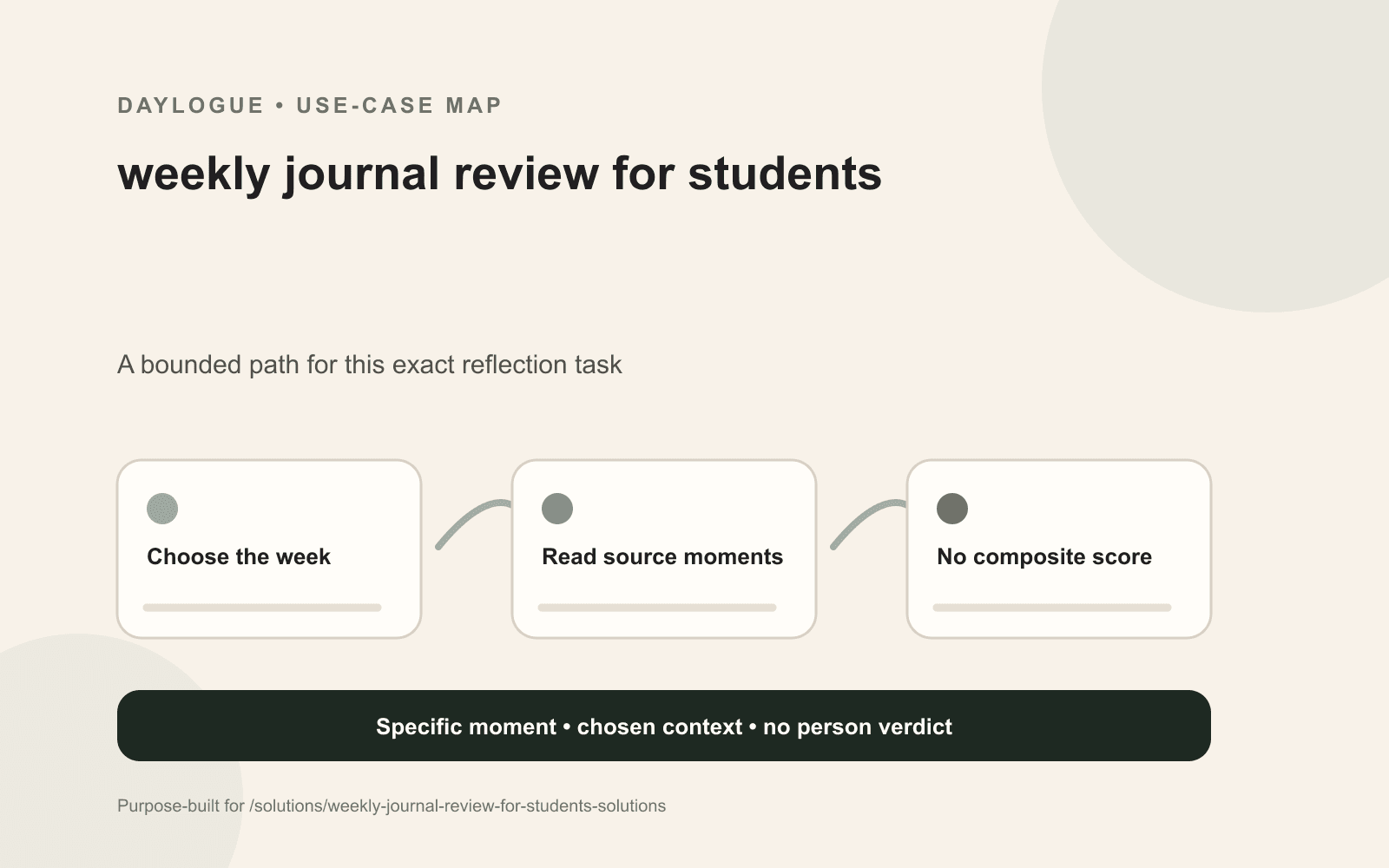
A weekly journal review for students can follow the school week in three lanes: what happened in class, what happened around other people, and what happened when school was over. One repeated scene and one exception are enough for a useful readback. The review is not homework, and missing entries do not lower a grade.
A school week has more than one lane
Classes are only one part of a student’s week. Commutes, meals, jobs, practice, family calls, roommates, and the hour after everything ends can shape what gets written. A review that separates class, social, and off-campus scenes makes it easier to see context without reducing the week to academic performance.
The class lane may include a confusing lecture, a presentation, or the relief of understanding a problem. The social lane may hold a lunch table, group chat, club meeting, or quiet moment with a friend. The after-school lane can include work, exercise, rest, gaming, chores, or nothing scheduled at all.
A student can have entries in one lane and none in another. The blank lane is not a deficit. It only marks what was not recorded during that window.
A map of the week before an explanation
A simple timeline can list each existing entry by day and setting. Monday: library after calculus. Tuesday: bus ride after work. Thursday: dorm room before a group presentation. The map shows where the record came from before a summary begins.
This step can expose sampling bias. If every entry was written late at night, the journal may say more about late nights than about the whole week. If writing happened only after hard classes, positive class moments may be absent because they never prompted an entry.
The review can name that limit directly: “Most notes this week came after 10 p.m.” Such a sentence improves the readback without requiring the student to change when they write.
One repeat beside the scene that breaks it
A repeat may be concrete: the same building, the same time before class, or the phrase “I did not know what to say.” Two appearances support saying it repeated twice. They do not support “I am always awkward” or “this course makes me anxious.”
A counterexample may be tucked into another lane. The same student who felt stuck in a seminar may have spoken easily at a club meeting. That difference complicates a person-level story and turns attention toward setting, familiarity, group size, or preparation.
A careful weekly summary might read, “Speaking felt harder in two graded class scenes, while the ungraded club discussion felt different.” That wording keeps the source conditions visible and leaves the next question open.
| Lane | Scenes to include | Question that stays grounded |
|---|---|---|
| Class | Lectures, labs, feedback, presentations | What happened in the room? |
| People | Friends, roommates, clubs, group work | Where did the interaction feel different? |
| After school | Work, travel, rest, family, downtime | What context sat around the school day? |
| Exception | Any scene that breaks the apparent repeat | What was different here? |
A private review is not another grade
Students already receive scores, rankings, attendance marks, and feedback. A journal review can offer a different kind of record. It does not assign points for frequency, depth, optimism, or insight. A one-line note and a long reflection both count as source material.
Language matters. “Two entries were not recorded during finals week” is observable. “I lacked discipline” is a judgment that the journal cannot establish. The first sentence leaves room for sleep, workload, travel, or simply choosing not to write.
There is also no requirement to turn the review into a study plan. An academic task can move to the planner. The journal can stay with the experience around the task.
Worked example: deadline, dinner, and one quiet hour
Monday’s entry describes opening an assignment and realizing two sources were missing. Wednesday records a tense group dinner after the project scope changed. Friday has one line about finishing the draft in a quiet library corner. Those scenes share a project, but they carry different settings and pressures.
The repeat is uncertainty about scope. The Friday entry is also an exception because the quiet setting and complete source list changed the scene. A review can preserve that contrast without claiming the library caused success or that group work caused distress.
One open question could ask what information was available before each work session. The student may notice that next week or leave the question behind. The value of the review is the clearer record, not compliance with a follow-up.
School accounts and private journals serve different jobs
A school-managed email address or device may not remain under the student’s control after graduation, transfer, or account closure. Course systems may also have their own access and retention rules. Private reflection can use a separate account and avoid copied classroom, research, or peer information that does not belong in a personal journal.
Daylogue reads the entries you choose to sync to create narratives and surface patterns. Entries are not end-to-end encrypted.
NIST describes its Privacy Framework as a voluntary tool intended to help organizations identify and manage privacy risk.
A student review can reveal class schedules, housing routines, and peer relationships across several days. A separate personal account and careful handling of other people’s information are relevant to this multi-entry view.
Weekly reviews change near exams and breaks
Finals week is not an ordinary sample of the semester. Entries may cluster late at night, focus on deadlines, and omit social or restful moments. A review can name that concentration without presenting the week as proof of the student’s usual life.
Breaks create the opposite problem. A student may write in a different place, around different people, with fewer scheduled demands. Comparing that week directly with midterms can be interesting, but the setting change belongs in the conclusion.
A new term may reset routines entirely. Different instructors, housing, work hours, or travel can make last semester’s pattern less relevant. Keeping time windows visible allows an old readback to remain historically true without being carried forward as a permanent trait.
The student may decide that weekly review does not fit during the busiest period. Pausing creates no debt. A later entry can simply name that the record is sparse and begin from the present week.
Other people appear in the week, but the review stays yours
A student journal naturally includes professors, roommates, classmates, partners, and family. The review can describe what the writer observed and how they understood it at the time. It cannot establish another person’s hidden motive or assign them a fixed type.
“My professor paused after the question and moved on” is an observed sequence. “My professor wanted to embarrass me” is an interpretation. Both may be written when clearly separated, but the second does not become a fact because it appears in a weekly summary.
Names may be unnecessary for a useful readback. Roles or initials can preserve context with less identifying detail. In very specific scenes, even a role may identify someone, so leaving the event offline or unrecorded remains available.
The student can correct their own interpretation later without erasing the original reaction. That change is part of self-understanding, not evidence that the first entry was dishonest.
A weekly review may also notice what was absent from the student’s writing without using absence as evidence. No mention of a class does not mean the class was easy or unimportant. It may mean nothing happened that prompted a note. The summary can say “this class did not appear in my entries” and stop before inventing a reason.
A break from school may also deserve its own review window. Combining vacation and exam days can hide the setting change that explains much of the contrast. Separate windows preserve both experiences without asking them to tell one continuous story.
The worksheet can remain unfinished at the end of the review. An empty lane or unanswered question is part of the source record, not a prompt to invent material.
A readback that stays with the student
Daylogue is a system for self-understanding. Pattern journaling is how it reads you. Student check-ins can preserve chosen moments from different parts of the week and keep those source entries available when a possible pattern appears.
Daylogue does not turn a day without an entry into a streak loss, and a readback does not grade the student. A repeated scene stays a repeated scene until the student decides what it means, if anything.
Daylogue is not therapy and is not a replacement for professional care. It cannot decide why a student reacted a certain way, evaluate academic ability, or replace support from a qualified person. It can help keep the week from blurring together.
Worksheet
Three-lane school week review
A student worksheet for mapping class, social, and off-campus scenes before noting one repetition and a counterexample.
- Class scene and date:
- People or group scene and date:
- After-school or off-campus scene and date:
- Where and when most entries were written:
- One exact repeat across the week:
- One scene that does not fit:
- A question that may remain open:
Common questions
How many student journal entries belong in a weekly review?
Any number that actually exists. Two entries may support a small comparison, while seven may provide a wider view. Missing days stay missing. The summary can name the size and limits of the record rather than treating every week as complete.
Can a weekly student review include grades?
A grade can appear as part of a scene if the student wants it there, but the journal does not have to become a performance tracker. The reaction, setting, conversation, or expectation around the grade may be the more relevant material for reflection.
What if all my entries come from difficult moments?
That may reflect when writing felt useful rather than what the entire week was like. The review can state that the sample is weighted toward difficult moments. There is no need to add positive entries to balance the record artificially.
Does a repeated school situation prove a pattern?
It supports saying that the situation appeared more than once in the chosen window. A stronger interpretation benefits from source scenes, exceptions, and careful limits. It still does not define the student or prove a cause.
Is a school account a good fit for private student journaling?
A school account may be managed, retained, or closed under institutional rules. A personal account can avoid some ownership problems, but the chosen service still has its own processing terms. The student may also keep sensitive details offline or not record them.
Sources
Sources were checked on the dates shown. Product details and policies can change.
- NIST Privacy Framework · National Institute of Standards and Technology · checked August 31, 2026
- Daylogue privacy policy · Daylogue · checked August 31, 2026
Keep exploring
Daylogue Knowledge Center
Browse practical guides for reflection, journaling, patterns, and privacy.
Read moreHow Daylogue shows patterns
See how candidate patterns stay connected to evidence and correction.
Read moreWhy Daylogue exists
Read the principles behind a system for self-understanding.
Read moreDaylogue is not therapy and is not a replacement for professional care.