Written by Daylogue Editorial Team. Published August 8, 2026. Reviewed and updated August 8, 2026.
A weekly reflection counterexample is a comparable week, group, or work condition where an expected aggregate theme did not appear. It tests the first explanation without dismissing what people shared. Employer-context dashboards are designed not to display individual entries, transcripts, scores, or participation histories. Eligible aggregate self-reported trends appear only after the applicable threshold is met. The result is a narrower work-level question that can be revisited in a later aggregate window.
The week that complicates the first story matters
A release week runs late, and the aggregate readback contains more workload language than usual. The first story writes itself: releases create the strain. A counterexample adds another release week when the same language stayed steady. Maybe that week had an earlier scope freeze, one more person on call, fewer late approvals, or broader participation. The contrast does not cancel the difficult week. It shows which part of the work is worth examining more closely.
This is the point of weekly reflection counterexamples. A theme becomes a question with boundaries instead of a verdict. The readback names the period, the eligible group, the participation coverage, and the work conditions that make two windows comparable. The counterexample then keeps an exception visible beside the candidate theme. A decision can account for both rather than casting the loudest week as a permanent truth about the workplace.
The privacy boundary appears before the theme
The organization-facing renderer is designed to show eligible thresholded themes and participation, not individual entry text. The applicable threshold is evaluated again after a comparison adds a filter such as team, shift, location, role, or date window. A result below the threshold stays out of the readback, even when the original group was large enough. Thresholds reduce reidentification risk but do not make it impossible.
This workplace renderer is designed not to display person-level data to an employer or administrator. Separate consumer sharing features and authorized service, support, security, and legal-process paths use different rules. A workplace readback contains the candidate theme, coverage, comparison rule, exception, and work-level response rather than a private quotation, entry, voice transcript, identity, or person-level score.
| Theme | Different moment | Work question |
|---|---|---|
| Launch workload came up more often | Similar launch stayed steady | What changed in scope or staffing? |
| Role-clarity questions came up | Another unit stayed clear | Which decision rights differed? |
| Participation dropped | Peak week stayed broad | What changed in time or access? |
| Limited scheduling choice came up | Similar shift had more choice | Which scheduling options differed? |
A five-part sequence keeps the read honest
The sequence begins with one candidate theme stated in ordinary language. It then defines a fair comparison before anyone knows which result will be more convenient. The third part finds a different moment. The fourth identifies work conditions that changed. The fifth records a small, reversible work-level response and a later review window. Each part stays visible so a reader can inspect how the interpretation moved from the first story to the updated read.
Writing the comparison rule before reviewing the exception matters. A quiet holiday week is not a useful counterexample to the busiest week of the year. A launch week may be comparable to another launch week when staffing, deadline pressure, participation coverage, and team size are visible. The periods do not have to match perfectly. They need enough shared context that the differences can sharpen the question rather than manufacture a reassuring answer.
01
Candidate theme
The record states the aggregate repetition, date window, eligible group, and participation coverage without naming anyone.
02
Comparison rule
The record defines which schedule, workload, group size, and operational conditions make another window reasonably comparable.
03
Different moment
The record keeps a comparable period where the expected theme was absent, weaker, or expressed in another way.
04
Updated read
The record names the work conditions that differed and leaves more than one explanation open when the evidence is mixed.
05
Later check
The record connects one reversible work change to a future aggregate window without promising a particular outcome.
Comparability depends on more than the calendar
Two Mondays can look close on a calendar and still be poor comparisons. One may sit inside a product launch while the other follows a holiday. One may include a full team while the other reflects sparse voluntary participation. Workload, staffing, decision control, role clarity, shift design, deadline pressure, and coverage all shape what the contrast can support. A useful counterexample record makes those dimensions easy to scan instead of hiding them behind a single chart line.
Coverage deserves its own line. A theme based on broad participation carries different uncertainty from a week when only a small share of eligible people checked in. The readback can say that two periods are not comparable yet. That is a useful result. It prevents missing data from becoming a confident workplace story and creates a clear condition for a later comparison, such as a similar operational week with sufficiently broad participation.
External guidance keeps the response at the work level
WHO lists excessive workloads, understaffing, inflexible hours, low job control, unclear roles, job insecurity, discrimination, and conflicting home and work demands among workplace risks. Those categories offer a grounded set of work conditions for a counterexample record. A launch-week contrast might compare staffing and deadline control. A shift contrast might compare scheduling choice and role clarity. The language stays about the conditions people worked in, not a label attached to the people who contributed reflections.
WHO recommends organization-level changes that directly address working conditions and environments. A weekly readback can therefore end with a concrete change to the work: an earlier scope deadline, clearer approval rights, more predictable coverage, or a protected break in the busiest cycle. The aggregate reflection adds timely context to that decision. It does not establish a single cause, promise an effect, or turn a personal entry into evidence about an individual.
Five counterexample types test different weak spots
A time counterexample compares similar periods. A group counterexample compares large enough groups under similar work conditions. A condition counterexample looks at the same demand with a different level of control, staffing, or clarity. A coverage counterexample checks whether participation changed the apparent theme. A negative case records a planned work change followed by no visible movement in a later aggregate window. Each type asks a different question, so one exception cannot carry every interpretation.
The search for exceptions also has a stopping point. Counterexamples are not a way to keep looking until a concern disappears. One fair contrast may be enough to narrow the next work question. Several fair contrasts may show that the theme remains consistent across changing conditions. Mixed evidence can support a smaller experiment and another review window. The record keeps the theme, exception, and uncertainty together so the decision remains inspectable.
- Time: a similar operational week where the theme did not appear.
- Group: a sufficiently large comparison group under similar work conditions.
- Condition: the same demand with different staffing, control, or clarity.
- Coverage: a period that exposes how participation changed the apparent result.
- Negative case: a work change followed by no clear shift in the later aggregate.
No counterexample and weak counterexamples mean different things
Sometimes every fair comparison points in the same direction. The record can name the search rule and the windows examined. That consistency makes the theme harder to dismiss, but it still does not prove one cause. Several difficult release weeks may share workload language because they also share understaffing, late scope changes, and limited schedule control. The updated read keeps those explanations open while a work-level response addresses one visible condition at a time.
A missing counterexample can also reflect a short archive or uneven participation. In that case, the honest result is insufficient evidence. A narrower filter is not automatically a better answer, especially when it reduces privacy protection or creates a tiny subgroup. A future comparison window can be named in advance, along with the work details and coverage needed to make it useful. That preserves uncertainty without leaving the readback directionless.
Comparison can create privacy risk even from aggregates
NIST describes its Privacy Framework as a voluntary tool that helps organizations identify and manage privacy risk while protecting individuals' privacy. A counterexample method puts that idea into a practical weekly moment. Each new filter reduces the crowd. A group that begins above the threshold can become identifying after location, role, tenure, shift, and week are combined. The privacy check therefore belongs beside every comparison, not only beside the original theme.
The safest readback explains what was compared without revealing who contributed. It also keeps voluntary nonparticipation from becoming a signal about one person. A quiet aggregate week is not proof that everything went well, just as a missing entry is not a verdict about the person who skipped it. Retention and access boundaries belong in the record too, because an aggregate report can become a shadow personnel file when it is stored indefinitely or reused outside its stated purpose.
Daylogue's employer-context renderer is designed not to display individual entry text. Eligible aggregate metrics appear only after the applicable contributor and suppression threshold is met, and thresholds reduce rather than eliminate reidentification risk.
The decision record shows how the interpretation changed
A useful record carries the candidate theme, date window, eligible group, coverage, comparison rule, counterexample, alternative explanations, work-level response, accountable function, and review date. The accountable function might be capacity planning, operations, or scheduling. Naming the function keeps the record durable without presenting an internal Daylogue owner as part of the public method. A later reader can see why a change was selected even after the people in the meeting have changed.
No-action decisions belong in the record as well. Evidence may be too thin, the periods may not be comparable, or a more established workplace source may point toward another response. Recording that uncertainty protects against selective memory. It also separates a learning loop from a dashboard that creates activity for its own sake. The next review begins with the prior reasoning visible, including a counterexample that made the original story less certain.
Weekly reflection adds context beside established workplace tools
NIOSH presents Total Worker Health as an approach supported by research, a hierarchy of controls, training, toolkits, and the Worker Well-Being Questionnaire. Weekly reflection serves a different role. It can add current aggregate context between periodic surveys or broader operational reviews. A counterexample makes that context more useful by showing where the theme did not hold. The readback complements established controls and reviewed workplace tools rather than replacing them.
That distinction keeps expectations honest. An aggregate reflection is not an outcome study, a causal analysis, or a person-level evaluation. It is a timely source of questions about the work. When a counterexample changes the interpretation, the record can connect the contrast to a small operational response. When it does not, the record can show that too. Either result becomes part of a longer evidence trail instead of a one-week headline.
The updated read ends in an ordinary work moment
A counterexample becomes useful when the next work moment is visible. The planning deadline moves one day earlier. Approval rights become clear before the final review. A second person covers the closing shift. A protected lunch break appears in the busiest cycle. These are changes people can experience, and a later aggregate window can revisit the same work question without promising that one adjustment will produce a specific result.
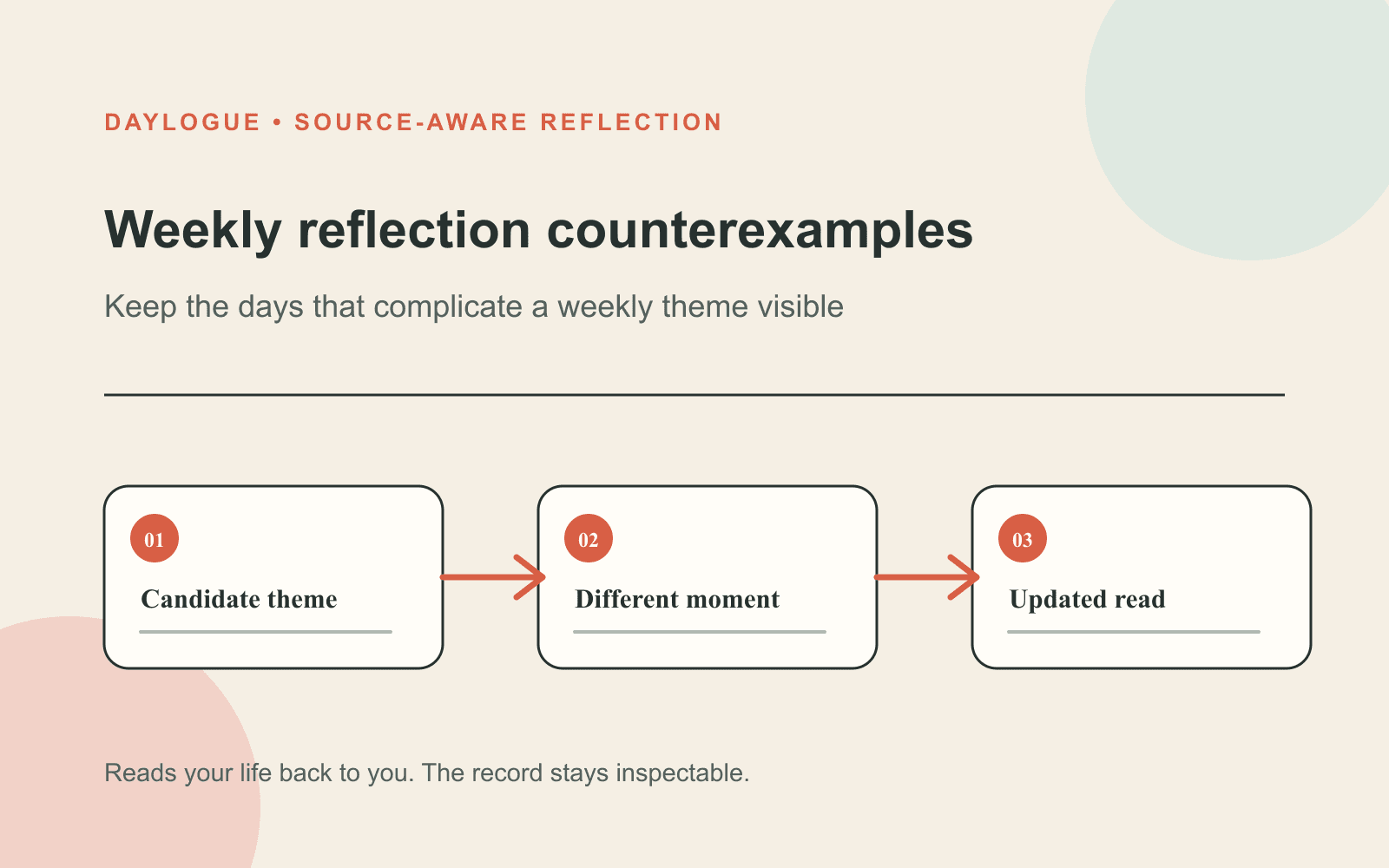
Daylogue is a system for self-understanding. In a workplace readback, the organization-facing signal stays downstream of what people choose to share and remains about the work. The diagram for this page shows that movement plainly: candidate theme, different moment, updated read. Keeping all three visible lets the record challenge an easy story while leaving private entries private.
Worksheet
Weekly Workplace Counterexample Record
A compact worksheet for keeping the candidate theme, fair comparison, privacy boundary, updated read, and later work-level review in one place.
- Candidate aggregate theme, date window, eligible group, and participation coverage
- Privacy threshold checked again after each team, shift, location, role, or time filter
- Comparison rule defined before the different moment was reviewed
- Comparable week, group, or condition where the expected theme did not appear
- Visible differences in workload, staffing, control, schedule, role clarity, or coverage
- Alternative explanations and missing evidence that remain unresolved
- One small reversible work-level response and the accountable function
- Later aggregate review window, including no change or an inconclusive result
- Employment firewall: no private quotation, identity, person-level score, or use in an employment decision
Common questions
What is a weekly reflection counterexample?
It is a comparable week, group, or work condition where the expected aggregate theme did not appear or appeared differently. It tests the first explanation and helps narrow the next work-level question.
Can a workplace reader open the entries behind a counterexample?
No. This method uses aggregate themes, participation coverage, comparison rules, and work conditions. Private journal entries, voice entries, identities, and person-level histories remain outside the readback.
How does the five-person threshold apply to a comparison?
The aggregate view begins with at least five active members. The threshold applies again after every added filter, since a large group can become identifying when it is narrowed by team, shift, location, role, or week.
Does a counterexample prove the original theme was wrong?
No. It shows that the theme did not hold under every comparable condition. The contrast may point toward differences in workload, staffing, control, timing, role clarity, or participation coverage.
What happens when no fair counterexample exists?
The record distinguishes consistent evidence from insufficient evidence. Several fair comparisons pointing the same way can sharpen a work question, while a short archive or uneven coverage leaves the result uncertain.
What belongs in the final weekly readback?
The final readback includes the candidate theme, coverage, comparison rule, different moment, updated interpretation, one reversible work-level response, accountable function, and later aggregate review window.
Sources
Sources were checked on the dates shown. Product details and policies can change.
- Mental health at work · World Health Organization · checked August 8, 2026
- Total Worker Health · National Institute for Occupational Safety and Health · checked August 8, 2026
- NIST Privacy Framework · National Institute of Standards and Technology · checked August 8, 2026
- Daylogue privacy policy · Daylogue · checked August 8, 2026
Keep exploring
Daylogue Knowledge Center
Browse practical guides for reflection, journaling, patterns, and privacy.
Read moreHow Daylogue shows patterns
See how candidate patterns stay connected to evidence and correction.
Read moreWhy Daylogue exists
Read the principles behind a system for self-understanding.
Read moreDaylogue is not therapy and is not a replacement for professional care.