Written by Daylogue Editorial Team. Published August 31, 2026. Reviewed and updated August 31, 2026.
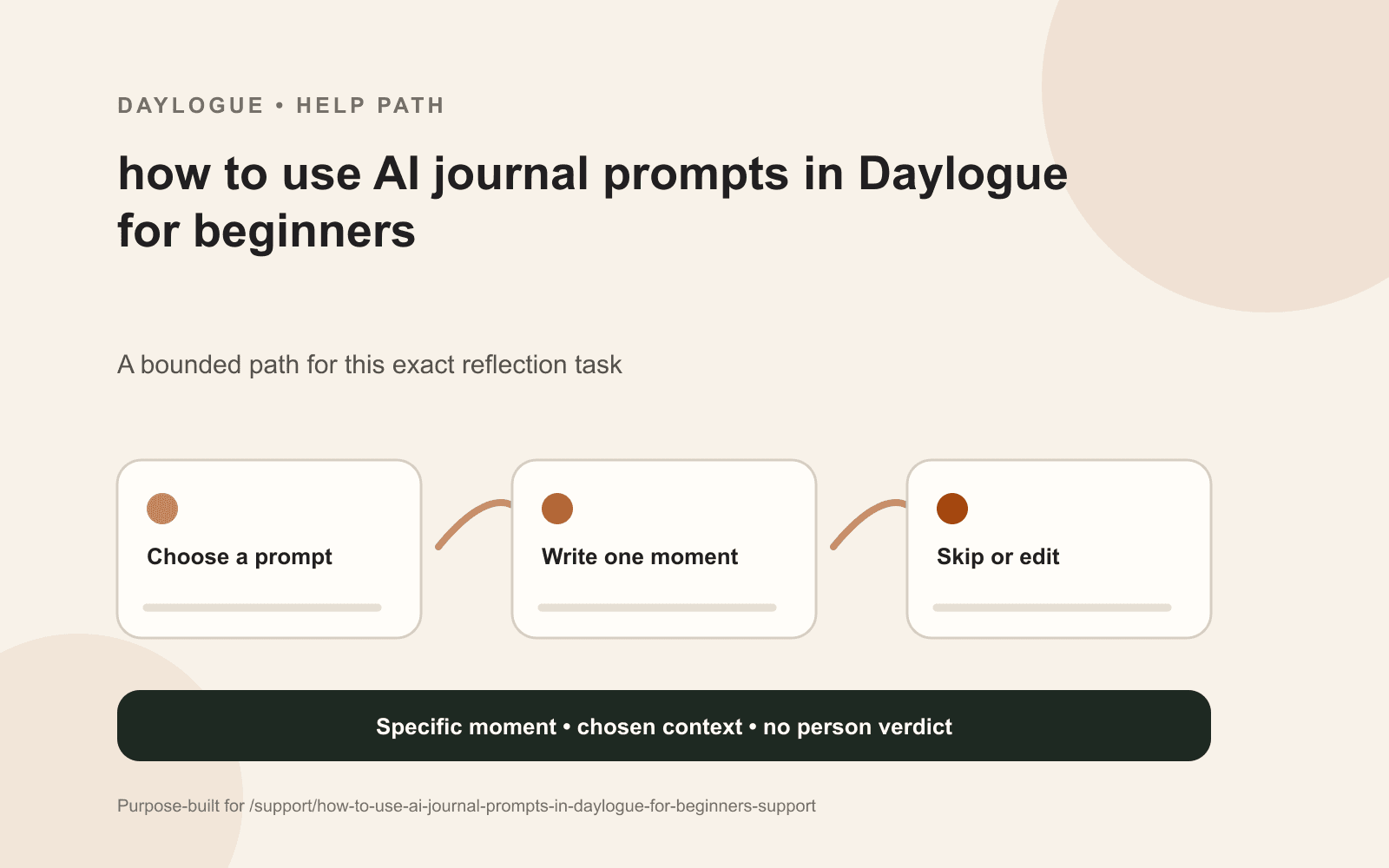
A first AI journal prompt in Daylogue can stay close to one event, such as a meeting that keeps replaying. A few lines about what happened, the detail that lingers, and what remains uncertain are enough. The prompt can be changed, skipped, or left unfinished when it does not fit.
A scene works better than a life story
Beginners often meet the blank page by trying to explain everything at once. A narrower scene is easier to hold: the pause before an answer, the sentence that changed the room, or the choice that still feels unresolved. The prompt has a modest job here. It can help place a real moment into words without deciding what that moment says about the person.
Event, detail, open question
One possible sequence moves from event to detail to open question. The event anchors the record. The detail protects what might disappear by Friday. The open question leaves room for context that has not arrived yet. None of these parts has to produce a lesson, and the entry can end as soon as it preserves what matters.
01
Locating the moment
A time and place give the entry edges without requiring a full account of the day.
02
Keeping the sharp detail
The exact phrase, pause, or choice is easier to inspect later than a broad conclusion.
03
Marking what is unknown
A question preserves uncertainty instead of turning a guess about motive into a fact.
04
Stopping at enough
The writer can save, revise, move the thought offline, or leave without saving.
A rushed meeting in plain words
A reader might picture a project meeting that ended with an agreement that felt rushed. A grounded reply can record who asked for the decision, which option was selected, and the concern that never got voiced. That account is more useful than a polished statement about being bad at boundaries because it remains tied to an inspectable source moment.
- The meeting that keeps replaying
- The choice made too quickly
- The phrase that still sounds unfinished
- The detail likely to disappear by Friday
When an AI prompt starts doing too much
Prompts drift when they supply motives, personality labels, or certainty that the entry did not provide. They also drift when every answer becomes a task list. Language that stays close to observable details is easier to correct. If the question feels intrusive or simply wrong, leaving it unanswered is a valid end to the check-in.
| If the prompt does this | A smaller alternative |
|---|---|
| Supplies a personality label | The event and exact words, if revisiting them feels useful |
| Turns a guess into a fact | The interpretation can remain a question |
| Expands into a biography | Only the relevant scene can remain |
| Feels too exposed | Reduce detail or keep the record elsewhere |
The first answer is allowed to change
New information can make the hurried choice look practical, reveal a missing constraint, or show that a remembered phrase was incomplete. The original wording can remain beside later reflection. Generated phrasing never outranks the source entry, so revision is part of an honest record rather than proof that the first attempt failed.
On a later read, the replaying meeting might sit beside the rushed choice and unfinished phrase. Friday’s fading detail can show what deserves one follow-up question, while the rest stays unresolved.
What saving the entry means
Before syncing personal writing, the account, processing, retention, export, and deletion terms are worth reading as separate boundaries. Daylogue is a system for self-understanding. Daylogue reads the entries you choose to sync to create narratives and surface patterns. Entries are not end-to-end encrypted. No AI mode still syncs content and is not a local-only or end-to-end-encrypted mode. Vault storage does not make the service unable to decrypt content.
Prompt Pack
First AI prompt field card
A compact reference for opening one AI-assisted entry while keeping the writer in charge of its meaning.
- Scene: where the moment happened
- Detail: the phrase or choice that lingered
- Known fact: what the entry supports
- Open question: what remains unclear
- Voice check: wording that sounds like you
- Scope check: no person label or verdict
- Privacy check: only detail you want to sync
- Stopping point: enough for a later reread
Common questions
How long does a first AI-prompt entry need to be?
A few concrete lines can be enough. Recognizable context matters more than length or polished prose.
What if the suggested question feels unrelated?
It can be rewritten, narrowed to the useful part, or skipped. A prompt is not a test with a correct response.
Can the wording be edited later?
Yes. Later context can be added, certainty can be reduced, and a phrase that no longer fits can be removed.
Will one entry explain a repeated situation?
No. One entry preserves a moment; it cannot establish cause or a stable pattern by itself.
What details might stay outside Daylogue?
Confidential work information and another person’s private story may belong in a smaller description or offline record.
Sources
Sources were checked on the dates shown. Product details and policies can change.
- Daylogue evidence and methods · Daylogue · checked August 31, 2026
- Daylogue privacy policy · Daylogue · checked August 31, 2026
Keep exploring
Daylogue Knowledge Center
Browse practical guides for reflection, journaling, patterns, and privacy.
Read moreHow Daylogue shows patterns
See how candidate patterns stay connected to evidence and correction.
Read moreWhy Daylogue exists
Read the principles behind a system for self-understanding.
Read moreDaylogue is not therapy and is not a replacement for professional care.