Written by Daylogue Editorial Team. Published August 14, 2026. Reviewed and updated August 14, 2026.
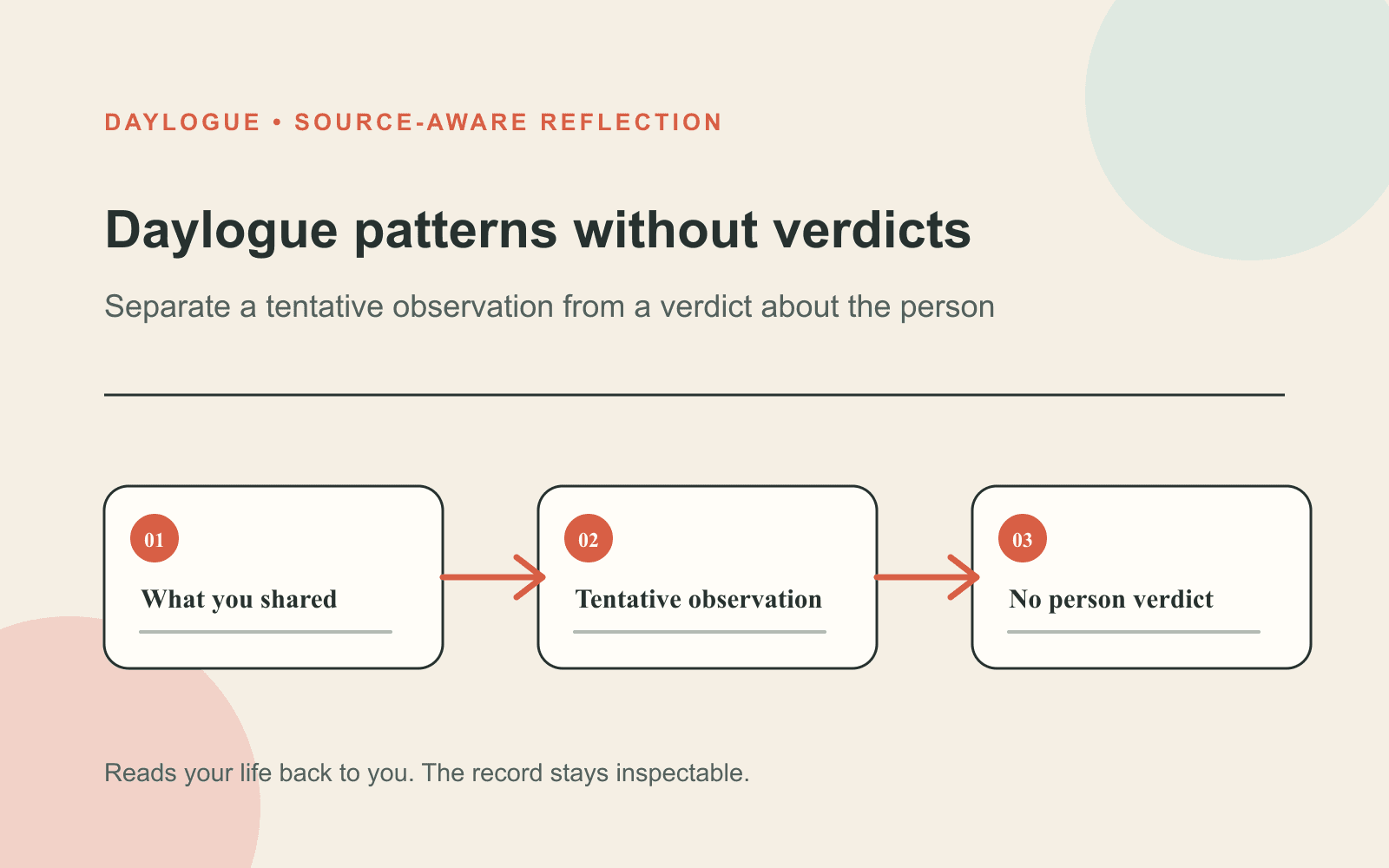
To use Daylogue as a beginner, record brief and honest check-ins on ordinary days, not just the dramatic ones. When the Patterns screen shows summary cards, check the displayed period and compare the summary with what you remember recording. Use each card as a prompt for reflection, not a cause, prediction, or verdict. This guide does not assume the cards open underlying entries or provide correction controls.
Start with ordinary check-ins
A useful record begins with days that feel ordinary enough to forget. Note what happened, choose the structured fields that fit, and add a sentence of context when it helps. You do not need polished prose. A plain note such as "late meeting, low energy, quiet evening" gives your future self more to work with than a perfect paragraph written once a month.
Try to describe rather than explain. "Work came up twice this week" stays close to the record. "Work always ruins my mood" turns a few entries into a conclusion. Daylogue can help you notice repetition, but you remain the person who decides what matters and what does not. An unrecorded day does not erase the value of what you already recorded.
01
Record the day you actually had
Choose the fields that fit and add one concrete detail, such as the setting, the part of the day, or what took most of your attention.
02
Keep the wording close to experience
Write what happened and what you noticed. Leave causes and permanent labels out until you have enough evidence to question them.
03
Return when it is useful
There is no need to reconstruct unrecorded entries. A smaller honest record is easier to trust than a reconstructed one.
Give the record enough time
One check-in captures a moment. Several check-ins across different days can reveal a recurring overlap worth reviewing. That distinction matters because two similar days may be coincidence. Let the record build before you call anything a pattern, and keep the surrounding context attached so a repeated word does not become a story on its own.
You can improve the record by using similar language for the same kind of event. If you call the same weekly block "planning" one day and "team sync" another, add a shared tag that makes the connection visible. Notice when consistent labels start flattening genuinely different situations. The goal is a record you recognize, not tidy data for its own sake.
Read the Patterns screen as an overview
Begin with the period and wording shown on the screen. The assigned screenshot displays summary cards for top mood, average energy, average stress, and a peak-energy day. Read those cards as descriptions of recorded fields for that period, not as a complete account of what happened. A recurring overlap does not show that one thing caused another.
The assigned sources and screenshot do not document a control that opens underlying entries from a summary card. You can compare a card with your original journal record through whatever review controls are visible in the current version of Daylogue. When the current screen does not show a source link, keep that limitation visible instead of assuming a hidden evidence path.
- Check the date range before deciding that a pattern is current.
- Notice which recorded field and period the card summarizes.
- Compare the card with journal context only through controls you can actually see.
- Look for a comparable day that complicates the first interpretation.
- Write your own interpretation as a possibility, not a fact.
Question a summary when it does not fit
A useful summary should survive your questions. First separate an inaccurate entry from an interpretation that feels wrong. The assigned sources do not document the current in-product sequence for correcting an entry. Check the controls visible in your account or current Daylogue support before assuming a correction changes an existing summary.
Try writing one sentence that supports the observation and one that complicates it. For example, "Stress was higher on three short-sleep check-ins" can sit beside "Two other short-sleep days felt steady." That pair is more honest than choosing the cleaner story. It also gives you something concrete to watch without telling yourself what will happen next.
Know what Daylogue reads and stores
Daylogue stores journal entries and check-in notes on its servers in readable form, protected in transit by TLS and by per-user database access controls. Daylogue reads that material to write narratives and surface patterns. This is not end-to-end encryption. Review the current privacy policy before entering anything you would not want processed under those terms.
Daylogue does not run emotion recognition on your face or on the tone of your voice. It works only from what you choose to share. You can delete your account and all data anytime. The assigned privacy excerpt does not document an export or entry-correction workflow, so check current account controls or support for those tasks and verify the result rather than assuming it.
Use a simple review loop
A beginner review can stay small. Pick one summary card, note the period it covers, add a counterexample from your own record if one is available, and write one question for the coming week. Then stop. Rereading everything at once often creates more noise than clarity. A defined review keeps attention on what the record can support today.
Your question might be "Does this same time slot still feel heavy when I slept enough?" or "What was different on the calmer version of this day?" These questions do not prescribe a change. They help you notice the next ordinary example. Over time, that makes the journal easier to read without turning it into a scorecard.
| Review move | What to look for | What to avoid |
|---|---|---|
| Read the card | Displayed period, field, and summary wording | Assuming the card is a complete explanation |
| Find a counterexample | A comparable day when the result differed | Explaining away every exception |
| Write one question | A narrow possibility you can notice later | Predicting how the next day will feel |
| Close the review | One note in your own words | Rereading the full journal every time |
Checklist
Beginner Pattern Review Checklist
Use this short checklist when a Daylogue summary card appears so you can read only what the current screen shows and keep the conclusion in your own hands.
- Confirm the observation covers the dates you expected.
- Name the field and period displayed on the card.
- Notice when the current screen does not provide a source link.
- Find one comparable day that did not fit.
- Verify correction, export, and deletion steps in current account controls or support.
- Write one possible interpretation in your own words.
- Choose one narrow question to notice next time.
- Stop the review before it turns into a verdict.
Common questions
How many check-ins do I need before reviewing a pattern?
There is no useful magic number for every situation. Wait for several examples across distinct days, then compare the summary with the journal context available to you. Two similar notes may be coincidence, so keep the language tentative when the record is still thin.
What if a Daylogue pattern feels wrong?
Check the period and field shown on the card, then compare it with your own record using controls visible in the current app. The assigned sources do not document a card-to-entry or correction workflow, so current support is the safer source for exact steps.
Does a pattern prove that one thing caused another?
No. An overlap can show that two things appeared together in your record, but it cannot establish cause by itself. Use it to form a better question, then keep looking at the context around both matching and nonmatching days.
Are my Daylogue entries end-to-end encrypted?
No. The privacy policy says journal entries and check-in notes are stored on Daylogue servers in readable form so the service can write narratives and surface patterns. They are protected in transit and by per-user access controls.
Do I need to fill in unrecorded days?
No. Leave a day unrecorded when you no longer remember it clearly. Return with the day you have now. Honest gaps are easier to understand than entries written later to make the record look complete.
Sources
Sources were checked on the dates shown. Product details and policies can change.
- Daylogue evidence and methods · Daylogue · checked August 14, 2026
- Daylogue privacy policy · Daylogue · checked August 14, 2026
Keep exploring
Daylogue Knowledge Center
Browse practical guides for reflection, journaling, patterns, and privacy.
Read moreHow Daylogue shows patterns
See how candidate patterns stay connected to evidence and correction.
Read moreWhy Daylogue exists
Read the principles behind a system for self-understanding.
Read moreDaylogue is not therapy and is not a replacement for professional care.