Written by Daylogue Editorial Team. Published August 31, 2026. Reviewed and updated August 31, 2026.
A morning journal prompt in Daylogue can begin with the day as it actually is: rested or tired, spacious or already crowded. From there, one flexible intention may be enough. The entry can name what deserves protection without pretending the schedule or your capacity will stay unchanged.
The real morning beats the ideal one
Morning pages often become performance plans before the first hour has happened. A calmer record starts with available capacity and known constraints. “I slept poorly and have two calls before ten” describes the starting conditions. “I need to be focused” turns those same conditions into pressure without adding information.
Three lines before the day speeds up
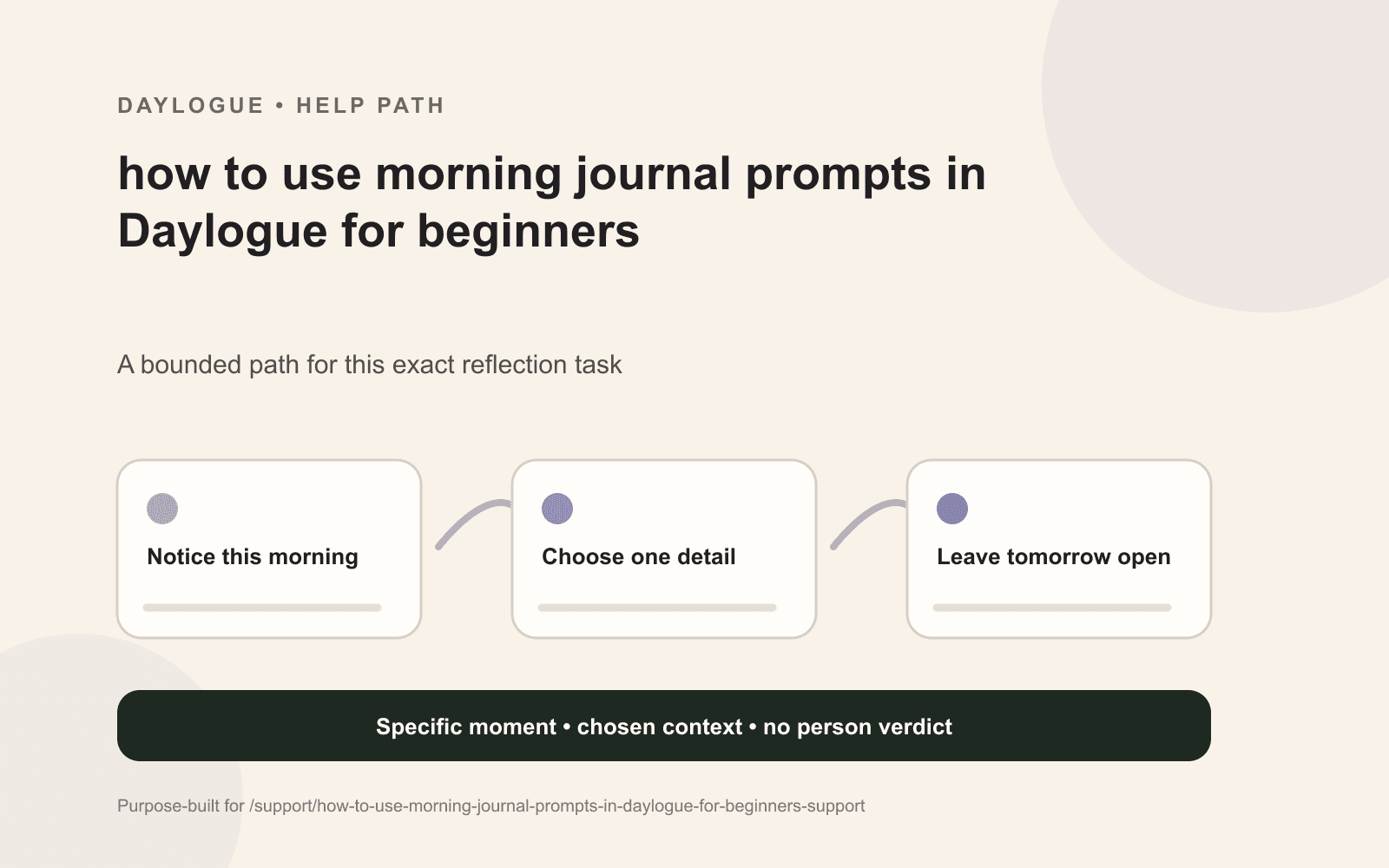
One line can capture current state, another can name the piece of the day that matters, and a third can leave room for change. This is not a contract with the future. It is a timestamped intention that can later be compared with what actually unfolded. Uncertainty is useful context, not a flaw in the entry.
01
Describing capacity
Sleep, attention, available time, or competing demands can give the entry a truthful base.
02
Naming one protected point
The focus might be a conversation, a quiet hour, or a boundary around one task.
03
Keeping a smaller version
A second workable form of the intention can remain available if plans shift.
04
Leaving a question
The day may answer something the morning cannot know, so prediction is optional.
An intention can bend
A beginner might write that the inbox already feels loud, a difficult conversation is scheduled, and finishing one draft would make the day feel less scattered. If the conversation moves or the draft waits, the entry has not failed. It still records what mattered at the start and what was known then.
- Current capacity without a score
- Known constraint before noon
- One point worth protecting
- A smaller version if plans move
When a prompt becomes a private manager
Words such as must, should, and no excuses can turn a check-in into a private manager. Questions like “What might be worth protecting?” leave room for fatigue, caregiving, interruptions, and other facts. Optional language keeps the morning prompt from punishing the person when the day changes shape.
| Pressure-heavy wording | More flexible wording |
|---|---|
| I have to win the day | What would make the next two hours workable? |
| I will not get distracted | Which interruption is already likely? |
| Everything is urgent | Which item loses value if it waits? |
| I failed my intention | What changed after it was written? |
The useful comparison happens later
The morning entry does not need an immediate verdict. A weekly reread can compare intention with outcome and notice when a constraint changed. The useful question is not whether the plan was followed perfectly. It is whether the original intention still looks realistic in context and what an exception adds.
At day’s end, the morning capacity note can sit beside the constraint that actually arrived. The protected point and smaller fallback show how the plan flexed without grading the day.
Morning context is still personal context
A short capacity note may reveal schedule, work, family, or sleep details, so the same syncing boundaries apply as they do to longer writing. Daylogue is a system for self-understanding. Daylogue reads the entries you choose to sync to create narratives and surface patterns. Entries are not end-to-end encrypted. No AI mode still syncs content and is not a local-only or end-to-end-encrypted mode. Vault storage does not make the service unable to decrypt content.
Checklist
Morning constraint card
A four-line morning reference that protects flexibility and keeps an intention from becoming an obligation.
- Current capacity in plain words
- Known constraint before noon
- One point worth protecting
- Smaller version if plans change
- Question the day may answer
- Language check for hidden pressure
- Private detail that can stay offline
- Permission to close after one line
Common questions
When is the best time for a morning prompt?
The useful time is the one that fits, including after coffee, during a commute pause, or not at all.
Does a morning entry need goals?
No. It can record conditions or hold a question without turning into a plan.
What if the schedule changes immediately?
The original entry remains a record of what was known then, and an update can add the change.
Can mornings be compared with evenings?
Yes, descriptively. A later entry can show what shifted without treating one day as a lasting rule.
How short can the entry be?
A capacity note and one open question may be enough. More words do not make it more honest.
Sources
Sources were checked on the dates shown. Product details and policies can change.
- Daylogue evidence and methods · Daylogue · checked August 31, 2026
- Daylogue privacy policy · Daylogue · checked August 31, 2026
Keep exploring
Daylogue Knowledge Center
Browse practical guides for reflection, journaling, patterns, and privacy.
Read moreHow Daylogue shows patterns
See how candidate patterns stay connected to evidence and correction.
Read moreWhy Daylogue exists
Read the principles behind a system for self-understanding.
Read moreDaylogue is not therapy and is not a replacement for professional care.