Written by Daylogue Editorial Team. Published August 31, 2026. Reviewed and updated August 31, 2026.
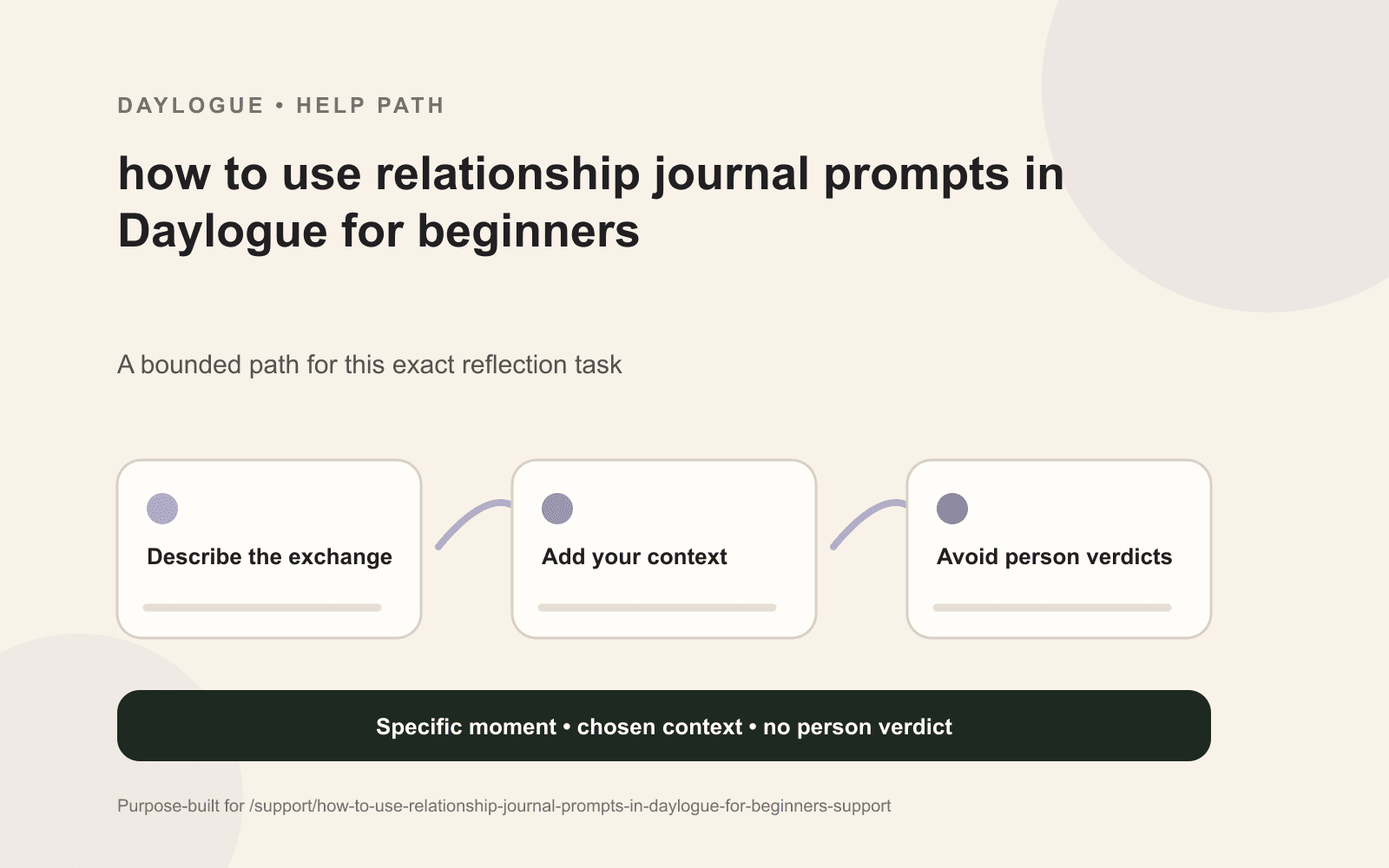
A relationship journal prompt in Daylogue can separate the exchange you remember from the meaning you attached to it. One entry might record the exact request, the pause that followed, and the question still worth asking. It does not need to decide another person’s motive or assign either person a type.
Keeping the exchange and the story beside each other
Relationship moments are hard to revisit when remembered words and inferred motives blend. The first layer is the exchange: what was said, requested, or changed. The second is the meaning the writer made from it. Both matter, but separating them prevents an assumption from quietly becoming fact.
Facts, interpretations, and gaps
A message can be quoted if it is yours to record or summarized with less identifying detail. The interpretation might be “I read the short reply as distance.” Missing information could include timing, workload, or intent. The journal can hold those gaps without pretending to fill them.
01
Recording the exchange
The words, request, pause, or changed plan can be described with only needed detail.
02
Naming your reading
“I took that to mean” keeps interpretation visible as interpretation.
03
Listing the gap
Unknown intent, missing context, and timing may change the meaning.
04
Keeping a possible question
A question can clarify without becoming an instruction to confront or respond.
After a plan changes
A reader might recall dinner plans changing through a brief text. The entry may capture disappointment, late notice, and the belief that the relationship was not a priority. It may also say the reason was unknown. A later conversation could confirm part of that reading, change it, or reveal a constraint invisible at the time.
- What was said or changed
- What you made it mean
- What remains unknown
- What question still feels genuine
A journal is not a rehearsal for prosecution
Prompts drift when they assemble a case against someone, declare what the relationship is, or script a perfect response. Reflection can clarify what the writer wants understood and which question could invite real information. The goal is not to win an imaginary conversation but to know which claims belong to the event.
| Conclusive wording | Source-aware wording |
|---|---|
| They ignored me | I sent a message and have not received a reply |
| They do not care | I read the change as distance |
| I am too sensitive | The late notice landed hard |
| A drafted accusation | One question about missing context |
A question can be the finished entry
Sometimes one honest question is the useful output: “What changed between making the plan and canceling it?” It may remain in the journal, be asked later, or never be used. Daylogue does not mediate the relationship or decide who is right. It preserves the person’s account without turning it into a verdict.
What was said, your interpretation, and what remains unknown can stay on separate lines. A genuine question may be the only next step the source material supports.
The timing of a question belongs in the reflection too. A useful question may not fit a hurried text exchange, a shared room, or a moment when either person lacks context. The journal can preserve the wording without creating an obligation to ask it. It can also hold more than one version, including a shorter question and a decision to wait. That flexibility keeps preparation separate from confrontation and leaves room for information that the original entry could not contain.
Another person’s details deserve restraint
A personal entry can minimize names, confidential facts, and identifying context while still preserving what the exchange meant to the writer. Daylogue is a system for self-understanding. Daylogue reads the entries you choose to sync to create narratives and surface patterns. Entries are not end-to-end encrypted. No AI mode still syncs content and is not a local-only or end-to-end-encrypted mode. Vault storage does not make the service unable to decrypt content.
Worksheet
Conversation context sheet
A relationship reflection aid for separating remembered exchange, personal interpretation, and missing information.
- What was actually said?
- What changed in the plan?
- What did you make it mean?
- Which feeling belongs to your account?
- What information is missing?
- What detail can be omitted?
- What question remains genuine?
- Would stopping protect the moment?
Common questions
Can I write about someone else?
You can decide how much identifying detail is necessary; another person’s confidential story may stay out.
What if I remember the words differently later?
A correction can sit beside the earlier account without pretending memory is a perfect recording.
Can a prompt tell me what they meant?
No. It can separate observations from interpretations, but motive may require information not present.
Does journaling replace a conversation?
No. It clarifies your account; any next step remains your choice and depends on context.
What if serious harm is involved?
A reflection tool is not emergency or professional support, and another form of help may be appropriate.
Sources
Sources were checked on the dates shown. Product details and policies can change.
- Daylogue evidence and methods · Daylogue · checked August 31, 2026
- Daylogue privacy policy · Daylogue · checked August 31, 2026
Keep exploring
Daylogue Knowledge Center
Browse practical guides for reflection, journaling, patterns, and privacy.
Read moreHow Daylogue shows patterns
See how candidate patterns stay connected to evidence and correction.
Read moreWhy Daylogue exists
Read the principles behind a system for self-understanding.
Read moreDaylogue is not therapy and is not a replacement for professional care.