Written by Daylogue Editorial Team. Published August 31, 2026. Reviewed and updated August 31, 2026.
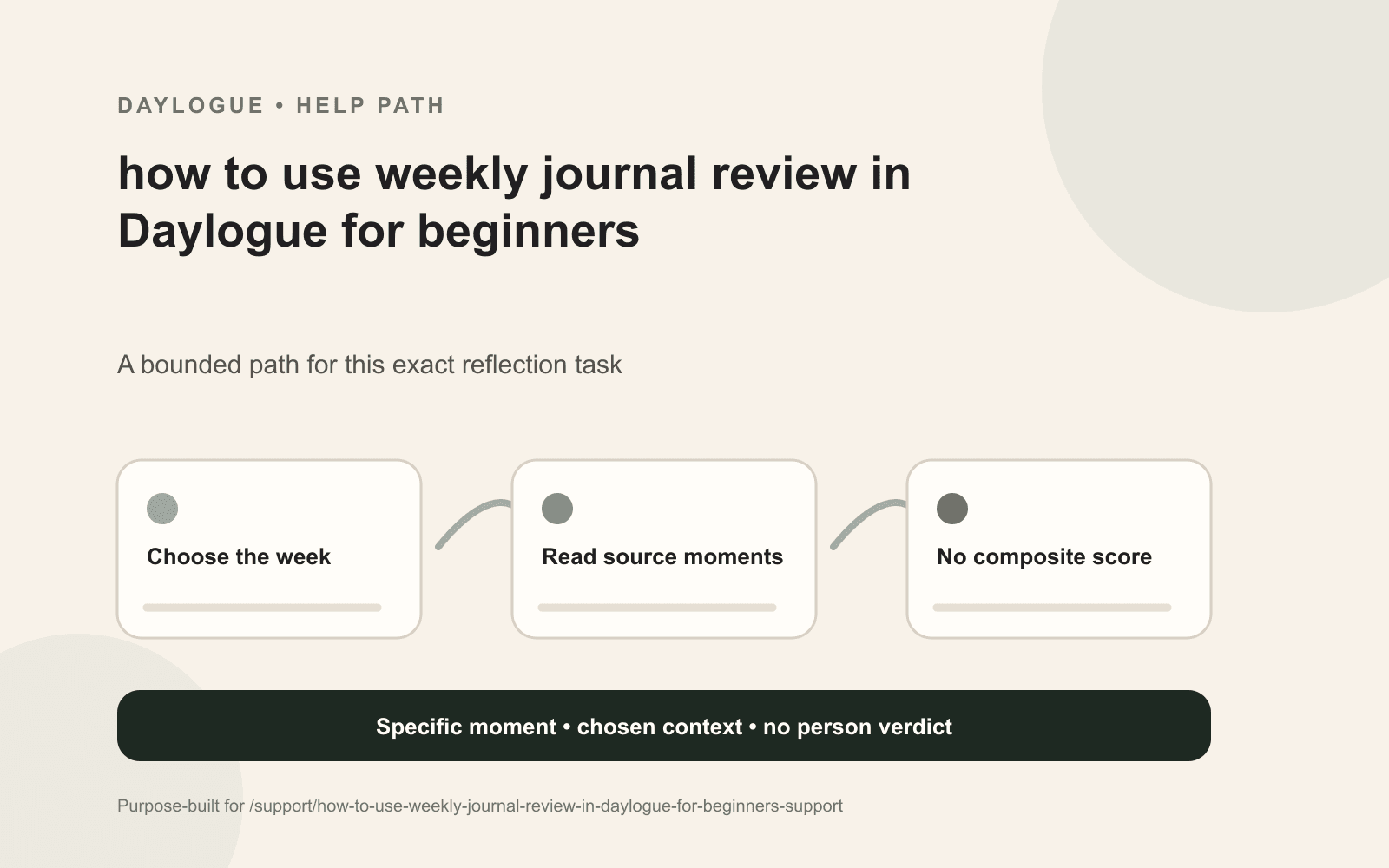
A beginner weekly journal review in Daylogue can use three or four entries instead of rereading everything. The review may note one repeated thread, one exception, and one question that remains open. The source entries stay visible so a polished recap does not replace the week that was actually recorded.
A small source set is easier to inspect
A weekly review becomes exhausting when it asks the person to reread every line. A smaller source set can still be useful if its boundaries are clear. Three entries from different parts of the week may reveal a recurring phrase while leaving the unrecorded days unclaimed. Missing material is part of the limits.
Repeat, exception, open question
The repeated thread names what appeared more than once. The exception keeps the thread from becoming a rule. The open question marks what the week cannot answer. This structure resists the temptation to describe the person as always stressed, consistently avoidant, or finally fixed on the strength of a few recent entries.
01
Selecting a bounded set
A few dated entries make the limits of the review visible.
02
Marking a repeated thread
Exact phrases or comparable scenes work better than a broad theme label.
03
Preserving an exception
A different setting or result keeps the recap from becoming a rule.
04
Leaving one open question
The review can end with uncertainty instead of prescribing the next week.
Three entries from one crowded week
A reader might find rushed handoffs in Monday and Thursday entries, while Saturday describes a slow morning with no work context. The review can say that handoff pressure appeared in two recorded work scenes. It cannot conclude that the whole week was defined by pressure. Saturday matters as a different setting, not as evidence that the work scenes were false.
- Dates attached to source entries
- Exact phrase that repeated
- Scene that does not fit the thread
- Question that remains genuinely open
Recent does not always mean representative
The last entry is often easiest to remember, and a vivid event can outweigh several quieter ones. Dates, source links, and exact phrases help correct that recency bias. A summary that sounds elegant but cannot point back to its moments deserves narrowing. The purpose is recall with context, not a definitive weekly score.
| Review shortcut | More careful alternative |
|---|---|
| Reread everything | A bounded set of entries |
| The week was always stressful | Pressure appeared in two recorded scenes |
| Ignore the outlier | The exception stays beside the repeat |
| Turn the recap into goals | One optional question at the end |
Carry one thread, not a weekly verdict
One question may be enough to carry forward: “Does unclear ownership keep showing up in the scenes I record?” That question can guide attention without demanding another entry or experiment. The next week may add support, reveal a counterexample, or make the question irrelevant. All three outcomes are legitimate.
The repeated phrase can sit beside the dated exception, rather than only the loudest entry. If one honest question survives the comparison, that is enough for this week.
The source sample can change what the week appears to say. Three entries written after difficult meetings will not represent quiet mornings that were never recorded. A useful recap names that selection instead of smoothing it away. Dates, settings, and skipped days can remain visible beside the repeated phrase. If the next review includes a different mix of moments, the question may narrow or disappear. That change is new context, not proof that either review failed.
A weekly recap inherits the limits of its sources
The review can only speak for the entries included, and those entries remain synced personal material under the same processing terms. Daylogue is a system for self-understanding. Daylogue reads the entries you choose to sync to create narratives and surface patterns. Entries are not end-to-end encrypted. No AI mode still syncs content and is not a local-only or end-to-end-encrypted mode. Vault storage does not make the service unable to decrypt content.
Worksheet
Three-entry weekly review
A bounded weekly review sheet for comparing a repeat, an exception, and an open question without scoring the week.
- Entry dates included
- One repeated phrase or scene
- One exception kept visible
- Unrecorded days left unclaimed
- Recency bias checked
- Summary linked to source wording
- One optional question forward
- No weekly person verdict
Common questions
How many entries belong in a weekly review?
There is no fixed number. Three or four may be enough if the dates and limits remain clear.
What if I skipped most of the week?
The review can cover only what was recorded and say nothing about the missing days.
Does repetition prove a pattern?
No. It can form a question, while frequency, context, and exceptions still matter.
Why keep the original entries nearby?
They show whether the recap preserves exact context or quietly adds certainty.
Can the weekly review end without a plan?
Yes. Remembering one thread accurately can be the complete job for that review.
Sources
Sources were checked on the dates shown. Product details and policies can change.
- Daylogue evidence and methods · Daylogue · checked August 31, 2026
- Daylogue privacy policy · Daylogue · checked August 31, 2026
Keep exploring
Daylogue Knowledge Center
Browse practical guides for reflection, journaling, patterns, and privacy.
Read moreHow Daylogue shows patterns
See how candidate patterns stay connected to evidence and correction.
Read moreWhy Daylogue exists
Read the principles behind a system for self-understanding.
Read moreDaylogue is not therapy and is not a replacement for professional care.