Written by Daylogue Editorial Team. Published August 31, 2026. Reviewed and updated August 31, 2026.
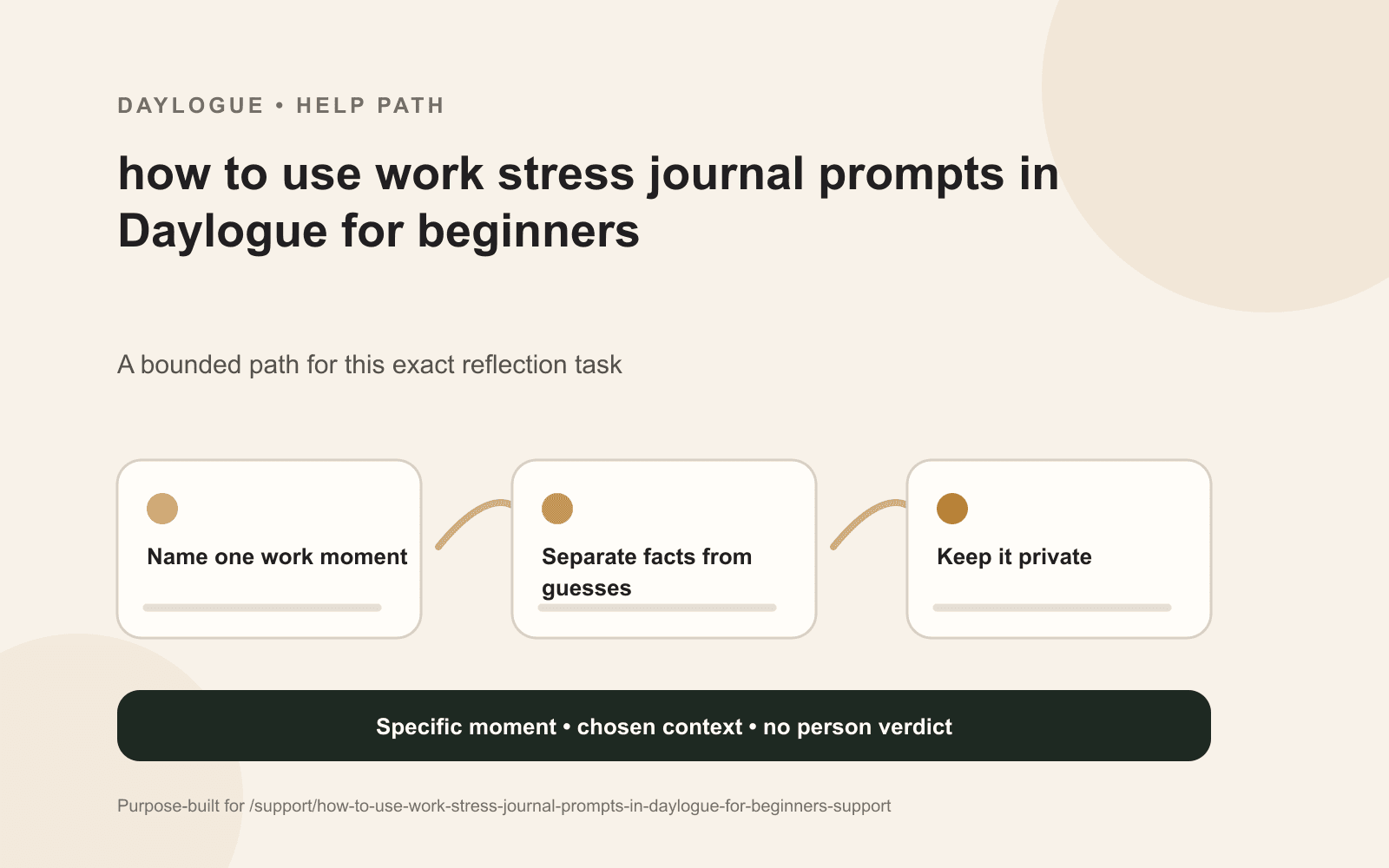
A work stress journal prompt in Daylogue can zoom in on one episode instead of judging the entire job. The entry might describe a call that ran over, an unclear request, or a rushed handoff, then separate the demand from the constraint. One hard moment does not have to become a verdict about competence or career fit.
The workday is too large for one conclusion
“Work was terrible” may be emotionally true and still leave little to inspect later. A single episode gives the reflection edges. The meeting began late, the brief changed, or three people requested updates at once. Naming the event keeps one scene from making every part of the role carry its weight.
Demand and constraint tell different stories
The demand is what the moment asked for: speed, concentration, restraint, ambiguity tolerance, or more hours. The constraint is what made that demand harder: missing information, unclear authority, overlapping deadlines, or no uninterrupted time. Keeping them separate can show conditions without blaming the person.
01
Isolating the episode
A beginning and ending point keep one moment from swallowing the whole job.
02
Naming the demand
The entry can identify what the situation required without deciding if that demand was reasonable.
03
Naming the constraint
Missing time, context, authority, or support may better explain the pressure.
04
Saving a contrast
A similar task that felt manageable can show which condition changed.
A rushed handoff in context
A reader might recall a handoff arriving fifteen minutes before a client call with two conflicting files. The entry can record timing, ambiguity, and the choice made under pressure. It does not need to conclude the writer cannot handle stress. Another handoff with clear ownership may provide an important contrast.
- Call that ran over
- Request with unclear ownership
- Handoff missing context
- Comparable task with better conditions
Confidential work details outside the entry
Work entries can expose customer names, internal plans, employee information, or legal details that do not belong in a consumer journal. A less identifying description can preserve the personal moment. “I lost my place for ten seconds” is also more precise than “I am incompetent under pressure.”
| Global judgment | Bounded record |
|---|---|
| I cannot do this job | This handoff arrived late and lacked an owner |
| I am bad under pressure | I lost my place when requests changed |
| Confidential project name | The kind of constraint without identifiers |
| A productivity score | Demand, constraint, and exception |
Protecting work details and dropping self-verdicts
A later review may reveal repeated demands or constraints, but it needs enough source scenes and exceptions. The journal does not measure workplace risk or evaluate performance. It can help the person remember what happened and what surrounded it while decisions about work remain outside the reflection.
The overlong call can sit beside the better-supported task, with the change after each one noted separately. The contrast can clarify working conditions without evaluating the person or career.
A bounded episode record can also preserve what happened after the pressure changed. The missing file may have arrived, ownership may have become clear, or the deadline may have moved. That sequence adds useful context without claiming that one condition caused the writer’s response. A contrasting scene from the same kind of task can show which details were unusual and which were routine. The result remains a description of working conditions in recorded moments, not a score for resilience, competence, or fit.
Work reflection needs a confidentiality check
Customer, colleague, project, and legal details can be generalized or omitted before the personal account is synced. Daylogue is a system for self-understanding. Daylogue reads the entries you choose to sync to create narratives and surface patterns. Entries are not end-to-end encrypted. No AI mode still syncs content and is not a local-only or end-to-end-encrypted mode. Vault storage does not make the service unable to decrypt content.
Framework
Work episode map
A worksheet for documenting one demanding work episode without scoring the person or exposing unnecessary details.
- Episode beginning and ending
- Demand on attention or time
- Constraint narrowing choices
- Observable response
- Interpretation kept tentative
- Comparable episode
- Confidential detail generalized
- Question for a later review
Common questions
Is this productivity tracking?
No. The prompt preserves conditions around one difficult moment and does not calculate performance.
Can names and projects be included?
Less identifying language may be safer for customer, colleague, trade-secret, or protected information.
What if every day feels hard?
A few scenes may make conditions visible, but the journal does not need to analyze indefinitely.
Can the entry prove what caused stress?
No. It can document overlap while cause remains open to other factors and counterexamples.
Why save an exception?
A comparable task may reveal a different condition and prevent a broad self-verdict.
Sources
Sources were checked on the dates shown. Product details and policies can change.
- Daylogue evidence and methods · Daylogue · checked August 31, 2026
- Daylogue privacy policy · Daylogue · checked August 31, 2026
Keep exploring
Daylogue Knowledge Center
Browse practical guides for reflection, journaling, patterns, and privacy.
Read moreHow Daylogue shows patterns
See how candidate patterns stay connected to evidence and correction.
Read moreWhy Daylogue exists
Read the principles behind a system for self-understanding.
Read moreDaylogue is not therapy and is not a replacement for professional care.