Written by Daylogue Editorial Team. Published August 31, 2026. Reviewed and updated August 31, 2026.
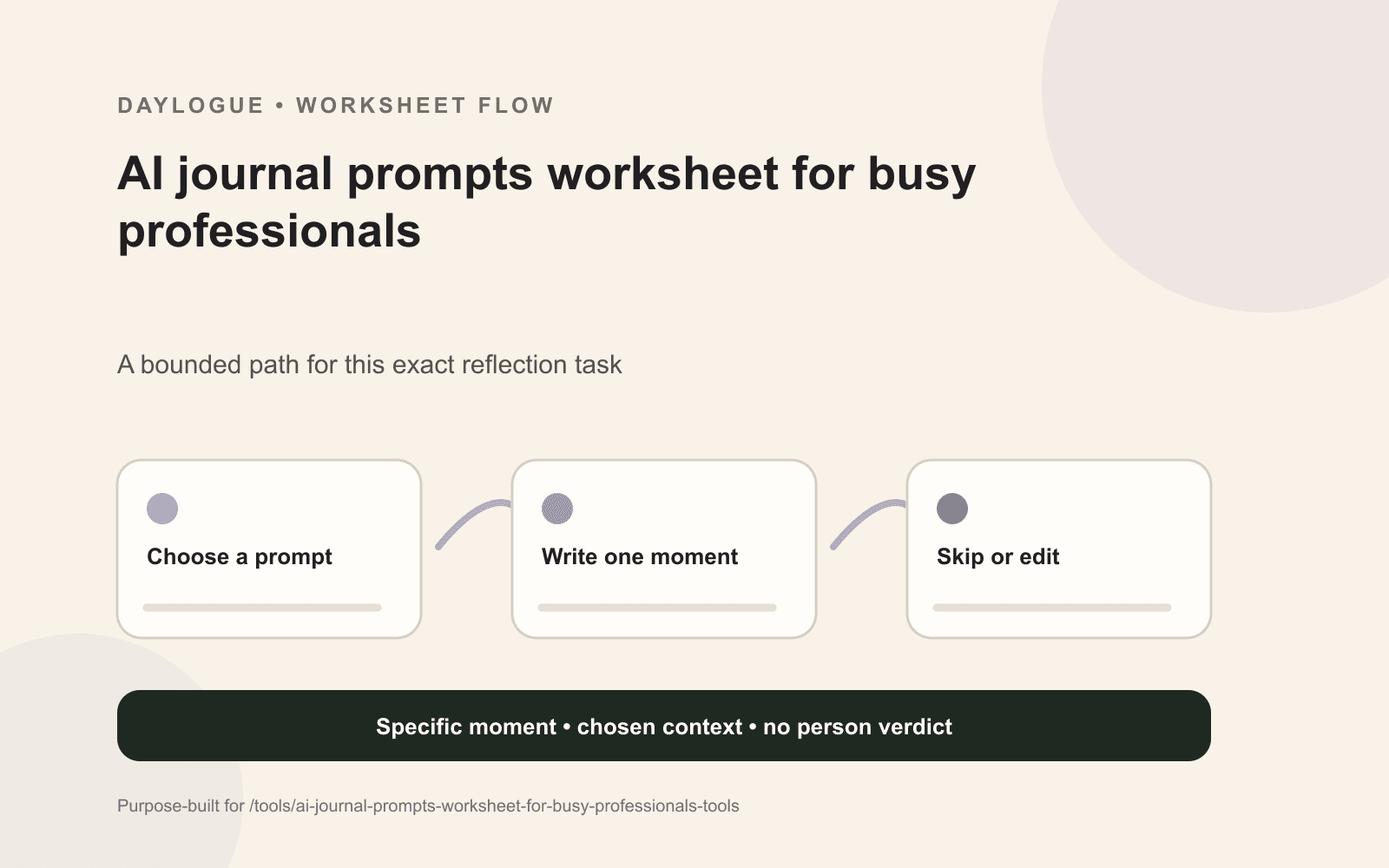
This AI journal prompt worksheet uses five minutes and one scene. One optional pass can hold the observable moment, the sentence still taking up attention, one rejected assumption, and the smallest question worth keeping. The page can close, move to tasks, or stay open for later. Stopping before it feels finished is fine. The slate is personal reflection, not a performance log.
Minute one: freeze one frame
The moment with the clearest edges can anchor the page. Its location, approximate time, people in broad roles, and the action that changed the scene can sit together. “Kitchen table, 6:20, the handoff moved again” is enough. The whole workday can stay outside the frame. The freeze-frame gives the remaining prompts something specific to work with.
If several moments compete, one that can be described without opening five other stories may fit best. A calendar change, one sentence in a review, or the instant a task moved owners has clearer edges than “the whole afternoon.” Role labels such as client, teammate, or manager can stand in when a name adds nothing. The goal is a scene that remains recognizable later while keeping confidential work details outside the entry.
Minute two: the line that lingered
The exact phrase still replaying, including your own, can sit here. “Let’s revisit next week” differs from “This is not ready.” If the words are uncertain, an approximate label can preserve that limit. A remembered line is source material, not proof of another person’s intent. Confidential names and project details can stay outside the slate.
Minute three: a rejected prompt premise
Every prompt carries an assumption. “What did you learn?” assumes the scene already has a lesson. “How will you improve?” assumes improvement is the right frame. The assumption that does not fit can be stated beside a replacement. “No lesson yet. The useful question is what remains undecided.” This line keeps the worksheet from pushing a polished conclusion.
- Instead of “What went wrong?”: “What changed?”
- Instead of “How will I improve?”: “What remains open?”
- Instead of “Why am I like this?”: “Which scene supports that thought?”
- Instead of “What should I do?”: “Which choice is actually mine?”
Minute four: route what remains
The remainder can move to one of three destinations. A clear action moves to the task system. An unresolved meaning stays as one question. A detail that carries unnecessary risk is removed or moved offline. The journal does not need to hold every artifact of the day. Routing protects it from becoming an inbox with feelings attached.
| Remainder | Destination | Example |
|---|---|---|
| Clear action | Task list | Send revised file at ten |
| Open meaning | Journal question | Why did the short delay hold so much attention? |
| Sensitive detail | Omit or offline | Client name and contract terms |
| No longer useful | Discard | Repeated prompt that adds nothing |
Minute five: a closing stamp
One stamp can close the page: closed, move to tasks, or return later. “Closed” means the scene has enough shape. “Move to tasks” means the practical next action lives elsewhere. “Return later” includes a date or condition, not a vague obligation. The stamp ends the worksheet without rating the day or promising a better tomorrow.
01
Closed
The scene and question can stay as they are while the slate closes.
02
A move to tasks
The actionable line can move while only its context remains in the journal.
03
A later return
A realistic time or event can mark when another look might be useful.
Why the slate stays source-aware
Daylogue describes itself as a system for self-understanding, and pattern journaling is how it reads what a person chooses to record. A 2019 study of 395 young adults examined narrative coherence alongside identity functioning and well-being, and its results did not support a simple universal benefit. The slate preserves one scene and one revisable question. It makes no claim that a neat story or daily completion produces an outcome.
Worksheet
Five-minute workday decision slate
A compact prompt sheet with one freeze-frame, one lingering line, one rejected assumption, one routing choice, and a closing stamp.
- 00:00–01:00 Freeze-frame fields: place, time, broad roles, changed action.
- 01:00–02:00 Lingering line: exact words or clearly marked approximation.
- 02:00–03:00 Rejected premise: which prompt assumption does not fit?
- Replacement question: one narrower opening with no verdict.
- 03:00–04:00 Route: task list, journal question, offline note, or discard.
- Sensitive-detail check: names, contracts, credentials, and another person’s story.
- 04:00–05:00 Stamp: closed, move to tasks, or return later.
- Return condition: a date or event, never a vague obligation.
- Final check: no score, lesson requirement, or performance language.
Common questions
Can the five-minute worksheet be used between meetings?
Yes, if the setting and device fit personal reflection. A single freeze-frame and closing stamp may be enough. On a managed device or visible screen, a low-detail placeholder may be the better route.
What if the prompt assumption feels wrong?
The assumption can be stated plainly beside a narrower question. The worksheet includes a rejection line so the prompt never gets treated as an instruction or verdict.
How is this different from a task list?
Actions move to the task system. The worksheet keeps the scene, lingering phrase, rejected assumption, and open question. This separation prevents reflection from becoming another productivity tracker.
Can I stop before all five minutes are done?
Yes. Each minute stands alone. A freeze-frame can be a complete entry, and the closing stamp can arrive whenever the useful part has been captured.
Sources
Sources were checked on the dates shown. Product details and policies can change.
- Daylogue evidence and methods · Daylogue · checked August 31, 2026
- Narrative identity and psychological well-being research · National Library of Medicine · checked August 31, 2026
Keep exploring
Daylogue Knowledge Center
Browse practical guides for reflection, journaling, patterns, and privacy.
Read moreHow Daylogue shows patterns
See how candidate patterns stay connected to evidence and correction.
Read moreWhy Daylogue exists
Read the principles behind a system for self-understanding.
Read moreDaylogue is not therapy and is not a replacement for professional care.