Written by Daylogue Editorial Team. Published August 8, 2026. Reviewed and updated August 8, 2026.
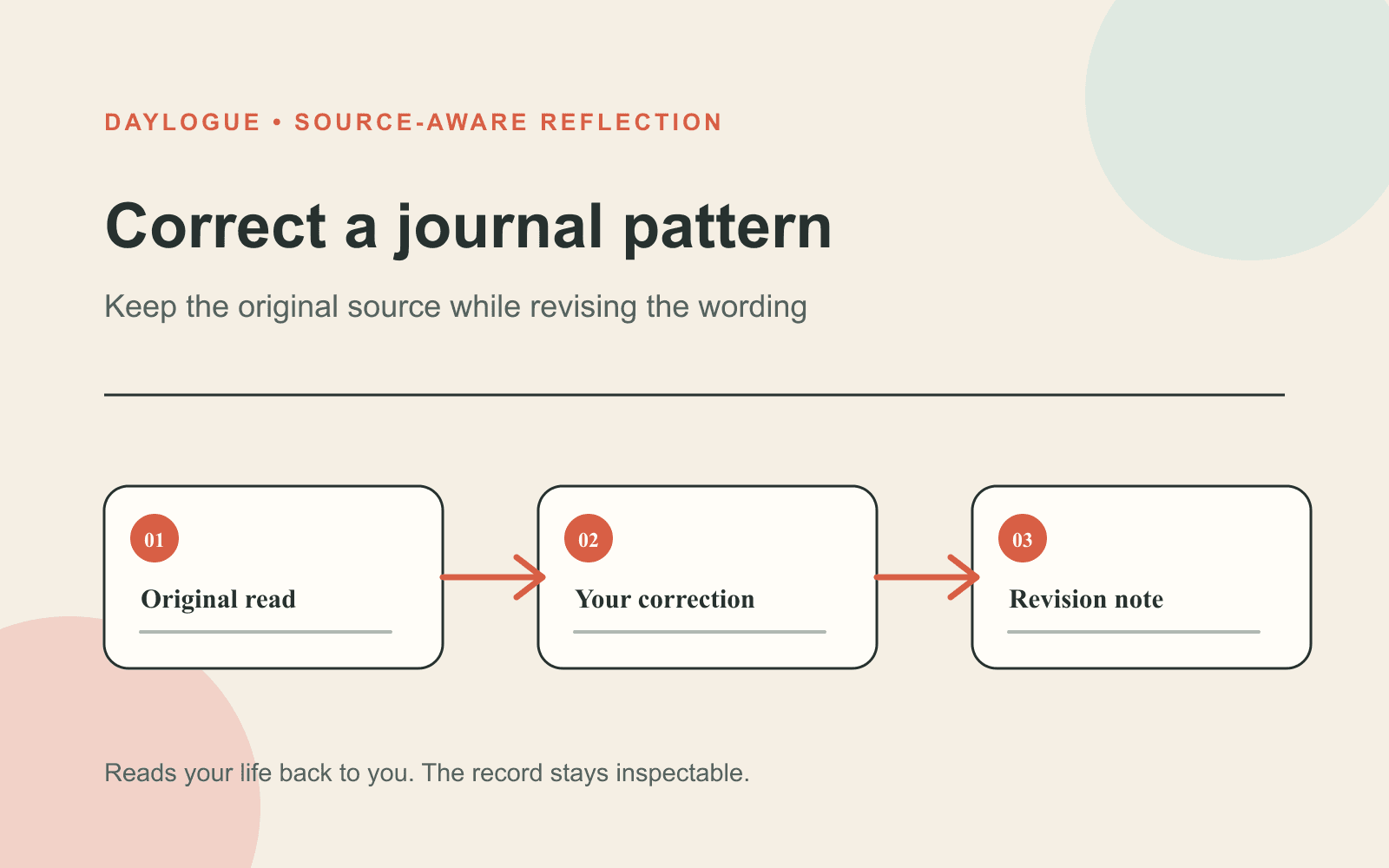
To correct a journal pattern, copy the original wording, identify the source moments it used, describe the mismatch, add missing context or a counterexample, and choose one action: narrow it, replace it, retire it, or leave it open. Keep the revision beside the original so the history stays understandable. Current Daylogue product pages do not document an in-product correction control, so this tool is a manual method, not a feature instruction.
Correction is part of reading
A journal pattern is a proposed way to read part of your history. This manual tool applies the pattern detection guide at /learn/how-ai-journal-pattern-detection-works, the Source Grounding glossary at /learn/glossary/source-grounding, and Daylogue's Evidence and Methods boundaries at /evidence. It does not claim an in-product correction feature.
Daylogue tells readers: The observation is ours. The meaning is yours. That boundary works only when disagreement is allowed to matter. A trustworthy correction method preserves what was noticed while letting you state why you accept, narrow, reject, or reinterpret it.
Choose the right kind of revision
Not every mismatch needs the same response. A read can be accurate for a shorter period, right about the event but wrong about its meaning, or unsupported because the source moments cannot be found. Name the kind of problem before rewriting the sentence.
Use the smallest change that fixes the issue. If 'Fridays are always hard' came from three deadline weeks, narrow it to those weeks. If the calm Fridays were overlooked, add them. If no source can be checked, mark the read unverified rather than polishing it.
| Problem | Action | Example response |
|---|---|---|
| Period is too broad | Narrow | This appeared during the May deadline period |
| Key context is missing | Replace | High stress appeared when the deadline and travel overlapped |
| Counterexamples outweigh support | Retire | This thread no longer fits the reviewed period |
| Source cannot be located | Leave open | Unverified until the supporting entries can be inspected |
| Wording fits but meaning differs | Reinterpret | The repeat is visible, but I understand it differently |
Write the revision note
Copy the original pattern exactly. Add the period it claimed to cover and the dated moments you could verify. Then write one sentence about the mismatch, one missed piece of context, and the corrected wording. This creates a trail you can understand later.
Keep the original sentence unchanged beside a dated revision so the change stays visible. A future read can then distinguish an old proposal from your later interpretation instead of viewing both as equally current.
01
Copy the original
Preserve the exact pattern wording and the date when you first saw or wrote it.
02
Trace its support
List the dated entries or check-ins that appear to support the observation.
03
Name the mismatch
Describe what is inaccurate, missing, outdated, too broad, or impossible to verify.
04
Add contrary context
Record at least one comparable moment or condition that changes the interpretation.
05
Choose and date the revision
Narrow, replace, retire, reinterpret, or leave the read open, then add today's date.
Watch for one overclaim replacing another
A recurring overlap does not show that one thing caused another. If the original read turned same-check-in sleep and stress into a cause claim, correct the time direction too. The revised version can say they appeared together without guessing which one drove the other.
Watch for identity language during revision. 'I am bad at conflict' is not a narrower pattern. 'Stress was higher in three check-ins that mentioned an unresolved conversation' stays with the recorded period and leaves room for the conversations that went differently.
- Keep the revised timeframe visible.
- Use the same comparison rule for supporting moments and exceptions.
- Remove cause language that the record does not establish.
- Replace identity verdicts with descriptions of recorded moments.
- Mark missing check-ins or fields as gaps, not evidence.
Ask what the product correction changes
A visible correction can affect several layers: the original entry, a saved summary, a displayed pattern, and future readbacks. The current pattern and evidence pages do not explain a correction workflow across those layers. Ask support which item changes and whether an older generated read remains in history.
The NIST Privacy Framework is a voluntary tool for identifying and managing privacy risk. Applied here, correction is also a data-control question. The answer needs to identify which version remains, who can access it, what an export includes, and what deletion covers.
Keep the promise narrow
No research or outcome claim has been approved for public use yet. A correction tool can make a personal read more inspectable. It does not prove that the revised read is objectively true or that using it will produce a particular change in your life.
The useful outcome is smaller and immediate: the record now shows your disagreement and the evidence you used. You can return later, compare new moments, and revise again. Nothing about a personal pattern needs to become permanent simply because it once sounded convincing.
Worksheet
Journal pattern revision note
Keep this note beside an original read to show what changed, why it changed, and which evidence informed your decision.
- Original wording and the date it first appeared in your record.
- Claimed timeframe and the source entries or check-ins you could verify.
- Mismatch: inaccurate, incomplete, outdated, too broad, or unverified.
- Missed context or comparable counterexample that changes the read.
- Action: narrow, replace, retire, reinterpret, or leave open.
- Revised wording that describes moments without defining the person.
- Revision date and one question to revisit after more comparable entries.
- Product-control question about future reads, export, correction, or deletion.
Common questions
How do I correct a journal pattern that feels wrong?
Copy the original, trace its sources, name the mismatch, add a comparable counterexample or missing condition, and choose whether to narrow, replace, retire, reinterpret, or leave it open.
Should I delete the original pattern wording?
Keep it beside a dated revision when possible. Preserving both makes the change understandable and prevents the corrected version from looking like it was always the original read.
What if only part of the pattern is accurate?
Narrow the timeframe, situation, or wording to the part the record supports. State which context changed the interpretation and keep the counterexample visible.
Can I correct a pattern inside Daylogue?
Current Daylogue product pages do not document an in-product pattern correction flow. This page provides a manual revision note. Confirm current controls and their effect on future readbacks with support.
When should I retire a journal pattern?
Retire it when comparable source moments no longer support it, when the context that made it useful has ended, or when its sources cannot be found and checked.
Sources
Sources were checked on the dates shown. Product details and policies can change.
- Daylogue pattern features · Daylogue · checked August 8, 2026
- Daylogue evidence and methods · Daylogue · checked August 8, 2026
- NIST AI Risk Management Framework · National Institute of Standards and Technology · checked August 8, 2026
- NIST Privacy Framework · National Institute of Standards and Technology · checked August 8, 2026
Keep exploring
Daylogue Knowledge Center
Browse practical guides for reflection, journaling, patterns, and privacy.
Read moreHow Daylogue shows patterns
See how candidate patterns stay connected to evidence and correction.
Read moreWhy Daylogue exists
Read the principles behind a system for self-understanding.
Read moreDaylogue is not therapy and is not a replacement for professional care.