Written by Daylogue Editorial Team. Published August 14, 2026. Reviewed and updated August 14, 2026.
A beginner reflection worksheet should make starting easier. Pick one prompt that matches the day, answer in a few honest lines, and close with a detail you may want to notice later. You can skip any question, stop when you have said enough, and return after an unrecorded day without catching up.
How to use this worksheet
Start by choosing a single lane: what happened, what took your attention, what felt easy or hard, or what you want to remember. You do not need to answer every prompt. A short response that sounds like you is more useful than a page written to meet an imaginary standard.
Keep observation separate from explanation. Write "I went quiet after the call" before deciding why. That small distinction leaves room for later context. If the same situation comes up across different days, you can compare the entries without pretending the first version told the whole story.
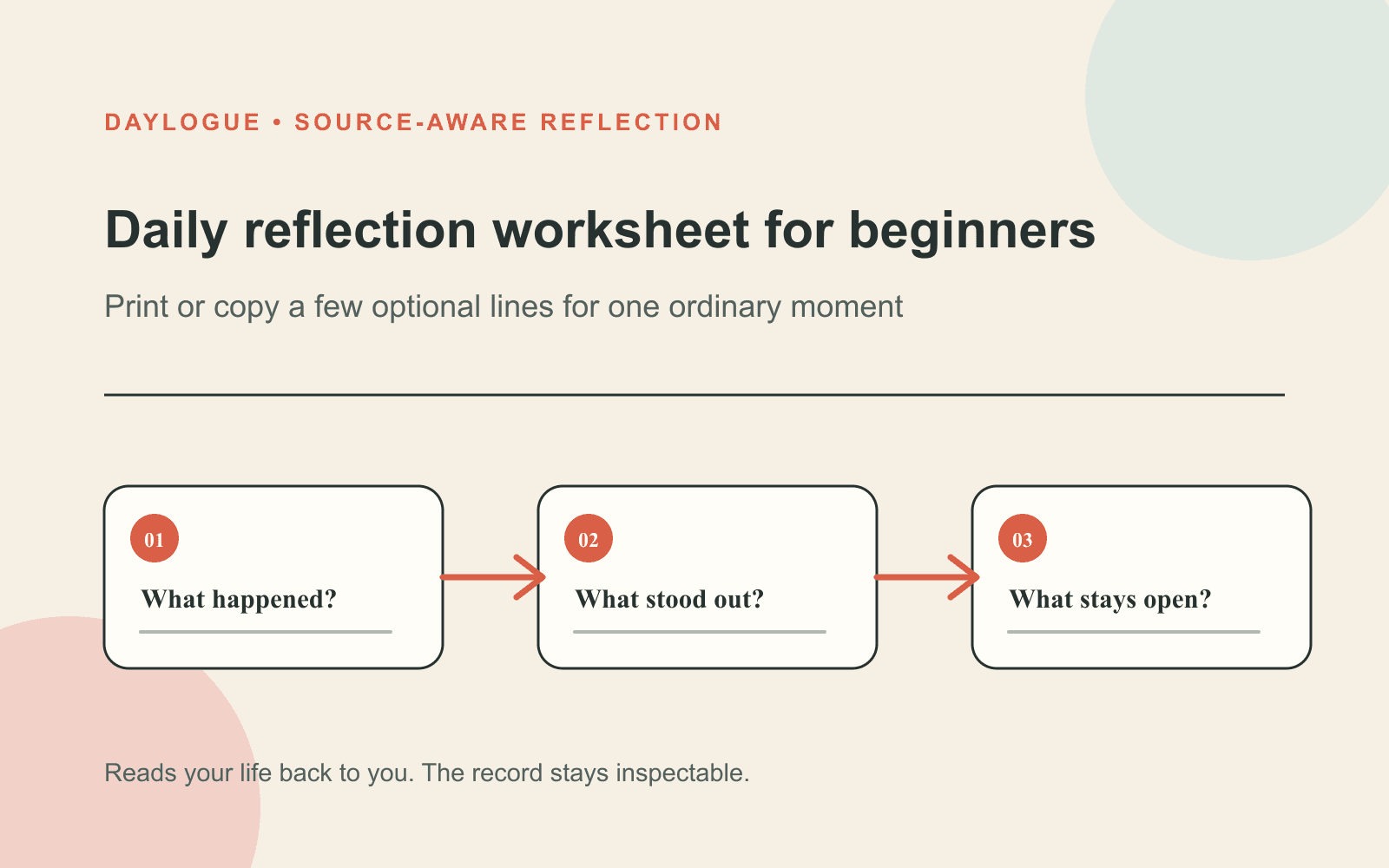
The one-page worksheet appears in the practical resource below. Use your browser's print command and write beneath each prompt on paper, or copy the prompts you want into a private note. This page does not collect or save typed responses, so choose the writing surface and storage boundary yourself.
01
Pick one lane
Choose the part of the day that still has your attention. Ignore the rest of the worksheet for now.
02
Write one concrete detail
Name a moment, setting, action, or sentence you remember. Specific details make later review easier.
03
Add one honest line
Say what you noticed without upgrading it into a permanent conclusion about yourself or anyone else.
04
Close the page
End with what you want to remember, or stop without a closing thought. Both are complete responses.
Prompts for what happened
These prompts help you create a simple record of the day. Try: "What moment stands out now?" "What took more energy than expected?" "What felt easier than it looked from the outside?" or "What part of today would be easy to forget by next week?" Choose the question that has an immediate answer.
If nothing stands out, write that. Ordinary and blank-feeling days belong in a journal too. They can become useful comparison points later because they show what your baseline looked like without asking you to invent drama. A sentence about the weather, the room, or the pace of the day is enough to begin.
Prompts for how the day landed
Try questions that stay close to your own words: "What am I carrying from today?" "When did I feel most like myself?" "What felt off, even if I cannot explain it?" and "What felt steady?" You do not need a precise emotion label. A body sensation, image, or plain adjective can hold the place.
Avoid pushing for a lesson. Some days make sense later. If a prompt starts pulling you toward an answer that feels too neat, switch to description. "My shoulders tightened when the room got loud" is useful on its own. It does not need to become advice or proof of what caused the reaction.
Prompts that preserve context
Context keeps a future review honest. Ask: "What else was happening around this moment?" "Was this a familiar situation or a new one?" "What was different from the last similar day?" and "Is there a comparable day that went another way?" These questions help you keep exceptions beside the apparent pattern.
A recurring overlap does not show that one thing caused another. If low energy and a crowded schedule appear together several times, the overlap may still be worth noticing. Write what lined up, then leave the cause open. That gives your future self a better question and keeps the worksheet from acting like an answer key.
| If the day felt | Try this prompt | Keep it small |
|---|---|---|
| Ordinary | What would I forget by next week? | One scene or detail |
| Crowded | What took most of my attention? | One demand, not the whole list |
| Hard to name | What did I notice in my body? | One sensation without explaining it |
| Good | What made this moment feel solid? | One condition that was present |
| Mixed | What were the two sides of today? | One sentence for each side |
What to do with your answers
At the end of a week, scan the worksheets without rereading every word. Circle a repeated situation, underline a sentence that surprises you, and mark a counterexample. Then write one question. You are looking for a thread worth noticing, not a final explanation of your week.
Existing positive writing studies use different topics, protocols, comparison groups, and outcome measures, which makes broad conclusions difficult. That is a good reason to keep your own practice modest. Use the worksheet because it helps you notice and remember, not because every prompt promises the same result for every person.
- Circle a situation that appeared on more than one day.
- Underline the most specific sentence you wrote.
- Mark a day that does not fit the emerging story.
- Write one open question for the next week.
Decide where your answers belong
A paper worksheet offers physical control but can be seen by anyone who finds it. A synced journal is easier to search and review, but its privacy depends on the service. Before copying answers into any app, read how that service stores and processes entries. Choose the place that fits the sensitivity of what you want to record.
Daylogue stores journal entries and check-in notes on its servers in readable form, protected in transit by TLS and by per-user database access controls. It reads entries to write narratives and surface patterns, so Daylogue is not end-to-end encrypted. Keep the worksheet on paper if that boundary does not fit what you want to write.
Worksheet
One-Page Beginner Reflection Worksheet
Print this page with your browser and write beneath the lines, or copy selected prompts into a private note. This page does not collect or save answers.
- What moment from today stands out right now? Response: [optional response]
- What took more attention than you expected? Response: [optional response]
- What felt easy, steady, heavy, or hard to name? Response: [optional response]
- What did you notice in your body during that moment? Response: [optional response]
- What else was happening around it? Response: [optional response]
- What was different from a similar day? Response: [optional response]
- What part of today would be easy to forget? Response: [optional response]
- What is one open question you want to carry forward? Response: [optional response]
Common questions
Do beginners need to answer every reflection prompt?
No. Pick the question that has the clearest answer today. One concrete response is enough. Leaving prompts blank keeps the worksheet useful instead of turning it into an assignment.
What if I do not know how I feel?
You can write what happened, what you noticed in your body, or what part of the day stayed with you. A reflection does not require a precise emotion label to be honest or useful later.
How long should a beginner reflection be?
Long enough to preserve one moment or observation. That might be two lines or a full page. Stop when the next sentence would only repeat what you already said.
Should I reconstruct an unrecorded day?
No. Start with the day you have now. Reconstructed entries can blur what you remember with what you think probably happened, and a gap is more honest than invented detail.
Can a worksheet tell me what caused a recurring feeling?
No. It can help you preserve examples and notice overlaps, but it cannot establish cause by itself. Keep counterexamples and surrounding context beside any repeated theme.
Sources
Sources were checked on the dates shown. Product details and policies can change.
- Daylogue evidence and methods · Daylogue · checked August 14, 2026
- Daylogue privacy policy · Daylogue · checked August 14, 2026
- Positive expressive writing systematic review · PLOS One · checked August 14, 2026
Keep exploring
Daylogue Knowledge Center
Browse practical guides for reflection, journaling, patterns, and privacy.
Read moreHow Daylogue shows patterns
See how candidate patterns stay connected to evidence and correction.
Read moreWhy Daylogue exists
Read the principles behind a system for self-understanding.
Read moreDaylogue is not therapy and is not a replacement for professional care.