Written by Daylogue Editorial Team. Published August 14, 2026. Reviewed and updated August 14, 2026.
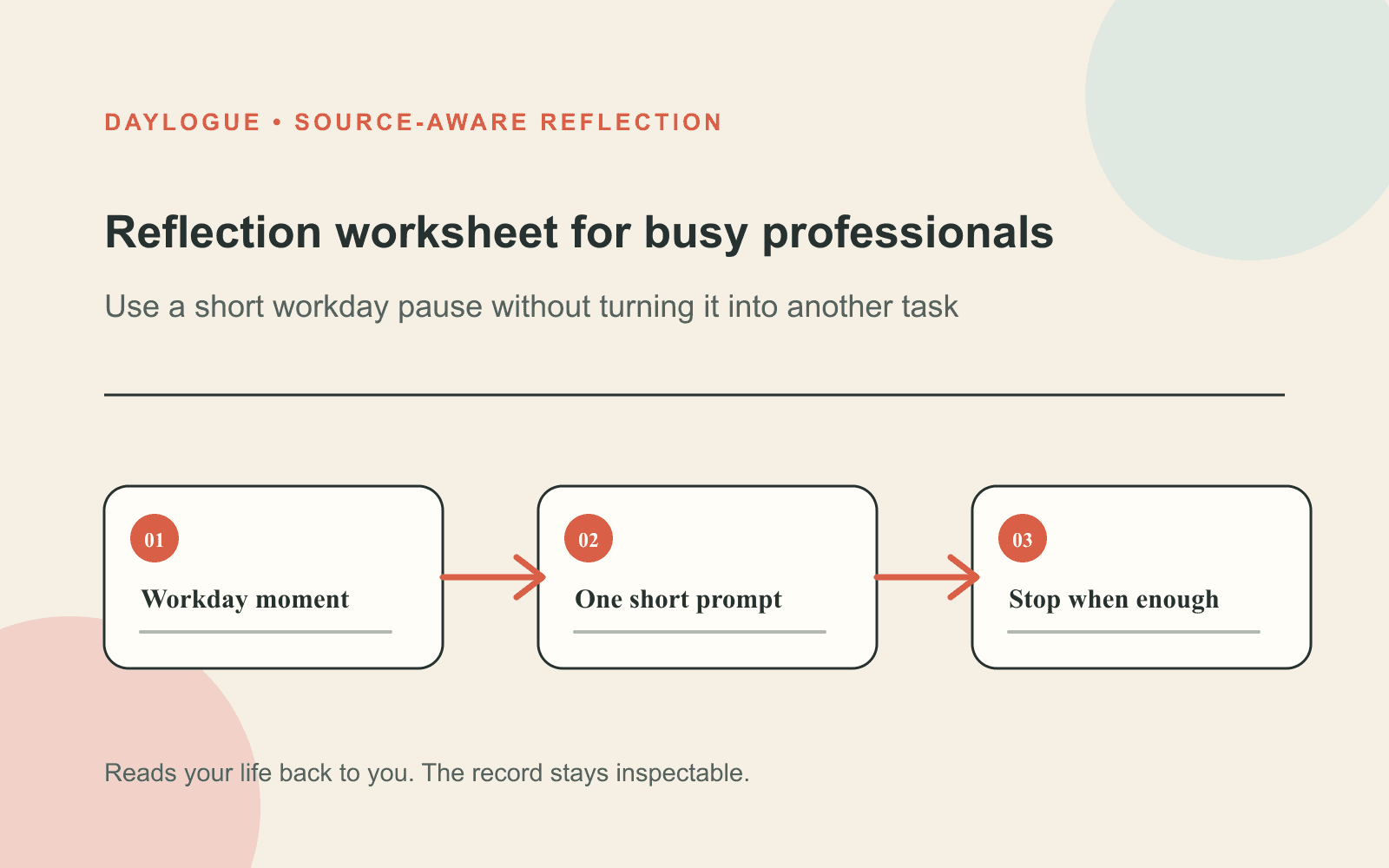
For a busy workday, use a three-part reflection: name the moment that took most of your attention, record the context around it, and note what you want to remember tomorrow. Keep the entry descriptive. You are building a reliable record of your days, not grading your performance or explaining your whole career.
The three-line workday review
Line one names the moment that still has your attention. Line two records what surrounded it, such as the time, setting, competing demand, or amount of preparation. Line three preserves what you want tomorrow's version of you to know. This format stays useful on days when a blank page feels like one more decision.
Keep the language plain. "The client call ran long, I rushed the handoff, and the afternoon felt scattered" gives you a sequence you can recognize later. "I am terrible at managing time" turns one workday into a verdict. A specific record is easier to compare and kinder to revisit.
The three-line worksheet appears in the practical resource below. Print this page with your browser and write on paper, or copy the lines into a private note before answering them. The page does not provide text fields or save responses, which keeps the storage choice visible.
01
Name the moment
Choose the meeting, task, exchange, or quiet stretch that had the strongest pull on your attention.
02
Add the surrounding conditions
Record what else was happening, including timing, interruptions, preparation, and workload, without assigning a cause.
03
Leave a note for tomorrow
Write one fact, question, or unfinished thread worth carrying forward. It does not need to become a plan.
Prompts for attention and workload
Ask "What claimed more attention than it deserved?" "What important task had no protected space?" "Where did I have enough room to think?" or "What changed the pace of the day?" These questions make workload visible without reducing the day to a productivity score.
If the answer is a list, choose one item and add context. A packed calendar may feel different when every block serves the same project than when the blocks compete with each other. Recording that distinction gives later review more texture than simply writing "busy again."
Prompts for boundaries and transitions
Try "When did work begin for me today?" "When did it actually end?" "What crossed into time I meant to protect?" and "What helped one part of the day stay separate from another?" The goal is to describe the boundary you had, not the boundary you think a successful person should have.
Transitions deserve their own line because they are easy to lose in a task list. Notice the drive, the walk between rooms, the final message, or the moment you closed the laptop. Those small scenes can explain the shape of a day better than a summary made entirely of completed work.
| What stayed with you | Prompt | Detail to capture |
|---|---|---|
| A meeting | What happened before and after it? | Time slot and surrounding tasks |
| An unfinished task | What kept it open? | One concrete interruption or dependency |
| A good stretch | What made focus possible? | Setting, timing, or available space |
| A hard exchange | What words or moment do I actually remember? | Observable detail, not assumed intent |
| A blurred ending | When did work stop asking for attention? | The last work-related action |
Reflect without scoring your performance
Replace "Was I productive?" with "What moved, what stalled, and what changed?" Replace "Did I do enough?" with "What did the day require?" These versions preserve useful facts and reduce the temptation to turn a complicated day into a pass or fail result.
A journal can hold competing truths. You may have finished the difficult task and still felt drained. You may have moved slowly and made the right call. Write both sides when both are present. The record becomes more trustworthy when it does not force a clean lesson out of a mixed day.
- Describe what changed instead of assigning a grade.
- Keep effort, outcome, and context as separate lines.
- Record mixed days without choosing one final label.
- Leave motives open unless someone stated them directly.
Review the week by situation
At week's end, group entries by recurring situations rather than good and bad days. Put similar meetings, deep-work blocks, handoffs, and late endings together. Then compare what was the same and what changed. A repeated situation with different results can be more informative than a tidy series of matching notes.
A recurring overlap does not show that one thing caused another. Three tense afternoons after the same time slot may be worth noticing, but the notes could also include deadlines, travel, or short sleep. Keep the pattern narrow, keep the exceptions visible, and decide what the record suggests rather than what it proves.
Choose where the workday record belongs
Work reflections can include names, confidential details, and information that belongs to other people. Remove what you do not need before saving an entry. A role or neutral description may preserve your own context without turning the journal into a record of someone else's private situation.
Daylogue stores journal entries and check-in notes on its servers in readable form, protected in transit by TLS and by per-user database access controls. It is not end-to-end encrypted because it reads entries to write narratives and surface patterns. A work detail that belongs only in a paper notebook or employer-approved system belongs there rather than in Daylogue.
Worksheet
The Three-Line Workday Reflection
Print this page with your browser or copy these lines into a private note. Write beneath each line there because this page does not collect or save responses.
- The moment that took most of my attention was: [optional response]
- Around that moment, these conditions were present: [optional response]
- What I actually observed, without explaining it, was: [optional response]
- One part of the day that went differently was: [optional response]
- The workday began for me when: [optional response]
- The workday stopped asking for attention when: [optional response]
- One fact or question worth carrying forward is: [optional response]
- One detail I can leave out to protect someone else's privacy is: [optional response]
Common questions
What is the fastest useful workday reflection?
Write the moment that took most of your attention, one condition around it, and one fact or question worth remembering tomorrow. Three clear lines can preserve more than a rushed page.
Should I use my reflection as a productivity score?
No. A score flattens workload, context, and mixed results. Describe what moved, what stalled, and what changed so you have a record you can inspect without grading yourself.
How can I journal about work without exposing other people?
Keep the entry centered on your own experience. Remove names, confidential project details, and unnecessary quotes. Use a role or neutral label only when it adds context you genuinely need.
What should I review at the end of the week?
Choose one recurring situation, gather the entries around it, and compare both matching and different outcomes. End with one open question rather than a sweeping conclusion about the whole week.
Does a repeated workday pattern establish a cause?
No. Repetition can help you notice an overlap, but several conditions may have changed at once. Keep deadlines, timing, sleep, travel, and other context visible before deciding what it means.
Sources
Sources were checked on the dates shown. Product details and policies can change.
- Daylogue evidence and methods · Daylogue · checked August 14, 2026
- Daylogue privacy policy · Daylogue · checked August 14, 2026
Keep exploring
Daylogue Knowledge Center
Browse practical guides for reflection, journaling, patterns, and privacy.
Read moreHow Daylogue shows patterns
See how candidate patterns stay connected to evidence and correction.
Read moreWhy Daylogue exists
Read the principles behind a system for self-understanding.
Read moreDaylogue is not therapy and is not a replacement for professional care.