Written by Daylogue Editorial Team. Published August 14, 2026. Reviewed and updated August 14, 2026.
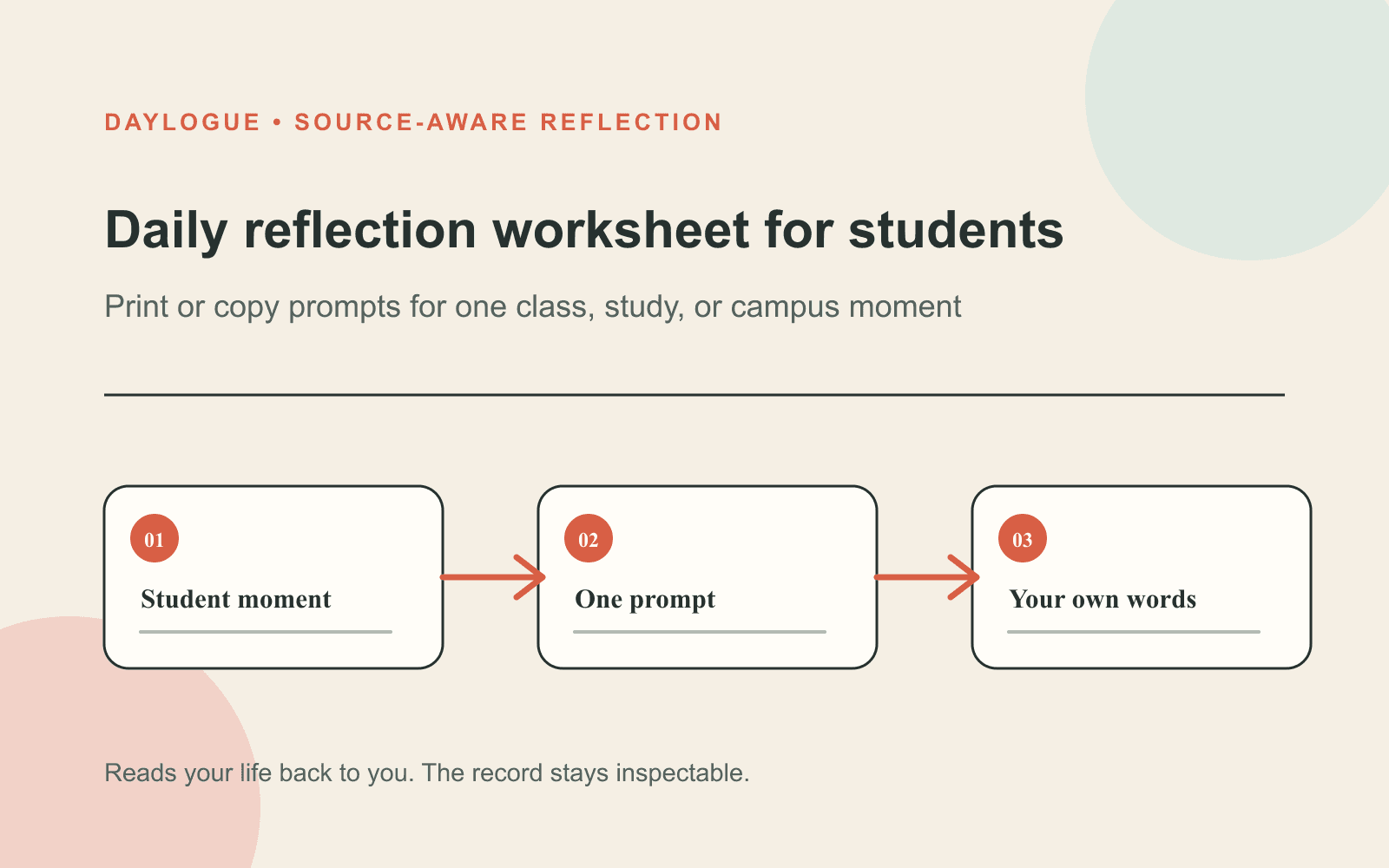
A student reflection can be simple: pick one moment from class, studying, or time with other people, write what happened, and add what you noticed. You can use one prompt between classes or a few at night. Skip anything that feels too personal. Leave unrecorded days as gaps rather than filling them to make the worksheet look complete.
Make reflection smaller than homework
Start with the moment you can still picture. Maybe it happened before class, during a group project, while studying, or on the walk back. Write the scene in ordinary language. You are not writing an essay, proving a point, or finding a theme. You are saving enough of the day to recognize it later.
One useful entry might read: "I kept rereading the same paragraph in the library, then focused better after moving downstairs." It holds a situation, a change, and a detail. It does not call you lazy or claim the new location caused the difference. That makes the entry easier to trust when you review it.
The Between-Classes Reflection Sheet appears in the practical resource below. Print this page with your browser and write on paper, or copy the prompts into a private note. The page does not offer answer fields or save responses, so your writing stays on the surface you choose.
01
Choose one scene
Pick the moment that stayed with you, even if it seems small or has nothing to do with schoolwork.
02
Write what happened
Use one or two sentences with details you actually remember. Leave guessed motives and causes out.
03
Add what you noticed
Name a thought, sensation, shift in attention, or plain feeling word if one fits.
04
Stop without a lesson
Your entry can end as a record. You do not need to turn every day into advice for tomorrow.
Prompts for classes and study time
Try "When did the material finally click?" "What part lost me?" "Where was my attention before I noticed it drifting?" or "What made it easier to begin?" These prompts focus on moments you can observe. They help you remember the conditions around learning without scoring your intelligence.
When a class felt rough, separate the course from the day. The same lecture can land differently after a late night, a crowded morning, or a calm start. Write the context you know. If you do not know why your attention changed, say that instead of filling the blank with a judgment.
Prompts for the social part of the day
Ask "When did I feel included?" "When did I have to work to keep up?" "What conversation stayed with me?" or "Where did I get to be quiet without it feeling awkward?" Keep the answer centered on your own experience. You do not need to decide what another person thought or meant.
Protect other people's privacy while you write. Initials can still be obvious if someone sees the page. Use "someone in class" or "a friend" when the identity is not necessary. Save the detail that matters to your reflection and leave out the part that only identifies someone else.
| Moment | Prompt | One detail to save |
|---|---|---|
| Before class | What am I carrying into the room? | One thought or body sensation |
| During study time | When did my attention change? | Place, task, or interruption |
| After a conversation | What part stayed with me? | Your reaction, not their motive |
| End of day | What would tomorrow me forget? | One scene from the day |
| Nothing stands out | What felt most ordinary? | A small baseline detail |
Prompts for days that do not fit one label
A day can be good in one place and hard in another. Try "What were the two different versions of today?" "What felt steady even while something else felt messy?" or "What changed between the first half and the second?" Write both sides without forcing one to cancel the other.
This matters when you review later. If you label the entire day "bad," you may miss the hour that felt easy. If you label it "great," you may lose the part that drained you. A mixed record gives you better comparison points and sounds more like an actual life than a rating.
- Write one sentence for each side of a mixed day.
- Use the time or setting to separate different moments.
- Keep a calm moment even when the rest felt crowded.
- Avoid turning one event into a label for the whole day.
Look back without overreading the record
Once a week, choose one repeated situation, such as the same class block or study setting. Read only the entries connected to it. Mark what lined up and what changed. A recurring overlap does not show that one thing caused another, so include the days that do not support the first story you notice.
End the review with a question you can answer from future entries. "Does the library still help when I arrive tired?" is more useful than "The library makes me focused." The question leaves room for different days. It also keeps the journal from telling you who you are based on a handful of notes.
Decide what stays on paper
School devices and shared family devices may not be private. Check who can access the device, browser history, backups, and any app account before recording sensitive details. A paper page can also be found, so choose storage based on the space you actually have, not the privacy you wish it offered.
Daylogue stores journal entries and check-in notes on its servers in readable form, protected in transit by TLS and by per-user database access controls. It reads entries to write narratives and surface patterns, which means it is not end-to-end encrypted. If that boundary does not fit a particular entry, another place or leaving the moment unrecorded may fit that entry better.
Worksheet
Between-Classes Reflection Sheet
Print this page with your browser or copy these prompts into a private note. Complete only the lines you want because this page does not collect answers.
- The scene I can still picture is: [optional response]
- Right before that moment, I was: [optional response]
- What I noticed in my attention or body was: [optional response]
- One part of the day that felt different was: [optional response]
- The detail tomorrow me might forget is: [optional response]
- A similar situation went another way when: [optional response]
- The other person's identity is or is not needed because: [optional response]
- One question I want to leave open is: [optional response]
Common questions
Can I use just one student reflection prompt per day?
Yes. One prompt with a concrete answer is enough. The worksheet is meant to help you notice your day, not add a full writing assignment to it.
What if nothing interesting happened at school today?
Write one ordinary detail, such as where your attention went, what the room felt like, or what part of the schedule moved quickly. Ordinary days make useful comparison points later.
Should I name friends or classmates in my journal?
Only when their identity is truly necessary and the storage feels appropriate. A neutral role often preserves enough context while reducing the amount of someone else's private information in your entry.
Do I need to write a lesson at the end of every reflection?
No. Many useful entries are simple records. You can end after describing the moment and what you noticed, especially when the meaning is not clear yet.
Can repeated journal entries prove why I focus better?
No. They can show which conditions appeared alongside better focus in your record, but they do not establish a cause. Keep exceptions and other changing conditions visible.
Sources
Sources were checked on the dates shown. Product details and policies can change.
- Daylogue evidence and methods · Daylogue · checked August 14, 2026
- Daylogue privacy policy · Daylogue · checked August 14, 2026
Keep exploring
Daylogue Knowledge Center
Browse practical guides for reflection, journaling, patterns, and privacy.
Read moreHow Daylogue shows patterns
See how candidate patterns stay connected to evidence and correction.
Read moreWhy Daylogue exists
Read the principles behind a system for self-understanding.
Read moreDaylogue is not therapy and is not a replacement for professional care.