Written by Daylogue Editorial Team. Published September 2, 2026. Reviewed and updated September 2, 2026.
Caregiving days often contain several people’s needs, yet the page still belongs to the person doing the reflecting. This gratitude journal prompts worksheet offers a quiet way to notice a real act, object, or condition without asking a difficult day to become a positive story. One household scene can sit apart from the writer's interpretation and any later context. The page does not speak for anyone else. Any field may stay blank, and there is no streak, score, or required conclusion.
The appreciated moment
The page opens with the exact appreciated moment in a caregiving scene. “What exactly happened?” is an optional starting point, not an assignment. A date beside the note leaves room for later context without erasing the first impression.
A household fact can add context without turning another person into the subject of the entry. the reflection remains about the writer’s own experience.
The action, object, or condition
A useful specific gratitude worksheet entry point between breakfast, pickup, appointments, household tasks, and bedtime may be the person, object, or condition involved. This caregiving prompt can wait until there is a scene worth keeping. It asks: Who or what contributed? That pause protects the difference between a memory and a conclusion.
A few quiet minutes may only produce a fragment. that fragment can remain unfinished until the household rhythm offers more room.
| caregiving question | A possible caregiving note | A conclusion the page does not require |
|---|---|---|
| What exactly happened? | the exact appreciated moment between breakfast, pickup, appointments, household tasks, and bedtime | A verdict about the whole day |
| Who or what contributed? | the person, object, or condition involved between breakfast, pickup, appointments, household tasks, and bedtime | A motive assigned without enough context |
| What became easier or warmer? | the small difference it made between breakfast, pickup, appointments, household tasks, and bedtime | A score for the person writing |
The small difference it made
For parents and caregivers, the small difference it made may be easier to recall than a summary of the whole day. This specific gratitude worksheet box offers one question: What became easier or warmer? A phrase, a date, or an empty caregiving line can all be honest responses.
A schedule change, handoff, or interruption may shape the scene without explaining another person’s motives. the worksheet keeps that uncertainty visible.
01
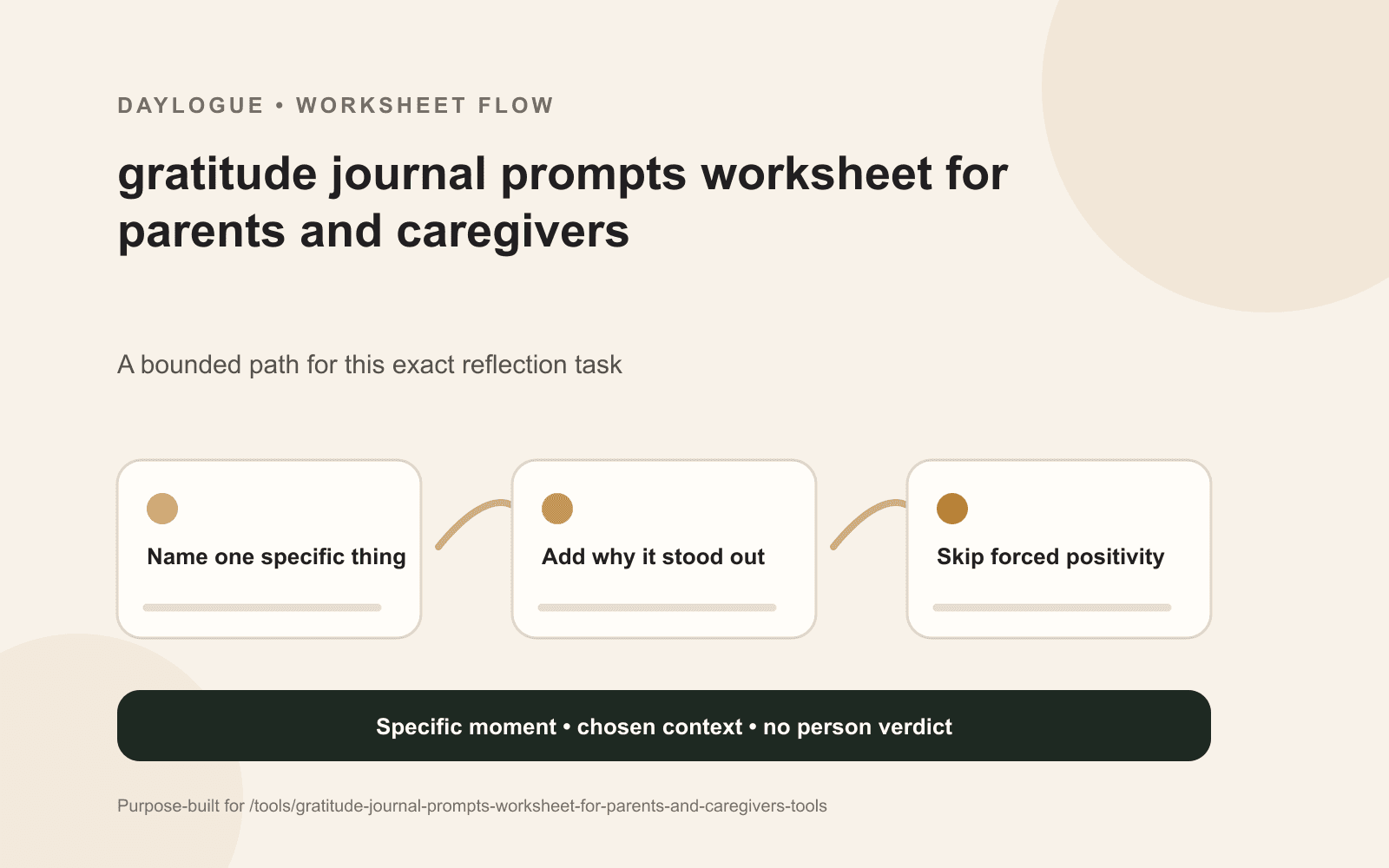
Step 1: What exactly happened?
The exact appreciated moment may fill this caregiving line. The field can remain empty when the prompt does not fit between breakfast, pickup, appointments, household tasks, and bedtime.
02
Step 2: Who or what contributed?
The person, object, or condition involved may fill this caregiving line. The field can remain empty when the prompt does not fit between breakfast, pickup, appointments, household tasks, and bedtime.
03
Step 3: What became easier or warmer?
The small difference it made may fill this caregiving line. The field can remain empty when the prompt does not fit between breakfast, pickup, appointments, household tasks, and bedtime.
04
Step 4: What else was true that day?
The harder truth beside it may fill this caregiving line. The field can remain empty when the prompt does not fit between breakfast, pickup, appointments, household tasks, and bedtime.
Appreciation on a hard day
This section holds the harder truth beside it without asking it to explain everything else. One optional caregiving prompt is: What else was true that day? Later context can appear on a new line instead of replacing the earlier record.
The first reading may soften or sharpen after rest or a later conversation. a new dated line can show the difference while preserving the original context.
Ordinary support
The page becomes more useful when ordinary support that might be missed stays close to the event itself. Its caregiving question is: Which ordinary support would be easy to overlook? Any answer may remain provisional, especially when the day is still unfolding.
Caregiving contains exceptions to almost every routine. the unusual day belongs beside any suspected repeat so neither one takes over the story.
A different lens next time
A short gratitude journal prompts note about the exact appreciated moment can be enough for this field. One caregiving question may help when the scene is clear: What exactly happened? The box can remain blank when it is not, and nothing needs to become a verdict.
No consistency score follows the entry. the page can close after one sentence, especially when care work has already used the available attention.
- What exactly happened? A caregiving response might hold the exact appreciated moment, and an unanswered line remains valid.
- Who or what contributed? A caregiving response might hold the person, object, or condition involved, and an unanswered line remains valid.
- What became easier or warmer? A caregiving response might hold the small difference it made, and an unanswered line remains valid.
- What else was true that day? A caregiving response might hold the harder truth beside it, and an unanswered line remains valid.
- Which ordinary support would be easy to overlook? A caregiving response might hold ordinary support that might be missed, and an unanswered line remains valid.
Enough context to remember
By this point in the specific gratitude worksheet, the person, object, or condition involved may look different from the first account. A later caregiving question remains available: Who or what contributed? A dated addition can preserve both versions without forcing a clean ending.
A 2019 study of 395 American young adults found that the relationship between narrative coherence and well-being was more complex than a simple universal benefit. That limit matters here. The specific gratitude worksheet can hold fragments, mixed accounts, and unresolved notes without forcing them into one clean story. It supports a record, not a promised outcome.
One point of view, not a person verdict
A caregiver’s note records one point of view. It cannot speak for a child, dependent person, or family member, and it cannot establish a verdict about them. Another person’s words or participation belong only where consent and the situation allow.
Elsewhere on the specific gratitude worksheet can focus on the caregiver's own actions, limits, questions, and observations. It cannot establish what another person felt, intended, or needed, even when the writer knows them well.
A caregiving day example with a clear boundary
Gratitude Journal Prompts Worksheet is most useful here for noticing a specific act, object, or condition without asking a difficult day to become a positive story. A useful note might name the colleague who moved a deadline, the friend who sent a meal, or the working charger found before class. The harder parts of the day can remain on the same page.
Specific appreciation can coexist with frustration, grief, or fatigue. The worksheet does not require one feeling to cancel another. For parents and caregivers, the page can stay close to during a handoff, after a routine changes, or when the house becomes quieter. A date, one source detail, and an explicit gap make the record easier to inspect later.
A second scene may confirm the first impression, narrow it, or point another way. The worksheet keeps that new material beside the earlier note, so a later account adds context without pretending the first one never existed.
- Source detail: the exact part of the caregiving day scene worth preserving.
- Relevant context: one condition that changes how the source can be read.
- Counterexample: a comparable caregiving day scene that points another way.
- Open question: what remains unknown until another dated entry adds context.
Worksheet
Gratitude Journal Prompts Worksheet cards for parents and caregivers
Twenty reusable caregiving cards for parents and caregivers, each pairing a concrete setting with one optional gratitude journal prompts question, a source-detail space, and room for later context.
- Card PC149A opens before the household wakes while someone else needed attention. On Card PC149A, focuses on the appreciated moment; the optional line on Card PC149A offers one optional question: Which ordinary support would be easy to overlook. Card PC149A closes with space that can hold one exact line, while the final line on Card PC149A may remain unfinished.
- Card PC149B begins after a rushed handoff while someone else needed attention. Card PC149B pairs keeps the action, object, or condition in view with a line on Card PC149B that makes this question available: What exactly happened. The return line on Card PC149B has room for an exception; the ending on Card PC149B can carry a later date.
- Card PC149C catches a moment during a quiet drive while someone else needed attention. The middle of Card PC149C centers the small difference it made, then the next field on Card PC149C leaves this prompt open: Who or what contributed. Card PC149C leaves the ending open: one space might include one visible detail, and Card PC149C does not require a return.
- Card PC149D uses the setting between two household tasks while someone else needed attention. On Card PC149D, looks at appreciation on a hard day; the optional line on Card PC149D asks, without requiring an answer: What became easier or warmer. Card PC149D closes with space that may contain a changed condition, while the final line on Card PC149D can end there.
- Card PC149E stays near after plans changed while someone else needed attention. Card PC149E pairs gives space to ordinary support with a line on Card PC149E that carries one possible question: What else was true that day. The return line on Card PC149E can start with one open uncertainty; the ending on Card PC149E leaves the conclusion open.
- Card PC149F opens when the house settled while someone else needed attention. The middle of Card PC149F focuses on a different lens next time, then the next field on Card PC149F offers one optional question: Which ordinary support would be easy to overlook. Card PC149F leaves the ending open: one space can hold one exact line, and Card PC149F may remain unfinished.
- Card PC149G begins before the next pickup while someone else needed attention. On Card PC149G, keeps enough context to remember in view; the optional line on Card PC149G makes this question available: What exactly happened. Card PC149G closes with space that has room for an exception, while the final line on Card PC149G can carry a later date.
- Card PC149H catches a moment before the household wakes after the schedule shifted. Card PC149H pairs centers the appreciated moment with a line on Card PC149H that leaves this prompt open: Who or what contributed. The return line on Card PC149H might include one visible detail; the ending on Card PC149H does not require a return.
- Card PC149I uses the setting after a rushed handoff after the schedule shifted. The middle of Card PC149I looks at the action, object, or condition, then the next field on Card PC149I asks, without requiring an answer: What became easier or warmer. Card PC149I leaves the ending open: one space may contain a changed condition, and Card PC149I can end there.
- Card PC149J stays near during a quiet drive after the schedule shifted. On Card PC149J, gives space to the small difference it made; the optional line on Card PC149J carries one possible question: What else was true that day. Card PC149J closes with space that can start with one open uncertainty, while the final line on Card PC149J leaves the conclusion open.
- Card PC149K opens between two household tasks after the schedule shifted. Card PC149K pairs focuses on appreciation on a hard day with a line on Card PC149K that offers one optional question: Which ordinary support would be easy to overlook. The return line on Card PC149K can hold one exact line; the ending on Card PC149K may remain unfinished.
- Card PC149L begins after plans changed after the schedule shifted. The middle of Card PC149L keeps ordinary support in view, then the next field on Card PC149L makes this question available: What exactly happened. Card PC149L leaves the ending open: one space has room for an exception, and Card PC149L can carry a later date.
- Card PC149M catches a moment when the house settled after the schedule shifted. On Card PC149M, centers a different lens next time; the optional line on Card PC149M leaves this prompt open: Who or what contributed. Card PC149M closes with space that might include one visible detail, while the final line on Card PC149M does not require a return.
- Card PC149N uses the setting before the next pickup after the schedule shifted. Card PC149N pairs looks at enough context to remember with a line on Card PC149N that asks, without requiring an answer: What became easier or warmer. The return line on Card PC149N may contain a changed condition; the ending on Card PC149N can end there.
- Card PC149O stays near before the household wakes with one practical task unfinished. The middle of Card PC149O gives space to the appreciated moment, then the next field on Card PC149O carries one possible question: What else was true that day. Card PC149O leaves the ending open: one space can start with one open uncertainty, and Card PC149O leaves the conclusion open.
- Card PC149P opens after a rushed handoff with one practical task unfinished. On Card PC149P, focuses on the action, object, or condition; the optional line on Card PC149P offers one optional question: Which ordinary support would be easy to overlook. Card PC149P closes with space that can hold one exact line, while the final line on Card PC149P may remain unfinished.
- Card PC149Q begins during a quiet drive with one practical task unfinished. Card PC149Q pairs keeps the small difference it made in view with a line on Card PC149Q that makes this question available: What exactly happened. The return line on Card PC149Q has room for an exception; the ending on Card PC149Q can carry a later date.
- Card PC149R catches a moment between two household tasks with one practical task unfinished. The middle of Card PC149R centers appreciation on a hard day, then the next field on Card PC149R leaves this prompt open: Who or what contributed. Card PC149R leaves the ending open: one space might include one visible detail, and Card PC149R does not require a return.
- Card PC149S uses the setting after plans changed with one practical task unfinished. On Card PC149S, looks at ordinary support; the optional line on Card PC149S asks, without requiring an answer: What became easier or warmer. Card PC149S closes with space that may contain a changed condition, while the final line on Card PC149S can end there.
- Card PC149T stays near when the house settled with one practical task unfinished. Card PC149T pairs gives space to a different lens next time with a line on Card PC149T that carries one possible question: What else was true that day. The return line on Card PC149T can start with one open uncertainty; the ending on Card PC149T leaves the conclusion open.
Common questions
How much time does this specific gratitude worksheet need?
There is no target time. A quiet opening after someone settles or before the next pickup may hold one useful detail, and a partial page is still a valid page. The rest can wait for a later return or remain empty.
Does every gratitude journal prompts question need an answer?
No. Each question is optional, and the one that fits the current scene may be the only one used. A blank field has no score and makes no claim about what the writer felt or meant.
Can an answer change after more context appears?
Yes. A dated note beside the original can show what changed later. Keeping both lines visible preserves what was known at each point without forcing either one to become the final story.
What if the specific gratitude worksheet shows no repeat?
No repeat is required. Separate scenes, mixed evidence, and exceptions can remain separate. Sometimes the most useful result is realizing that the first hunch does not fit every day.
Can this worksheet be used outside Daylogue?
Yes. It can live on paper, in a notebook, or in another notes tool. Daylogue is a system for self-understanding. This worksheet does not require an account.
Can this page describe another family member?
The specific gratitude worksheet captures the caregiver's limited perspective, not a finding about another person. A child, dependent person, or family member cannot be reduced to the writer's account, and their participation depends on consent.
Sources
Sources were checked on the dates shown. Product details and policies can change.
- Daylogue evidence and methods · Daylogue · checked September 2, 2026
- Narrative identity and psychological well-being research · National Library of Medicine · checked September 2, 2026
Keep exploring
Daylogue Knowledge Center
Browse practical guides for reflection, journaling, patterns, and privacy.
Read moreHow Daylogue shows patterns
See how candidate patterns stay connected to evidence and correction.
Read moreWhy Daylogue exists
Read the principles behind a system for self-understanding.
Read moreDaylogue is not therapy and is not a replacement for professional care.