Written by Daylogue Editorial Team. Published August 31, 2026. Reviewed and updated August 31, 2026.
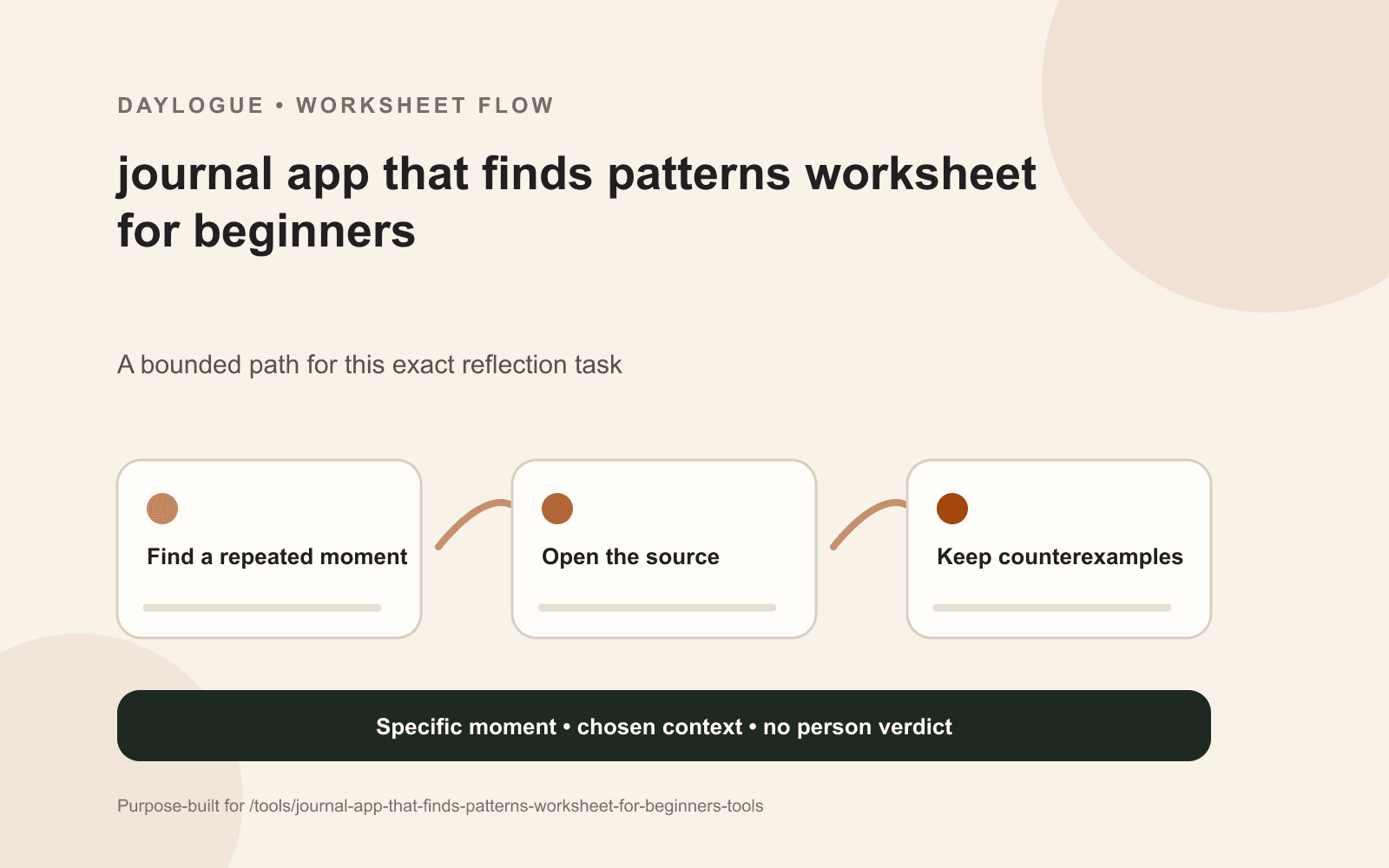
For beginners, a journal app that finds patterns can work like a small evidence table. Each field can hold one candidate, a rule for comparable scenes, exact source lines that support it, and at least one conflicting scene. The candidate can then be narrowed, kept, or retired. Any field can stay empty, and the review can stop without a conclusion. The sheet creates no confidence score and makes no prediction.
Cell A: the smallest candidate
A sentence that can be disproved fits this cell. “In three recent entries, rushed transitions appeared beside the phrase ‘no room’” is testable. “Transitions make me fail” is not. The window, count, scene type, and exact phrase can appear together. Identity language and future predictions can stay outside the cell.
Cell B: what counts as comparable
One visible feature can define the comparison: same time slot, activity, place, transition, or type of conversation. Differences can sit underneath. Comparable does not mean identical. The rule simply prevents two unrelated uses of the same word from becoming one pattern.
- Time rule: similar hour or part of day.
- Activity rule: same task or transition.
- Place rule: same setting with relevant context.
- Conversation rule: similar purpose, not merely the same person.
- Difference note: one important way the scenes diverged.
Cell C: receipts for the candidate
The shortest exact source line, date, and scene label can accompany each supporting entry. Paraphrase can make the pattern sound stronger than the original. Two receipts may justify a question. They do not establish cause. If a transcript was corrected, the corrected source and a visible edit preserve that change.
For example, a candidate about rushed transitions could cite “no room to reset” from Monday after a delayed train and “went straight into the next thing” from Wednesday after a meeting ran long. The worksheet keeps those lines separate. Their shared position between activities may be worth checking, but the different settings remain visible. A third receipt from an ordinary transition can add more information than another dramatic scene because it tests the candidate against a quieter comparison.
Cell D: receipts against the candidate
The same condition with different wording or outcome may provide a counterexample. “None found in this window” can mark a record that lacks one. That is different from claiming there are no exceptions. A conflicting receipt can narrow the candidate, suspend it, or retire it.
A useful counterexample matches the comparison rule closely. If the candidate concerns late meetings, a calm weekend morning is not a strong test. A late meeting followed by an unhurried note is closer. The source line still belongs when it weakens the first idea. A visible difference, such as a shorter agenda, a familiar group, or time left before the next commitment, can sit beside it. The difference becomes context for revision, not an explanation of cause.
| Evidence shape | Decision | Wording |
|---|---|---|
| Support plus clear conflict | Narrow | May appear under a smaller condition |
| Support with missing comparable scenes | Hold | Worth checking, not established |
| Conflict outweighs support | Retire | The candidate no longer fits this window |
| New source changes meaning | Correct | Earlier wording replaced with the revision retained |
Cell E: scope and expiration
The candidate can name where it applies: this week, this semester, this project, or another bounded context. A review date can sit beside it. Old patterns are not fixed statements about a person. When the context changes, fresh evidence is needed. Expiration keeps history from becoming destiny.
Method note for the worksheet
Daylogue describes itself as a system for self-understanding, and pattern journaling is how it reads what a person chooses to record. A 2019 study of 395 young adults found an association between narrative coherence and the study’s measure of identity functioning, while its relationship with well-being was more complex than a universal benefit. This sheet supports source visibility and correction. It does not convert a personal record into a universal conclusion.
Worksheet
Candidate pattern trial sheet
A five-cell worksheet for stating a narrow candidate, defining comparable scenes, attaching receipts for and against, and setting scope and expiration.
- Cell A: candidate with window, count, scene, and exact phrase.
- Cell B: comparison rule for time, activity, place, or conversation.
- Cell B note: one important difference between scenes.
- Cell C: supporting receipt one with date and source line.
- Cell C: supporting receipt two with date and source line.
- Cell D: conflicting receipt or “none found in this window.”
- Cell E: scope such as week, semester, project, or season.
- Expiration: date when fresh evidence becomes necessary.
- Decision choices: keep, narrow, hold, correct, or retire.
- Language check: overlap only, with no cause, score, or prediction.
Common questions
How many receipts should a pattern worksheet include?
Two supporting scenes can be enough to open a question. More entries may add context, but count alone does not create certainty. A comparable exception is as important as another supporting line.
What if I cannot find a counterexample?
“None found in this window” can mark the current record. The journal may be incomplete, and future comparable scenes may differ. A missing exception is not proof that none exists.
When should I retire a candidate pattern?
Retirement may fit when conflicting scenes outweigh support, the comparison rule no longer fits, the context expired, or the question stopped helping. Retirement is a successful review decision.
Can this worksheet tell me what will happen next?
No. It organizes a chosen personal record. It cannot predict a future day, establish cause, or turn repeated phrases into a fixed statement about a person.
Sources
Sources were checked on the dates shown. Product details and policies can change.
- Daylogue evidence and methods · Daylogue · checked August 31, 2026
- Narrative identity and psychological well-being research · National Library of Medicine · checked August 31, 2026
Keep exploring
Daylogue Knowledge Center
Browse practical guides for reflection, journaling, patterns, and privacy.
Read moreHow Daylogue shows patterns
See how candidate patterns stay connected to evidence and correction.
Read moreWhy Daylogue exists
Read the principles behind a system for self-understanding.
Read moreDaylogue is not therapy and is not a replacement for professional care.