Written by Daylogue Editorial Team. Published August 8, 2026. Reviewed and updated August 8, 2026.
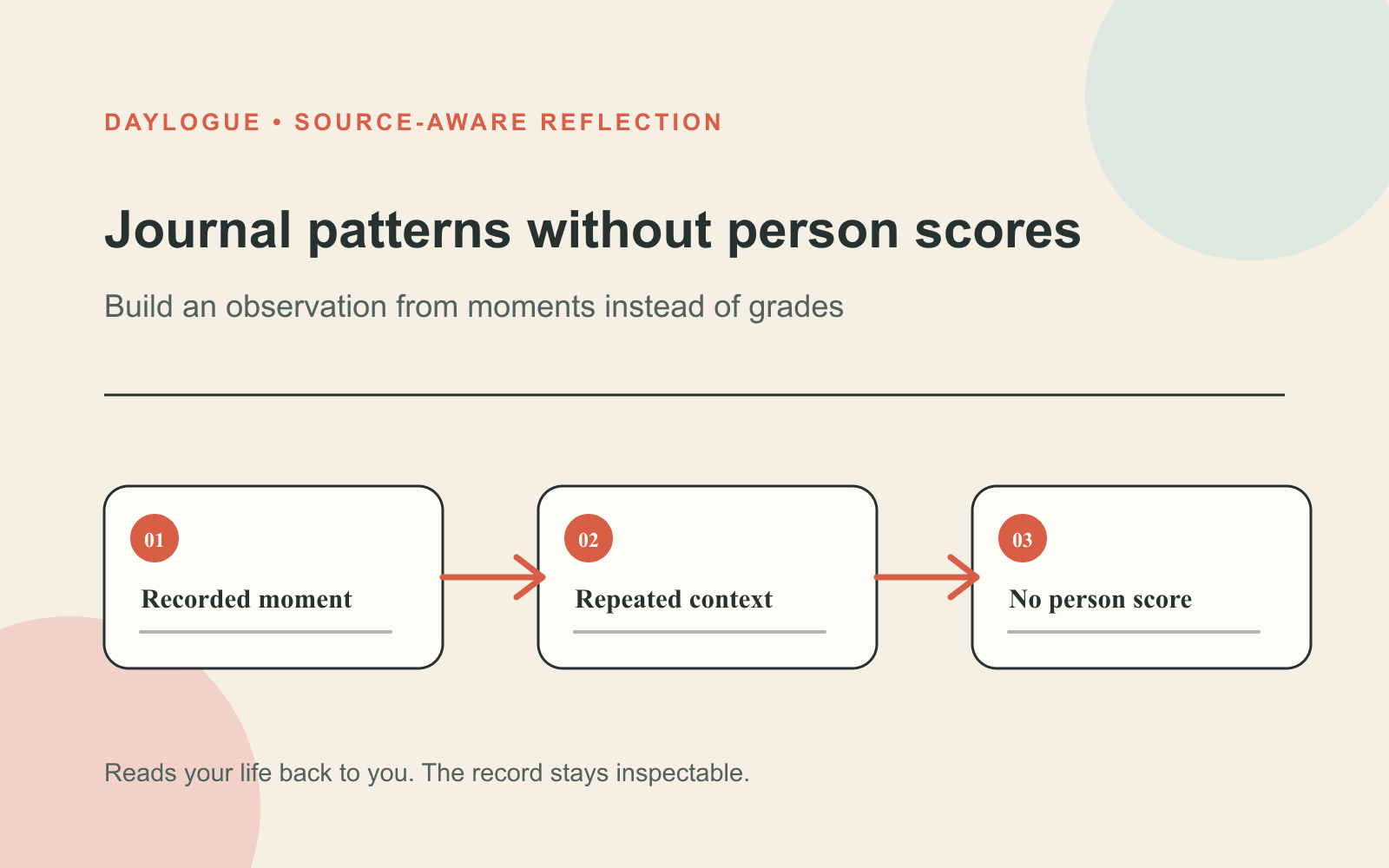
Journal patterns do not need a person score. Use a specific observation instead: name what repeated, define the period, attach source moments, include an exception, and end with a question. Mood, energy, stress, and sleep can remain separate check-in fields without being blended into one grade. The result should describe part of your record and stay open to correction.
A pattern is not a grade
A score compresses many things into one number. A pattern statement keeps the parts visible. 'Stress appeared higher in three check-ins that mentioned the Friday handoff' tells you what repeated and where to look. 'One number grades the whole week' hides both.
Daylogue's pattern page says it tracks mood, energy, stress, and sleep across check-ins. Read /features/patterns for that feature, /learn/life-pattern-tracker for the broader evidence model, and /learn/no-streak-journaling for the low-pressure practice. This builder keeps those fields separate instead of creating a personal grade.
Replace the score with structure
Start with a timeframe and a recurring situation. Add what you recorded in the same check-ins, then include a comparable moment that differed. This produces a statement you can test against the personal record instead of a number you can only accept or distrust.
Keep magnitude modest. Words such as always, never, normal, and good or bad can turn a small sample into a verdict. Count the moments you actually reviewed and name the dates. If the period contains many gaps, put that limitation in the sentence.
| Avoid | Use instead | Why |
|---|---|---|
| One number grades the whole week | Three high-stress check-ins appeared in this two-week period | The source and timeframe remain visible |
| A fixed label for the whole person | Mood labels varied across four recorded days | The statement describes entries, not the person |
| Your sleep caused the stress | Short sleep and higher stress appeared in the same check-ins | Overlap is not presented as cause |
| Fridays are the problem | What was different on the Friday that felt lighter? | A question leaves interpretation with the reader |
Build a no-score read
Choose one question before opening the journal. You might ask what tends to be present on demanding workdays or which part of the week carries more recorded stress. A named question limits the temptation to sweep every field into one broad judgment.
Then use the builder in order. Gather comparable moments before drafting the conclusion so the evidence can shape the wording. Note what repeats, keep one exception, and draft the narrowest sentence that still feels useful.
01
Name one question
Choose a single situation or field to inspect instead of grading your entire week or life.
02
Set the period
Write the start and end dates and count how many check-ins actually exist within them.
03
List comparable moments
Use the same rule to gather supporting days and one day that does not fit.
04
Draft a narrow observation
Describe what appeared in the record without assigning a score, type, risk level, or identity label.
05
End with your question
Ask what might be worth noticing next, and leave the answer open.
Keep different fields separate
Mood, energy, stress, and sleep describe different parts of a check-in. One can move while another stays steady. Preserve that detail in the read. A lighter mood does not cancel low energy, and a hard day does not erase a good conversation recorded beside it.
Daylogue does not provide medical or readiness-style scores. That boundary is useful beyond health language. A journal read should not become a disguised ranking of resilience, stability, performance, or character.
- Keep each field in its original units or words.
- Keep unlike fields separate rather than averaging them into a personal index.
- Keep people, weeks, relationships, and life areas free of rankings.
- Keep counterexamples beside the main observation.
- Let the person decide whether the wording fits.
Respect the evidence limit
A recurring overlap does not show that one thing caused another. A no-score read can still overreach if it predicts the future or explains more than the entries support. Keep same-day observations in the same day and keep missing records visible.
The Daylogue evidence page says its current validation work is in protocol preparation. It also says no research or outcome claim has been approved for public use. That means product behavior and personal usefulness should not be presented as a proven outcome.
Use the result without turning it into a rule
A useful pattern can end with a small noticing question: 'What was present on the Friday that felt lighter?' You do not need a prescribed action, a target score, or a streak. The next check-in can support the thread, complicate it, or make it disappear.
Review the statement after more comparable moments arrive. Narrow it when a condition becomes clearer. Retire it when it no longer fits. A record that can change its mind is more honest than a score built to look stable.
Framework
No-score pattern statement builder
Fill in each line to create a specific journal observation without grading the person, the week, or the life area it describes.
- Question: What single situation or field am I trying to understand?
- Period: Which exact start and end dates does this review cover?
- Record: How many check-ins exist, and where are the gaps?
- Repeat: What appeared in at least three comparable source moments across distinct periods? Two moments are a couple of mentions, not a pattern.
- Exception: Which comparable moment did not fit the main thread?
- Statement: During this period, this detail appeared alongside this situation.
- Boundary: This observation describes recorded moments, not the person.
- Next question: What small difference would I like to notice next?
Common questions
What is a person score in a journal app?
It is a number or label that compresses different parts of a person's record into one judgment. This tool keeps fields and source moments separate so the reader can inspect what actually repeated.
Can I compare mood, energy, stress, and sleep without a score?
Yes. Review how each field moved within a defined period, name same-check-in overlaps, and keep their original units. Keep them separate so they do not become one personal grade.
What makes a no-score pattern specific?
It names a timeframe, a recurring situation, the recorded field or words, the number of source moments, and at least one comparable exception.
Should a pattern statement tell me what to do?
No. It can end with a question you want to notice next. You choose whether the observation matters and what, if anything, to do with it.
When should I retire a journal pattern?
Retire or rewrite it when newer comparable moments no longer support the wording, when the original context has changed, or when the source cannot be inspected.
Sources
Sources were checked on the dates shown. Product details and policies can change.
- Daylogue pattern features · Daylogue · checked August 8, 2026
- Daylogue evidence and methods · Daylogue · checked August 8, 2026
- NIST AI Risk Management Framework · National Institute of Standards and Technology · checked August 8, 2026
- NIST Privacy Framework · National Institute of Standards and Technology · checked August 8, 2026
Keep exploring
Daylogue Knowledge Center
Browse practical guides for reflection, journaling, patterns, and privacy.
Read moreHow Daylogue shows patterns
See how candidate patterns stay connected to evidence and correction.
Read moreWhy Daylogue exists
Read the principles behind a system for self-understanding.
Read moreDaylogue is not therapy and is not a replacement for professional care.