Written by Daylogue Editorial Team. Published September 2, 2026. Reviewed and updated September 2, 2026.
Classes, work, friends, and deadlines can crowd several different stories into the same afternoon. This relationship journal prompts worksheet offers a flexible way to separate an observable exchange from an interpretation before deciding what a conversation means. A student can use one campus scene, skip a question, or stop after a short phrase. Facts and interpretations stay separate, with room for a dated correction. There is no streak, grade, or required conclusion.
The observable exchange
The page opens with words or actions another person could recognize in a campus scene. “What words or actions can I quote?” is an optional starting point, not an assignment. A date beside the note leaves room for later context without erasing the first impression.
A class schedule can supply context without deciding what the moment meant. the page leaves that interpretation with the student who lived it.
Interpretation in a second column
A useful conversation sorting worksheet entry point between class, a study session, a shift, and the walk back home may be the meaning first attached to them. This campus prompt can wait until there is a scene worth keeping. It asks: What did I infer from them? That pause protects the difference between a memory and a conclusion.
A quick note between places can be useful even when the thought is unfinished. the page has room for a later correction after the deadline or conversation passes.
| campus question | A possible campus note | A conclusion the page does not require |
|---|---|---|
| What words or actions can I quote? | words or actions another person could recognize between class, a study session, a shift, and the walk back home | A verdict about the whole day |
| What did I infer from them? | the meaning first attached to them between class, a study session, a shift, and the walk back home | A motive assigned without enough context |
| What am I feeling in plain language? | one plain feeling word between class, a study session, a shift, and the walk back home | A score for the person writing |
Your own plain feeling word
For students, one plain feeling word may be easier to recall than a summary of the whole day. This conversation sorting worksheet box offers one question: What am I feeling in plain language? A phrase, a date, or an empty campus line can all be honest responses.
Grades, attendance, and social plans can affect the scene, but none of them needs to become a label for the person writing. the box stays close to what was actually noticed.
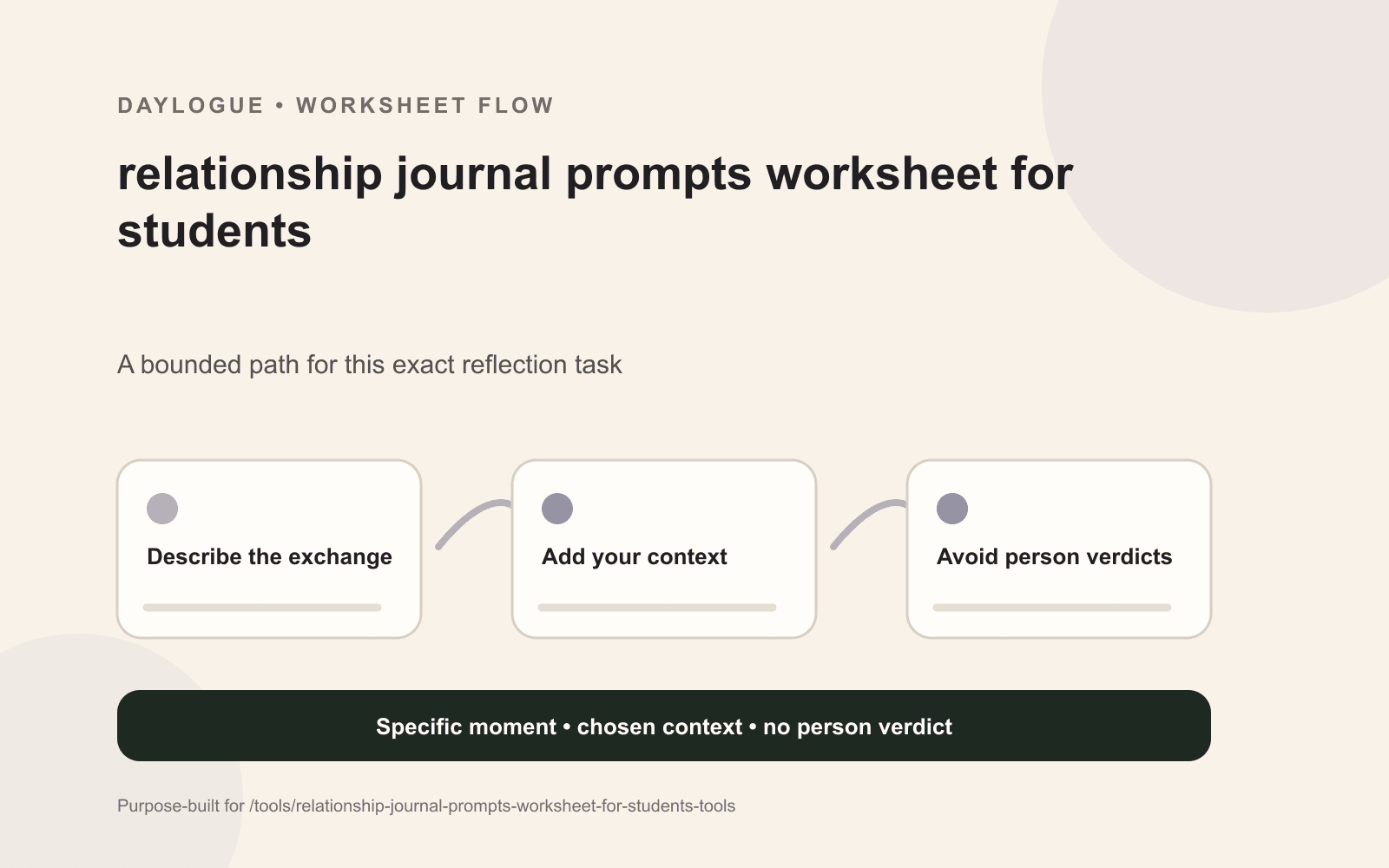
01
Step 1: What words or actions can I quote?
Words or actions another person could recognize may fill this campus line. The field can remain empty when the prompt does not fit between class, a study session, a shift, and the walk back home.
02
Step 2: What did I infer from them?
The meaning first attached to them may fill this campus line. The field can remain empty when the prompt does not fit between class, a study session, a shift, and the walk back home.
03
Step 3: What am I feeling in plain language?
One plain feeling word may fill this campus line. The field can remain empty when the prompt does not fit between class, a study session, a shift, and the walk back home.
04
Step 4: What question could replace my verdict?
A question that leaves room for context may fill this campus line. The field can remain empty when the prompt does not fit between class, a study session, a shift, and the walk back home.
A question instead of a verdict
This section holds a question that leaves room for context without asking it to explain everything else. One optional campus prompt is: What question could replace my verdict? Later context can appear on a new line instead of replacing the earlier record.
The first answer may change after sleep, another class, or a talk with someone trusted. a dated second line can show that change without treating the first as a mistake.
Room for the other point of view
The page becomes more useful when a response that does not need to happen yet stays close to the event itself. Its campus question is: What response can wait? Any answer may remain provisional, especially when the day is still unfolding.
One difficult hour does not have to describe the entire week. an exception belongs beside the repeat, where both remain visible.
More than one possible response
A short relationship journal prompts note about words or actions another person could recognize can be enough for this field. One campus question may help when the scene is clear: What words or actions can I quote? The box can remain blank when it is not, and nothing needs to become a verdict.
There is no streak to protect and no grade attached to the page. a partial entry can be enough for the moment available.
- What words or actions can I quote? A campus response might hold words or actions another person could recognize, and an unanswered line remains valid.
- What did I infer from them? A campus response might hold the meaning first attached to them, and an unanswered line remains valid.
- What am I feeling in plain language? A campus response might hold one plain feeling word, and an unanswered line remains valid.
- What question could replace my verdict? A campus response might hold a question that leaves room for context, and an unanswered line remains valid.
- What response can wait? A campus response might hold a response that does not need to happen yet, and an unanswered line remains valid.
A note after the conversation
By this point in the conversation sorting worksheet, the meaning first attached to them may look different from the first account. A later campus question remains available: What did I infer from them? A dated addition can preserve both versions without forcing a clean ending.
A 2019 study of 395 American young adults found that the relationship between narrative coherence and well-being was more complex than a simple universal benefit. That limit matters here. The conversation sorting worksheet can hold fragments, mixed accounts, and unresolved notes without forcing them into one clean story. It supports a record, not a promised outcome.
Your prompt and device choices
Every prompt is optional. A student may skip any question, use paper, or leave sensitive material off school-managed devices and accounts when that boundary fits better.
A non-sensitive example can carry the structure of the conversation sorting worksheet without naming a classmate, teacher, employer, or private conversation. Paper or a personally chosen device may fit better than a school-managed system for some material.
A campus day example with a clear boundary
Relationship Journal Prompts Worksheet is most useful here for separating observable exchanges from the meaning one person gave them. “They replied the next morning” can sit in one column and “I read the delay as distance” in another. A question for the next conversation can remain open beside both lines.
A personal journal can clarify the writer’s account; it cannot establish another person’s motive or settle a relationship on their behalf. For students, the page can stay close to before class, after a study block, or when moving between campus and home. A date, one source detail, and an explicit gap make the record easier to inspect later.
A second scene may confirm the first impression, narrow it, or point another way. The worksheet keeps that new material beside the earlier note, so a later account adds context without pretending the first one never existed.
- Source detail: the exact part of the campus day scene worth preserving.
- Relevant context: one condition that changes how the source can be read.
- Counterexample: a comparable campus day scene that points another way.
- Open question: what remains unknown until another dated entry adds context.
Worksheet
Relationship Journal Prompts Worksheet cards for students
Twenty reusable campus cards for students, each pairing a concrete setting with one optional relationship journal prompts question, a source-detail space, and room for later context.
- Card ST103A opens before the first class with three tabs still open. On Card ST103A, focuses on the observable exchange; the optional line on Card ST103A offers one optional question: What am I feeling in plain language. Card ST103A closes with space that can hold one exact line, while the final line on Card ST103A may remain unfinished.
- Card ST103B begins after a group project meeting with three tabs still open. Card ST103B pairs keeps interpretation in a second column in view with a line on Card ST103B that makes this question available: What question could replace my verdict. The return line on Card ST103B has room for an exception; the ending on Card ST103B can carry a later date.
- Card ST103C catches a moment between the library and lunch with three tabs still open. The middle of Card ST103C centers your own plain feeling word, then the next field on Card ST103C leaves this prompt open: What response can wait. Card ST103C leaves the ending open: one space might include one visible detail, and Card ST103C does not require a return.
- Card ST103D uses the setting after a shift with three tabs still open. On Card ST103D, looks at a question instead of a verdict; the optional line on Card ST103D asks, without requiring an answer: What words or actions can I quote. Card ST103D closes with space that may contain a changed condition, while the final line on Card ST103D can end there.
- Card ST103E stays near when a deadline moved with three tabs still open. Card ST103E pairs gives space to room for the other point of view with a line on Card ST103E that carries one possible question: What did I infer from them. The return line on Card ST103E can start with one open uncertainty; the ending on Card ST103E leaves the conclusion open.
- Card ST103F opens before an evening study block with three tabs still open. The middle of Card ST103F focuses on more than one possible response, then the next field on Card ST103F offers one optional question: What am I feeling in plain language. Card ST103F leaves the ending open: one space can hold one exact line, and Card ST103F may remain unfinished.
- Card ST103G begins on the walk back home with three tabs still open. On Card ST103G, keeps a note after the conversation in view; the optional line on Card ST103G makes this question available: What question could replace my verdict. Card ST103G closes with space that has room for an exception, while the final line on Card ST103G can carry a later date.
- Card ST103H catches a moment before the first class after plans changed. Card ST103H pairs centers the observable exchange with a line on Card ST103H that leaves this prompt open: What response can wait. The return line on Card ST103H might include one visible detail; the ending on Card ST103H does not require a return.
- Card ST103I uses the setting after a group project meeting after plans changed. The middle of Card ST103I looks at interpretation in a second column, then the next field on Card ST103I asks, without requiring an answer: What words or actions can I quote. Card ST103I leaves the ending open: one space may contain a changed condition, and Card ST103I can end there.
- Card ST103J stays near between the library and lunch after plans changed. On Card ST103J, gives space to your own plain feeling word; the optional line on Card ST103J carries one possible question: What did I infer from them. Card ST103J closes with space that can start with one open uncertainty, while the final line on Card ST103J leaves the conclusion open.
- Card ST103K opens after a shift after plans changed. Card ST103K pairs focuses on a question instead of a verdict with a line on Card ST103K that offers one optional question: What am I feeling in plain language. The return line on Card ST103K can hold one exact line; the ending on Card ST103K may remain unfinished.
- Card ST103L begins when a deadline moved after plans changed. The middle of Card ST103L keeps room for the other point of view in view, then the next field on Card ST103L makes this question available: What question could replace my verdict. Card ST103L leaves the ending open: one space has room for an exception, and Card ST103L can carry a later date.
- Card ST103M catches a moment before an evening study block after plans changed. On Card ST103M, centers more than one possible response; the optional line on Card ST103M leaves this prompt open: What response can wait. Card ST103M closes with space that might include one visible detail, while the final line on Card ST103M does not require a return.
- Card ST103N uses the setting on the walk back home after plans changed. Card ST103N pairs looks at a note after the conversation with a line on Card ST103N that asks, without requiring an answer: What words or actions can I quote. The return line on Card ST103N may contain a changed condition; the ending on Card ST103N can end there.
- Card ST103O stays near before the first class during a packed week. The middle of Card ST103O gives space to the observable exchange, then the next field on Card ST103O carries one possible question: What did I infer from them. Card ST103O leaves the ending open: one space can start with one open uncertainty, and Card ST103O leaves the conclusion open.
- Card ST103P opens after a group project meeting during a packed week. On Card ST103P, focuses on interpretation in a second column; the optional line on Card ST103P offers one optional question: What am I feeling in plain language. Card ST103P closes with space that can hold one exact line, while the final line on Card ST103P may remain unfinished.
- Card ST103Q begins between the library and lunch during a packed week. Card ST103Q pairs keeps your own plain feeling word in view with a line on Card ST103Q that makes this question available: What question could replace my verdict. The return line on Card ST103Q has room for an exception; the ending on Card ST103Q can carry a later date.
- Card ST103R catches a moment after a shift during a packed week. The middle of Card ST103R centers a question instead of a verdict, then the next field on Card ST103R leaves this prompt open: What response can wait. Card ST103R leaves the ending open: one space might include one visible detail, and Card ST103R does not require a return.
- Card ST103S uses the setting when a deadline moved during a packed week. On Card ST103S, looks at room for the other point of view; the optional line on Card ST103S asks, without requiring an answer: What words or actions can I quote. Card ST103S closes with space that may contain a changed condition, while the final line on Card ST103S can end there.
- Card ST103T stays near before an evening study block during a packed week. Card ST103T pairs gives space to more than one possible response with a line on Card ST103T that carries one possible question: What did I infer from them. The return line on Card ST103T can start with one open uncertainty; the ending on Card ST103T leaves the conclusion open.
Common questions
How much time does this conversation sorting worksheet need?
There is no target time. The few minutes between class and the library may hold one useful detail, and a partial page is still a valid page. The rest can wait for a later return or remain empty.
Does every relationship journal prompts question need an answer?
No. Each question is optional, and the one that fits the current scene may be the only one used. A blank field has no score and makes no claim about what the writer felt or meant.
Can an answer change after more context appears?
Yes. A dated note beside the original can show what changed later. Keeping both lines visible preserves what was known at each point without forcing either one to become the final story.
What if the conversation sorting worksheet shows no repeat?
No repeat is required. Separate scenes, mixed evidence, and exceptions can remain separate. Sometimes the most useful result is realizing that the first hunch does not fit every day.
Can this worksheet be used outside Daylogue?
Yes. It can live on paper, in a notebook, or in another notes tool. Daylogue is a system for self-understanding. This worksheet does not require an account.
What belongs off a school-managed system?
Any question may be passed over. Paper or a personally chosen device can be a better home for sensitive material than a school-managed device or account. One non-sensitive scene is enough to use the conversation sorting worksheet.
Sources
Sources were checked on the dates shown. Product details and policies can change.
- Daylogue evidence and methods · Daylogue · checked September 2, 2026
- Narrative identity and psychological well-being research · National Library of Medicine · checked September 2, 2026
Keep exploring
Daylogue Knowledge Center
Browse practical guides for reflection, journaling, patterns, and privacy.
Read moreHow Daylogue shows patterns
See how candidate patterns stay connected to evidence and correction.
Read moreWhy Daylogue exists
Read the principles behind a system for self-understanding.
Read moreDaylogue is not therapy and is not a replacement for professional care.