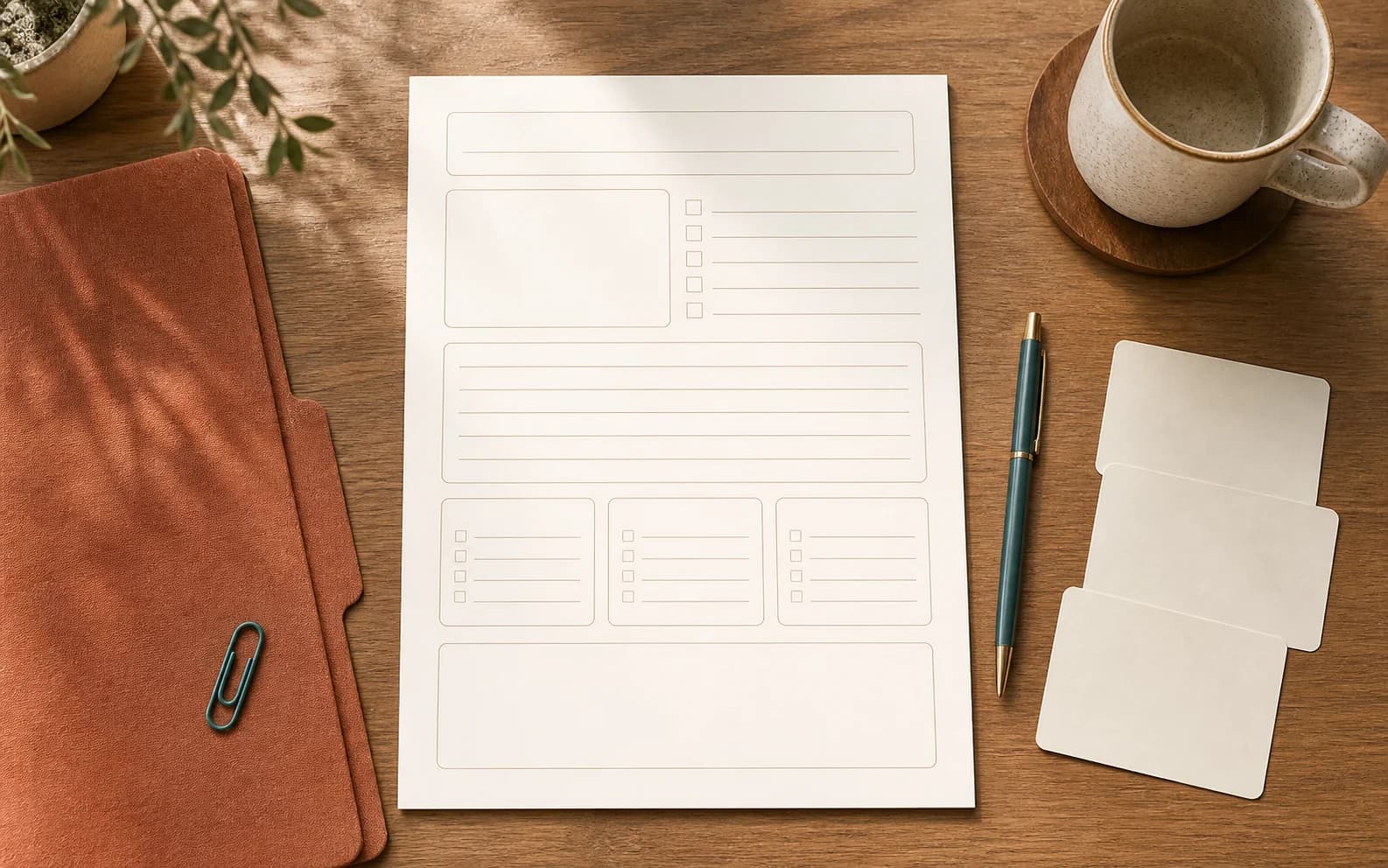
Written by Daylogue Editorial Team. Published August 20, 2026. Reviewed and updated August 20, 2026.
This self-discovery journal prompts worksheet helps a beginner move from a broad question to one specific moment. Choose a prompt, describe what happened, name what mattered in your own words, then find a comparable moment that went differently. Finish with a question, not an identity verdict. You can use the worksheet on paper, in a private note, or inside a journaling tool after checking how that service stores and processes what you write.
How the worksheet works
Self-discovery prompts work better when they point to something you can describe. “Who am I?” is large enough to invite a polished answer or a harsh verdict. “When did I feel most like myself this week, and what was happening?” gives you a scene, a time, and details to examine. The worksheet narrows the question before it asks for meaning.
Use one prompt per session. A short answer is valid. Write the event first, then your interpretation, then one piece of evidence that complicates the first story. That order keeps the page grounded in what happened while leaving room for surprise.
Step one: choose the kind of question you need
Begin with the area that already has your attention. You may be trying to understand a choice, a relationship, a recurring tension, a value, or a change in direction. One category at a time can keep the question manageable, and the rest can wait. One useful question creates more clarity than a long list answered quickly.
Skip prompts that assume growth, gratitude, forgiveness, or a hidden lesson. A neutral question makes room for an ordinary, mixed, or difficult answer. The worksheet does not need to end positively. It needs to leave an accurate record of one moment.
| Prompt family | Starter question | Detail to preserve |
|---|---|---|
| Choice | What made one option easier to choose? | The options available at the time |
| Value | When did I protect something important this week? | What the decision cost or changed |
| Relationship | What changed during one specific exchange? | The words, setting, and sequence |
| Tension | What felt pulled in two directions? | Both needs without choosing a winner |
| Identity | When did I act differently from my usual story? | A counterexample to the label |
Step two: complete one reflection row
Write one or two sentences for each field. First, describe the scene as if someone reading next month needed to recognize it. Second, write what mattered to you in that moment. Third, separate a fact from an interpretation. “I said no to the extra task” is a fact. “I am finally becoming confident” is an interpretation that may or may not hold across other moments.
Add a counterexample before finishing. If the page says you always avoid conflict, find one exchange when you spoke directly. If it says you never ask for help, find one moment when you did. The counterexample does not cancel the first experience. It protects the worksheet from turning one event into a permanent identity.
01
Describe the moment
Name the place, people by role, sequence, and concrete event without explaining what it means yet.
02
Name what mattered
Use your own words for the need, value, choice, or tension that held your attention.
03
Separate fact and interpretation
Write one observable detail beside the story you are currently telling about it.
04
Find a counterexample
Recall a comparable moment that went differently or included a condition missing from this one.
05
Leave one question open
Finish with what you want to notice next, without prescribing a result or naming a fixed trait.
Step three: review without deciding who you are
Read the completed row aloud or slowly. Circle language such as always, never, broken, lazy, good, or bad. Replace the label with the situation it describes. “I avoided the email twice when the request was unclear” can be examined. “I am an avoidant person” closes the question before the record has earned it.
A recurring overlap does not show that one thing caused another. Daylogue states that limit on its evidence page, and it is a useful rule for a paper worksheet too. Several similar entries can suggest a question worth following. They cannot establish that one event produced another response.
Choose paper, a note, or a journaling tool
Paper offers direct physical control and no service processing, but it can be lost or seen by someone nearby. A basic note is searchable but inherits the device and account settings around it. A journaling tool may organize prompts and entries over time. Before choosing, decide which details you plan to include and what privacy boundary those details require.
Daylogue's privacy policy says journal entries and check-in notes are stored on its servers in readable form, protected in transit by TLS and by per-user database access controls. It reads the material to write narratives and surface patterns. Daylogue is not end-to-end encrypted. Keep anything fully offline when you do not want a service to process it.
Use the next session to compare, not complete yourself
Return to the same prompt after a different kind of day. Compare the two scenes, especially the conditions that changed. The second answer may support the first, challenge it, or make the question less important. All three outcomes are useful. The worksheet is a way to preserve evidence about your own experience, not a test you can finish.
Leave gaps alone. A week without writing contains unknown days, not neutral evidence. Begin again with the current moment rather than backfilling answers that memory has already reshaped. A self-discovery practice can remain light enough to leave and return to without punishment.
Worksheet
Five-part self-discovery reflection row
Complete one row for one moment, then keep the first interpretation open by adding a counterexample and a question.
- The moment: what happened, where, and in what order?
- What mattered: which need, value, choice, or tension stood out?
- Fact and interpretation: what did you observe, and what story did you add?
- Counterexample: when did a comparable moment go differently?
- Open question: what would you notice next without demanding a result?
Common questions
How many prompts should a beginner answer at once?
Choose one prompt and one concrete moment. A focused answer with context is easier to revisit than a long set of broad answers completed quickly.
What if a prompt does not fit today?
Skip it. Choose a neutral question or leave the page blank. A worksheet should support attention, not pressure you to produce an insight on demand.
Can the worksheet tell me my true identity?
No. It can preserve experiences, interpretations, and exceptions. Use those details to ask better questions without treating one entry as a final verdict about you.
Should I use the worksheet on paper or in an app?
Choose based on the sensitivity of the material, the search or organization you need, and the storage and processing terms you are comfortable accepting.
How can I return after an unrecorded worksheet day?
Leave them unrecorded. Start with the current moment when you return. Reconstructing missing answers from obligation makes the record less honest.
Sources
Sources were checked on the dates shown. Product details and policies can change.
- Daylogue evidence and methods · Daylogue · checked August 20, 2026
- Daylogue privacy policy · Daylogue · checked August 20, 2026
Keep exploring
Daylogue Knowledge Center
Browse practical guides for reflection, journaling, patterns, and privacy.
Read moreHow Daylogue shows patterns
See how candidate patterns stay connected to evidence and correction.
Read moreWhy Daylogue exists
Read the principles behind a system for self-understanding.
Read moreDaylogue is not therapy and is not a replacement for professional care.