Written by Daylogue Editorial Team. Published August 31, 2026. Reviewed and updated August 31, 2026.
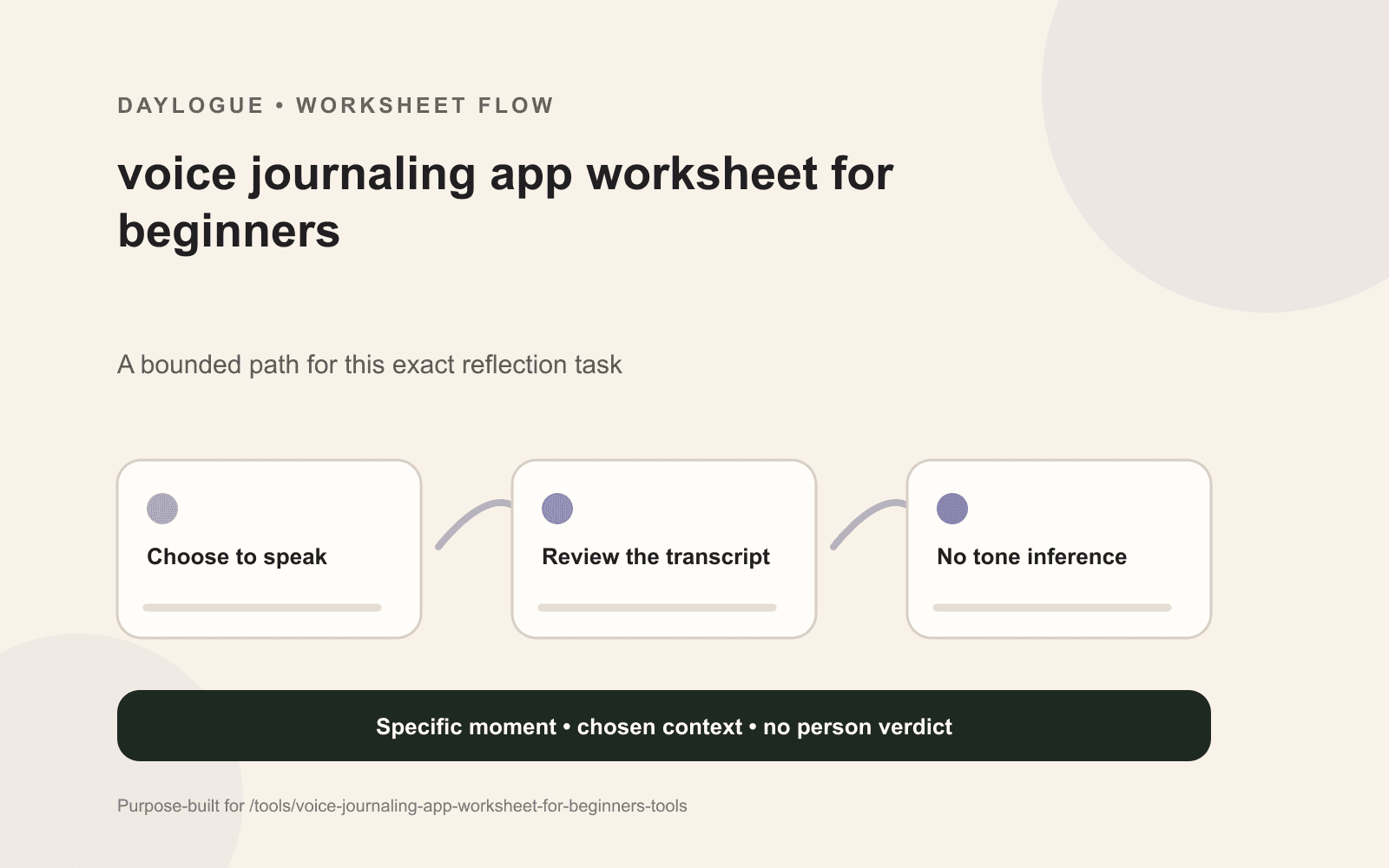
This voice journaling app worksheet begins after speaking stops. One optional review can check for missing or incorrect words, personal details that do not need to stay, and sentences that sound more certain than intended. The written record can be saved when it fits what the writer meant to share, while stopping or skipping remains an option.
Part 1: the recording conditions
One option is to note where you spoke, whether other people were nearby, and what was happening around you. A hallway, moving car, windy sidewalk, or shared room can change what reaches the transcript. This field is not a rating of the recording. It is context for deciding whether a strange phrase came from your wording, background noise, an interruption, or a transcription error that needs correction.
A short purpose line can come before the transcript review. You might be preserving the sequence of a conversation, capturing a decision made on a walk, or getting an unfinished thought out of your head. The purpose line gives the audit a center. When a sentence wanders away from that purpose, you can decide whether it adds needed context or is simply spoken material that does not belong in the saved reflection.
- Location and level of privacy
- Background sound or interruption
- Reason for making the voice note
- Names or identifying facts spoken aloud
Part 2: an accuracy pass
The transcript can be read without improving its style. A circled word can show where the text changes who did something, changes the order of events, or says the opposite of what you spoke. Those errors can come first. Filler words and repeated phrases can wait. Accuracy matters more than polish because a later reflection needs the correct people, sequence, and decision before it needs elegant sentences.
The audio memory you still have may help, with uncertainty marked instead of guessed. “Unclear word,” “name omitted,” or “timing uncertain” can stand where the recording cannot support a confident correction. A visible gap is better than a smooth sentence built from an assumption. The worksheet can leave you with text you recognize, including places where the spoken record did not capture enough information.
| Check | Why it matters | Worksheet action |
|---|---|---|
| Person or role | The transcript may attach an action to the wrong person | A replacement word or general role |
| Order of events | A reversed sequence can change the meaning | Number the events in spoken order |
| Negation | A missing “not” can reverse the sentence | A full-phrase comparison before saving |
| Unclear phrase | Guessing creates a detail you did not provide | An uncertainty mark or removal |
Part 3: details you did not mean to keep
Spoken reflections often include names, workplace details, addresses, or another person’s private words because speech moves faster than editing. Each identifying fact can prompt a question about whether the reflection still works with a role, broad description, or omitted detail. The goal is not to make every note vague. It is to keep only the personal information needed for the moment you want to remember.
The current service disclosures can be reviewed before a long voice history is saved. Account access, syncing, processing, export, deletion, and retention offer more detail than a general privacy label. If the boundary does not fit a detail, deletion or generalization remains available before saving. This pass is especially useful on a shared device, in a workplace setting, or after speaking about someone who did not choose to be part of the record.
Part 4: spoken fact and later interpretation
One line under what happened and two lines under what you think it meant can separate the two. This simple mark keeps an observed exchange beside the interpretation you formed while speaking. Both may belong in the reflection, but they perform different jobs. When you reread the note next week, you can keep the event, revise the interpretation, or add context without rewriting the original experience into a cleaner story.
Absolute phrases such as “always,” “everyone,” or “nothing worked” may deserve a second look. A replacement fits only when the transcript contains a concrete exception or when you know the phrase was emphasis rather than a factual claim. You do not need to flatten the emotion of the spoken note. The purpose is to show which sentence describes the scene and which sentence captures your immediate reading of it.
01
The event
A mark can identify the sentence that states what was said, done, scheduled, changed, or interrupted.
02
The interpretation
A second mark can identify the sentence that explains what you thought the event meant at the time.
03
One uncertainty
A missing fact or alternate reading can show what the recording cannot settle by itself.
04
Your wording
Generated phrasing that sounds polished but no longer resembles what you meant can stay outside the saved text.
Part 5: the save decision
Three boxes can hold the choices: save as written, save after edits, or do not save. The third choice matters. A spoken check-in can be useful in the moment even when you decide that the transcript should not become part of a synced history. If you save after edits, one read aloud remains optional. The sound of the sentence often reveals a missing word or an interpretation that grew more certain during editing.
A one-line return cue such as “compare this after Friday’s deadline” or “reread after the next conversation” can close the page. A cue gives the voice note a reason to reappear without turning it into an instruction. If no return is needed, “capture only” can serve as the label. It makes clear that the value was preserving the moment, not finding a recurring explanation from one recording.
The sheet across seven days
At the end of a week, correction types can be compared without judging the quality of your speaking. Repeated name errors may suggest using roles. Frequent timing errors may suggest beginning each recording with a date or sequence marker. Long privacy edits may suggest speaking in a more private place or deciding before recording which details can safely be generalized.
An exception belongs beside any repetition. One clear transcript can show that the setting, pace, or topic was different. The worksheet is meant to improve the inspectability of saved words, not produce a voice score. A useful weekly result is one recording habit you want to repeat and one transcript check that deserves more attention next time.
Sources and limits
Daylogue does not infer emotion from faces, voice tone, or physiology. It works from the words and context people choose to share. NIST describes its Privacy Framework as a voluntary tool intended to help organizations identify and manage privacy risk. These boundaries are why the worksheet audits the saved transcript and processing choices rather than claiming that pace, pauses, or vocal qualities reveal how a person feels.
Worksheet
Voice transcript audit sheet
A seven-part worksheet for checking transcription accuracy, identifying unnecessary personal detail, separating observation from interpretation, and deciding whether to save.
- The recording location and purpose.
- Corrections to names, negation, and event order.
- Unclear words marked instead of guessed.
- Personal details generalized when they are not needed.
- The event separate from your interpretation.
- Save, edit, or do not save choices.
- A return cue or a capture only label.
Common questions
Should I edit filler words out of a voice journal transcript?
You can remove filler when it makes rereading difficult, but correct changed names, negation, sequence, and missing facts first. Preserve wording that carries the way you actually understood the moment.
What if I cannot tell what one recorded word was?
The word can be marked as unclear or the phrase can be removed. A smooth replacement may distort the record when neither the recording nor memory supports it.
Can a voice journal read emotion from how I sound?
Daylogue works from the words and context a person chooses to share. It does not infer emotion from voice tone, pace, pauses, faces, or physiology.
When should I avoid saving a voice transcript?
Saving remains optional when the text includes detail that does not fit the current account and service boundaries, or when transcription errors make the record unreliable.
How often should I use the transcript audit sheet?
At first, it may fit after each important recording. Once the checks become familiar, it can remain available for noisy recordings, sensitive topics, or notes you expect to revisit.
Sources
Sources were checked on the dates shown. Product details and policies can change.
- Daylogue voice check-ins · Daylogue · checked August 31, 2026
- NIST Privacy Framework · National Institute of Standards and Technology · checked August 31, 2026
Keep exploring
Daylogue Knowledge Center
Browse practical guides for reflection, journaling, patterns, and privacy.
Read moreHow Daylogue shows patterns
See how candidate patterns stay connected to evidence and correction.
Read moreWhy Daylogue exists
Read the principles behind a system for self-understanding.
Read moreDaylogue is not therapy and is not a replacement for professional care.