Written by Daylogue Editorial Team. Published August 8, 2026. Reviewed and updated August 8, 2026.
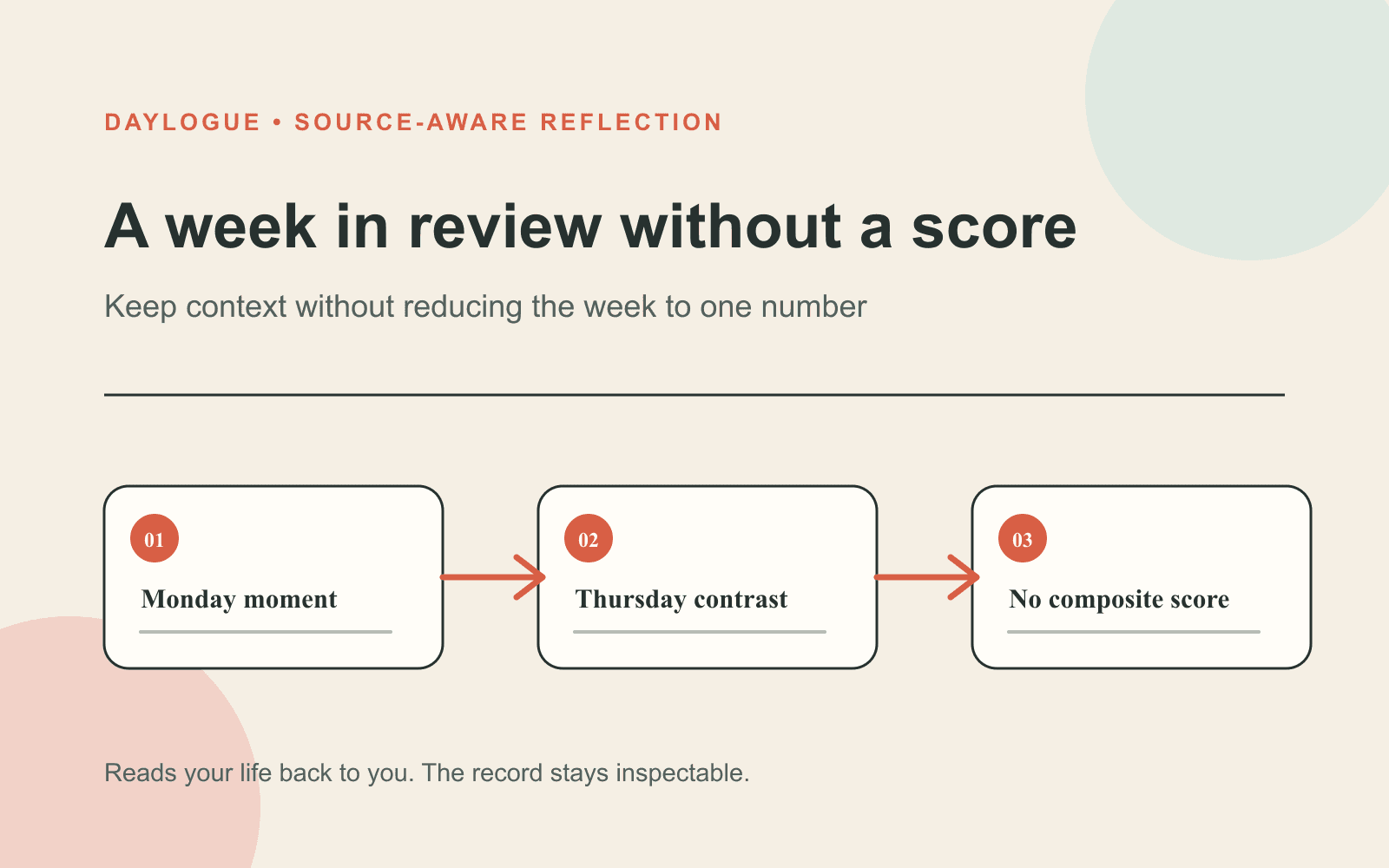
A score-free journal week in review summarizes the record without turning the person into a number. A useful evaluation looks for dated examples, repeated themes, counterexamples, missing days, and a way to question the read. Mood, energy, stress, or sleep fields can add context, but they should not collapse into a single combined personal score. Daylogue's public pattern and privacy pages do not establish that this exact weekly sequence or a confirm, reject, and reinterpret control currently ships.
One number cannot hold a whole week
A week can include a hard meeting, a quiet breakfast, a rushed commute, and a good conversation. A single combined personal score makes those moments compete for one final judgment. It may look tidy, but it hides the context that makes a read useful. A score-free review keeps the pieces visible. For the general method, use Daylogue's three-pass weekly readback at /learn/weekly-journal-readback-guides. This page is a buyer's product-evaluation checklist.
Daylogue's privacy policy says structured mood, energy, stress, and sleep data powers dashboards, trends, and AI features. Those fields can add context without becoming a verdict. The current Pattern Detection page at /features/patterns explains public product behavior. The evaluation criteria below do not claim that Daylogue renders this exact weekly sequence.
Show evidence before interpretation
A useful review begins with what the record contains: dates represented, entries made, repeated words, recurring situations, and comparable exceptions. Then it offers a tentative read. ‘Stress ran higher in the check-ins where you logged under six hours’ is inspectable. ‘The whole week got worse’ is broad, judgmental, and disconnected from the source moments.
A recurring overlap does not show that one thing caused another. A combined personal score often invites that leap because it suggests several inputs have been converted into one precise result. Keep each signal in its own units and let the user decide what deserves attention.
| Approach | What appears | What the person can do |
|---|---|---|
| Single score | One combined number | Little room to inspect context |
| Trend line | One metric over time | Check when a movement occurred |
| Candidate pattern | An overlap plus dated examples | Look for controls to question the read |
| Counterexample | A similar day that differed | Test whether context changes the read |
A calmer weekly sequence
Start with coverage, then events, then repeated language, then metrics, and finally exceptions. This order prevents a colorful chart or strong final entry from dictating the whole review. A missing day remains missing. It does not become a low score or a warning.
Finish with one open question. If Tuesday and Thursday both mention rushing before the same afternoon slot, describe those as a couple of mentions. Leave the fix open rather than prescribing one. Pattern language starts only after at least three comparable points appear across distinct periods, and even then the read stays tentative.
01
Show coverage
List which days and check-in types are represented so gaps stay visible.
02
Name repeated material
Point to words, situations, or metrics that appeared in at least three comparable points across distinct periods. Two appearances are a couple of mentions, not a candidate pattern.
03
Include the exception
Place the closest comparable day beside the candidate pattern.
04
End with a question
Offer one neutral detail to notice instead of a score or instruction.
Reflection research does not justify a grade
A systematic review of 51 positive writing studies found results were more consistent for some measures of how participants reported feeling and less consistent for several other reported and physical outcomes. The included studies were rated poor or fair quality. That does not support assigning a combined personal score to one week of journaling.
Research on narrative coherence also reports a more complex picture than ‘neater story equals better result.’ A study of 395 young adults found some expected associations only partly confirmed. A product should not turn that uncertainty into a confident progress meter.
A weekly readback still depends on readable data
Daylogue stores journal entries, check-in notes, generated narratives, and structured metrics in readable form for features that use them. Data travels with TLS and is protected by per-user access controls, but Daylogue is not end-to-end encrypted. Read the current Daylogue privacy policy before deciding what belongs in the record.
Privacy and scoring are separate choices. Removing the score reduces judgment, but it does not reduce how much data the system processes. A good evaluation asks both questions: does the readback respect my interpretation, and does the data model fit what I want to share?
Who a score-free review fits
This approach fits people who want continuity without streak pressure or a weekly verdict. It also fits anyone who has seen an average erase the day that mattered most. You can inspect the entry, understand the proposed thread, and leave it unresolved.
For product evaluation, ask to see the actual weekly review before choosing a plan. Check whether it names source dates, keeps separate metrics visible, shows counterexamples, and lets you question the read. The current Backstory page at /features/backstory explains how import can add continuity to the record, but that separate capability does not prove that a score-free weekly review interface exists.
Framework
The No-Score Weekly Readback
A five-part review structure that keeps evidence and uncertainty visible without turning the week into a grade.
- Coverage: which days and entry types are represented?
- Moments: which concrete events shaped the week?
- Repetition: which words, situations, or metrics appeared again?
- Counterexample: which comparable moment did not fit?
- Question: what neutral detail is worth noticing next?
Common questions
Why avoid a weekly combined personal score?
A combined personal score hides context and can make unlike experiences look comparable. Dated examples, separate metrics, and counterexamples give you more material to inspect.
Can a week in review still use mood numbers?
Yes. Keep each metric separate and show when it changed. Keep the fields separate so they do not add up to a precise judgment about the person.
What happens when several days have no entry?
The review should state that coverage is thin. Missing entries are not evidence of things getting better or worse, calm, or avoidance. They are simply missing.
Does a repeated overlap prove what caused it?
No. It supports a question, not a causal conclusion. Check other context and comparable exceptions before deciding what the overlap means.
Sources
Sources were checked on the dates shown. Product details and policies can change.
- Daylogue evidence and methods · Daylogue · checked August 8, 2026
- Daylogue privacy policy · Daylogue · checked August 8, 2026
- Positive expressive writing systematic review · PLOS One · checked August 8, 2026
- Narrative identity and psychological well-being research · Frontiers in Psychology via PubMed Central · checked August 8, 2026
Keep exploring
Daylogue Knowledge Center
Browse practical guides for reflection, journaling, patterns, and privacy.
Read moreHow Daylogue shows patterns
See how candidate patterns stay connected to evidence and correction.
Read moreWhy Daylogue exists
Read the principles behind a system for self-understanding.
Read moreDaylogue is not therapy and is not a replacement for professional care.