Written by Daylogue Editorial Team. Published August 21, 2026. Reviewed and updated August 21, 2026.
A conscientiousness score describes how questionnaire responses landed on a Big Five spectrum associated with organization, persistence, dependability, follow-through, and preference for structure. The instrument, reference group, facets, and response context belong beside the number. One planning example and one counterexample can keep the result descriptive rather than turning it into a character grade.
What the result actually captures
A conscientiousness score summarizes responses to statements about organization, persistence, dependability, follow-through, and structure. The result belongs to the specific questionnaire that produced it. It does not measure how hard a life has been, how many responsibilities a person carries, or whether someone deserves praise for meeting them. Read the number as a pattern in answers, not as a grade for effort.
Start by recording the instrument, version, item count, scale, and reference group. If the report gives a percentile, it compares the response pattern with a sample. If it gives only a raw average, use that instrument’s scoring guidance. Words like high, average, and low do not travel cleanly between websites unless the underlying items and comparison rules also match.
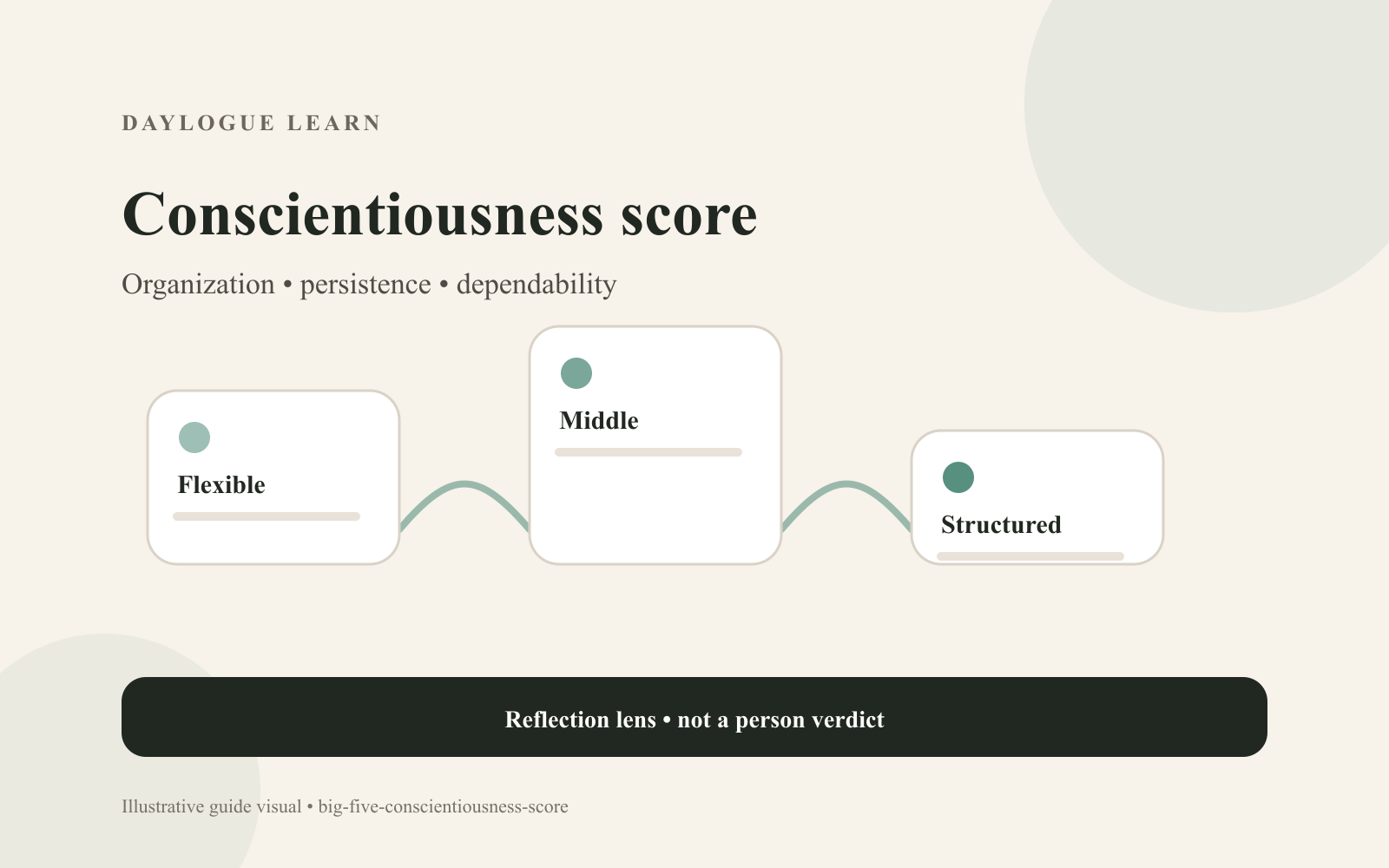
What the flexible side can look like
A lower conscientiousness result may fit scenes involving improvisation, loose scheduling, quick adaptation, or preference for keeping options open. Those behaviors are not proof of carelessness. A person might revise a plan smoothly when conditions change, tolerate an unfinished workspace, or choose speed over documentation when a task is temporary.
Look for distinctions that a broad label misses. Does flexibility appear in personal time but not around shared deadlines? Are routines difficult because priorities change, because the system is unclear, or because rigid planning costs more than it returns? The score cannot answer those questions. A dated example can show which interpretation deserves attention.
What the structured side can look like
A higher result may fit advance preparation, reliable routines, ordered materials, steady completion, or careful responsibility to other people. Structure can support coordination and reduce forgotten details. It can also become costly when a plan is maintained after the situation changes or when completion standards leave no room for rest.
The score becomes clearer after checking the setting. A meticulously tracked client launch and an overcontrolled weekend can arise from similar questionnaire tendencies while feeling very different in practice. Preserve the purpose, stakes, and people affected. The same organizing behavior cannot be evaluated apart from what it was trying to serve.
A middle score can hide selective structure
Many people plan selectively. They may keep exact systems for work that affects others and improvise their own errands. A middle score can reflect that contrast, moderate answers across items, or facets pulling in different directions. It does not mean the person has no habits or an ideally balanced personality.
The BFI-2 separates broad domains from facets. If a report includes facet results, inspect which themes contributed to the total. When the questionnaire reports only a broad score, hidden facet numbers remain unavailable. Use ordinary language instead: “I follow through reliably here, while order matters much less there.”
| Scene | Possible reading | Counterquestion |
|---|---|---|
| Detailed launch checklist | Structure supports shared coordination | Do I use the same care when stakes are lower? |
| Unplanned weekend | Flexibility protects open time | Does spontaneity create stress for anyone else? |
| Delayed personal paperwork | Low urgency changes follow-through | What happens when a real deadline appears? |
| Revised plan after new information | Organization includes adaptation | Did I update the system or abandon it? |
Separate trait language from available resources
Planning behavior depends on more than preference. Time, money, sleep, caregiving, disability, unclear ownership, tools, and changing demands can all shape what gets organized or completed. A self-report score does not inventory those conditions. Avoid using the result to explain a delayed task when the surrounding workload is the more immediate evidence.
This boundary also matters when interpreting another person. You rarely know every demand competing for their attention. A conscientiousness result should not be used to decide that someone is responsible, lazy, trustworthy, or unreliable as a whole person. Keep the language tied to the test and to observable events.
Pair a planning example with a counterexample
Try a two-scene exercise. First, record a recent moment when you planned, persisted, or followed through. Include what was at stake and who depended on the work. Next, record a scene where you improvised, postponed, or left something unfinished. Include what made that choice reasonable or costly.
Compare the conditions instead of deciding which scene is the real you. Shared responsibility may bring out structure. Familiar work may need less planning. A low-stakes task may stay open because attention went elsewhere. The contrast gives the score useful context while preventing one adjective from swallowing the week.
- What do I plan because other people depend on it?
- Where does improvisation improve the result?
- Which unfinished task has no clear owner?
- What routine survives a crowded week?
- When does perfection delay completion?
- Which recent action provides a counterexample to the score description?
What the instrument sources establish
The BFI-2 is a 60-item self-report inventory designed to measure five broad dimensions and 15 more-specific facet traits. That supports reading conscientiousness as a structured questionnaire result with both broad and narrower levels. It does not support converting one result into a universal judgment about discipline or future behavior.
The IPIP website includes over 3,000 items and over 250 scales, and its items and scales are in the public domain. The Daylogue Big Five guide explains that scores fall on spectrums and do not sort people into a small set of fixed types. Identify the exact scale, preserve the spectrum, and keep the result attached to examples.
A practical way to read the score
Write one sentence that names the test rather than naming yourself: “On this questionnaire, my conscientiousness answers landed in this range.” Then add one structured scene, one flexible scene, and the conditions around each. Note any facet result the instrument actually reported. Finish with a question about when planning helps and when it becomes friction.
Return to the question after another real event instead of retaking the test immediately. The new scene may reinforce the first interpretation or bend it. Either outcome is useful. The aim is a more accurate record of choices across contexts, not a more confident label.
Keep the examples concrete enough that you could recognize the conditions later. A finished tax form, an improvised dinner, a project plan revised after new information, and a delayed errand each show a different part of the picture. Record what was required, who depended on the outcome, how much time was available, and what competing demand was present. This makes room for conscientious choices that do not look identical. It also prevents one shifted deadline from erasing a longer record of careful preparation, or one tidy week from becoming proof of a permanent identity.
01
Document the test
Save the instrument, version, item count, date, scoring scale, and reference group shown in the report.
02
Choose two unlike scenes
Pair one structured example with one flexible or unfinished example from a different setting.
03
Name the conditions
Record stakes, shared responsibility, time, resources, and what changed from the usual routine.
04
Keep the result provisional
Use the score to form a question that another example could confirm, complicate, or revise.
Worksheet
Conscientiousness score context worksheet
A worksheet for keeping the instrument, score, response context, facet detail, example, counterexample, and an open question together without grading effort or character.
- Instrument and version used
- Date and response context
- Reported scale and reference group
- Plain-language description of the score
- One recent planning example
- One recent counterexample
- Conditions that differed between the scenes
- Facet detail the broad score may hide
- One person-verdict to watch for
- One question to revisit later
Common questions
Is a high conscientiousness score good?
No range is automatically good or bad. A higher conscientiousness score describes how answers leaned on that instrument. Its usefulness depends on response context, and the same pattern of answers can help in one setting while creating friction in another.
What does a middle conscientiousness score mean?
A middle score remains informative. It can reflect moderate answers, a blend of tendencies, or facets pulling in different directions. Look at the scoring scale and item pattern before calling it neutral.
Can my conscientiousness score change?
A later score can differ because of the instrument, item wording, norms, response context, timing, or genuine changes in how you answer. Compare the inputs before interpreting the difference.
Should I compare scores from two websites?
Only after confirming that both use the same instrument, version, scoring direction, and reference group. Shared descriptive dimension names do not make two reported numbers directly interchangeable.
How should I use the score for reflection?
Write one scene where the description fits and one where it does not. Add the setting, role, stakes, and timing. Keep the conclusion provisional and revisit it when another example appears.
Sources
Sources were checked on the dates shown. Product details and policies can change.
- International Personality Item Pool · Oregon Research Institute · checked August 21, 2026
- Berkeley Personality Lab: Big Five Inventory 2 · Berkeley Personality Lab · checked August 21, 2026
- Daylogue Big Five personality test guide · Daylogue · checked August 21, 2026
Keep exploring
Big Five personality test guide
Start with the Big Five model, its five domains, scoring basics, and limits.
Read morePersonality tests for self-awareness
Compare assessment frameworks without treating a result as a person verdict.
Read moreDaylogue Reflection Profile
Try Daylogue’s non-clinical self-awareness quiz and keep its result in context.
Read moreDaylogue is not therapy and is not a replacement for professional care.